William I Of The Netherlands
| Name | William I Of The Netherlands |
| Title | King of the Netherlands and Grand Duke of Luxembourg 1815–1840 |
| Gender | Male |
| Birthday | 1772-08-24 |
| nationality | Kingdom of the Netherlands |
| Source | https://www.wikidata.org/wiki/Q2079957 |
| pptrace | View Family Tree |
| LastUpdate | 2025-11-12T01:16:22.085Z |
Family Tree
Tap  to expand more relatives
Introduction
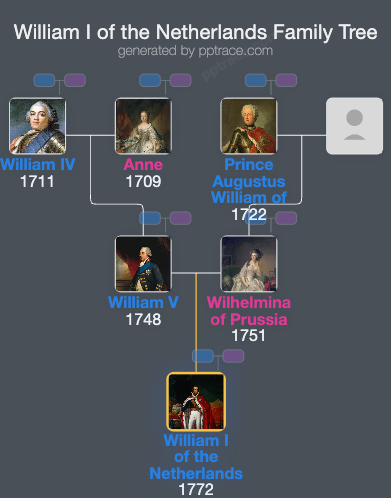
William I (Willem Frederik), born on 24 August 1772, died on 12 December 1843, was the King of the Netherlands and Grand Duke of Luxembourg from 1815 until his abdication in 1840. He was the son of William V, Prince of Orange, the last stadtholder of the Dutch Republic, and Wilhelmina of Prussia.
William V was the last stadtholder of the Dutch Republic, and William I was informally called Erfprins (Hereditary Prince) until the death of William V in 1806. William I married Wilhelmina of Prussia, his first cousin, on 1 October 1791 in Berlin. She was the daughter of King Frederick William II of Prussia. After her death in 1837, William remarried Countess Henrietta d'Oultremont on 17 February 1841 in Berlin.
During his youth, William was tutored by Swiss mathematician Leonhard Euler and Dutch historian Herman Tollius. He also received military training under General Frederick Stamford. He attended the military academy in Brunswick in 1788–89 and studied briefly at the University of Leiden.
William's military career began with his appointment as a general of infantry in the Dutch States Army in 1790, serving under his father, the captain general. In 1793, he was appointed commander-in-chief of the Dutch forces during the Flanders campaign, participating in battles such as Veurne, Menin, and Landrecies. Despite victories at Gosselies and Lambusart, the allies were defeated at the Battle of Fleurus in 1794. Following the Batavian Revolution of 1795 and the establishment of the Batavian Republic, William V and his family went into exile in London.
In exile, William returned to the continent in 1799 and again in 1802, forming the King's Dutch Brigade in Britain, which swore allegiance to the British monarch. He visited Napoleon Bonaparte at St. Cloud in 1802, gaining insight into French plans for the Netherlands. In 1806, he supported Prussian forces during the War of the Fourth Coalition, commanding a Prussian division at the Battle of Jena–Auerstedt, which resulted in his surrender at Erfurt. Napoleon confiscated his principality, and William was taken as a prisoner of war but was soon paroled.
Following Napoleon's defeat in 1813, William was restored to power. In November 1813, he disembarked at Scheveningen and was offered the throne, which he initially declined, proclaiming himself Sovereign Prince of the Netherlands in March 1814. Recognizing the strategic importance of uniting the Low Countries, he also became the ruler of the former Austrian Netherlands and was appointed Grand Duke of Luxembourg, in accordance with the secret Eight Articles of London. The union of these territories fulfilled his family's long-standing goal to unite the Low Countries.
On 16 March 1815, William proclaimed the Netherlands a kingdom, adopting the title of king, with his son, William II, as a military leader in the Battle of Waterloo. He ratified a constitution that granted him substantial powers and established a parliamentary system divided into two chambers: the Eerste Kamer (First Chamber) and the Tweede Kamer (Second Chamber). His reign was characterized by efforts to foster economic development, the founding of universities in Leuven, Ghent, and Liège, and the promotion of trade. He also imposed Dutch as the official language in Flanders and promoted the Reformed faith, which created tensions with the mainly Catholic south.
The Belgian Revolution of 1830 resulted in the independence of Belgium, which William was unable to prevent despite military campaigns. The conflict and economic strains led him to abdicate in 1840 in favor of his son, William II. William I spent his final years in Berlin, where he died in 1843 at the age of 71.
His children with Wilhelmina included Willem Frederik George Lodewijk (later King William II), born on 6 December 1792, who married Grand Duchess Anna Pavlovna of Russia; and others whose births and deaths are documented. William held numerous honors and orders from various countries, including the Order of the Garter from the United Kingdom and the Order of the Black Eagle from Prussia.