Wilhelmina Of Prussia, Princess Of Orange
| Name | Wilhelmina Of Prussia, Princess Of Orange |
| Title | Consort of Prince William V of Orange (1751-1820) |
| Gender | Female |
| Birthday | 1751-08-07 |
| nationality | Kingdom of Prussia |
| Source | https://www.wikidata.org/wiki/Q58003 |
| pptrace | View Family Tree |
| LastUpdate | 2025-11-12T01:16:22.944Z |
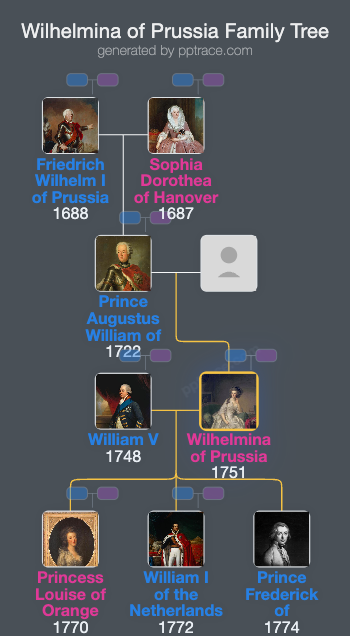
Family Tree
Tap  to expand more relatives
Introduction
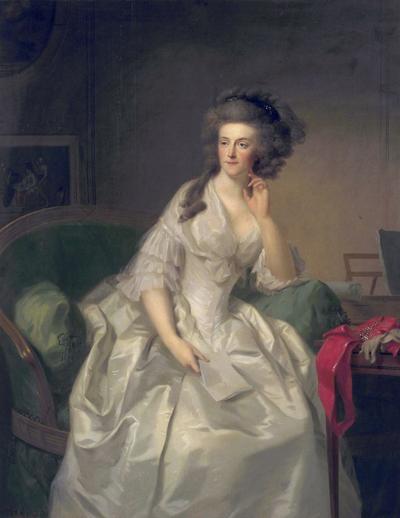
Princess Wilhelmina of Prussia (Frederika Sophia Wilhelmina), born on 7 August 1751, died on 9 June 1820, was a member of the Prussian royal family and the consort of William V of Orange. She was the daughter of Prince Augustus William of Prussia and Duchess Luise of Brunswick-Wolfenbüttel. Wilhelmina was raised by her grandmother.
She was married to William V of Orange on 4 October 1767 in Berlin. William V was the last Dutch Stadtholder. The marriage was arranged with the influence of Duke Louis Ernest of Brunswick-Lüneburg, who observed that Wilhelmina desired joint rule and began to challenge his authority. Wilhelmina maintained correspondence with her uncle, King Frederick II of Prussia, expressing her political ambitions.
Wilhelmina actively participated in Dutch political conflicts beginning in 1781. She was a supporter and a principal figure within her husband’s political faction, which opposed the regency of her uncle, Duke Louis Ernest. From 1782, she was recognized as the de facto leader of the dynastic Stadtholder party and influenced political decisions through correspondence with foreign powers. In 1785, she advised William V to refuse abdication after he was pressured to do so. The family relocated from The Hague to Nijmegen in 1786. During the revolutionary movement in 1787, Wilhelmina was stopped at Goejanverwellesluis while attempting to reach The Hague and was denied permission to proceed.
She sought military support from her brother, King Frederick William II of Prussia, and requested intervention, which led to the Prussian invasion of the Dutch Republic on 13 September 1787. William V was restored to power two weeks later. The conflict resulted in many Dutch rebels fleeing to France and Brussels. Wilhelmina later demanded the replacement of several regents.
Following the Dutch patriots' return in 1795 with support from France, William V and Wilhelmina went into exile, living initially in Kew, then in Nassau and Braunschweig. William V died in 1806. Wilhelmina and her daughter lived in various locations within the Confederation of the Rhine, including Weimar, Oranienburg, and Berlin. Their son, William, also went into exile but returned to become King William I of the Netherlands in 1813.
Wilhelmina returned to the Netherlands in 1814, settling in Villa Welgelegen. In 1815, she hosted Tsar Alexander I of Russia in Haarlem. She died at Het Loo on 9 June 1820 and was initially buried at the Church of Apeldoorn. In 1822, she was reburied in the Royal Crypt.
She and William V had five children: an unnamed son who died in infancy in 1769, Frederika Luise Wilhelmina (1770–1819), William I of the Netherlands (1772–1843), an unnamed son born and deceased in 1771, and Willem Georg Frederik, Prince of Orange-Nassau (1774–1799).