Prince Frederick Of Orange-Nassau
| Name | Prince Frederick Of Orange-Nassau |
| Title | Dutch prince |
| Gender | Male |
| Birthday | 1774-02-15 |
| nationality | Kingdom of the Netherlands |
| Source | https://www.wikidata.org/wiki/Q316076 |
| pptrace | View Family Tree |
| LastUpdate | 2025-11-12T01:16:21.244Z |
Family Tree
Tap  to expand more relatives
Introduction
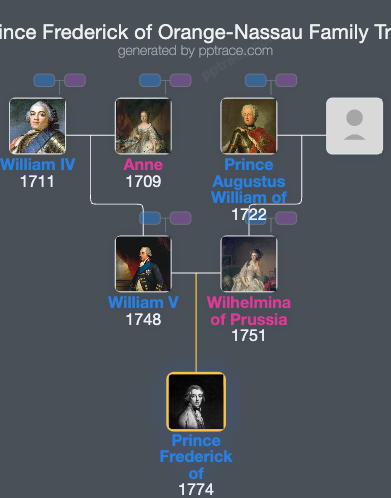
Prince Frederik of Orange-Nassau, also known as William George Frederick, was born on 15 February 1774 in The Hague, Dutch Republic. He was the youngest son of William V, Prince of Orange and Stadtholder of the Dutch Republic, and Princess Wilhelmina of Prussia, who was the sister of King Frederick William II of Prussia. His siblings included Frederica Louise Wilhelmina (1770–1819) and Willem Frederik (1772–1843); the latter later became the first King of the Netherlands.
Prince Frederik graduated from military training in Brunswick, where his cousin was the reigning duke. His early education included tutoring by General Prince Frederick Stamford, mathematician Leonhard Euler, and historian Herman Tollius. He began active military service in 1792, after the Dutch States-General granted him the rank of lieutenant-general of the cavalry and grand master of artillery. He chose a military career associated with the Holy Roman Empire.
During the War of the First Coalition, Frederik served in the Dutch and Austrian armies. In 1793, he actively participated in defending the Dutch Republic against French forces. He was often at the forefront of battles, notably defending northwestern Brabant and serving under his older brother at Veurne and Menin. He was wounded in battle at Wervik in September 1793, suffering a shoulder injury that was never fully healed. In 1794, he was promoted to general of the cavalry.
Following the establishment of the Batavian Republic in 1795 and his father's flight to Great Britain, Frederik accompanied his family into exile. In July of that year, Frederik and aide-de-camp Perponcher traveled to Osnabrück for a gathering of Dutch officers, with plans for a raid in the Batavian Republic. While in England, Frederik formed a romantic connection with Princess Mary, the fourth daughter of King George III; however, the marriage did not occur before his death. Queen George III reportedly supported the match, but Frederick's death prevented it from materializing.
Frederik subsequently traveled to Vienna, where he received the rank of Major General in May 1796. Serving in the Austrian army under Wilhelm von Wartensleben and later under Paul Kray, he participated in various battles across Germany, including the conquest of Kehl in 1797. He was recognized for his military performance during the engagements at Einöd and was awarded the Military Order of Maria Theresa. That summer, he underwent surgery for his shoulder injury at Görz and recovered in Baden.
In October 1797, Frederik was appointed lieutenant field marshal. After a winter in Hampton Court, he returned to Vienna in April 1798, and undertook a tour of the Italian border. Still unwell, he collapsed in Gorizia and was later appointed in November 1798 as commander of the Austrian army in Italy with the rank of Feldzeugmeister, preparing the army against French forces.
While in Padua in January 1799, Frederik visited sick soldiers and may have contracted a malignant fever. He died there on the night of 5–6 January 1799 at the age of 24, in the arms of his aide Hendrik George de Perponcher Sedlnitsky. Initially buried in Padua's Hermits of Padua cloister, his family later commissioned a marble monument by Antonio Canova, and his remains were moved to the family crypt at the Nieuwe Kerk in Delft in 1896. The monument was reconstructed within the church, which had sustained damage during World War II.
Prince Frederik's death occurred during exile amidst ongoing European conflicts, and he was recognized for his service in both the Dutch and Austrian military forces.