Princess Louise Of Orange-Nassau
| Name | Princess Louise Of Orange-Nassau |
| Title | Dutch princess (1770-1819) |
| Gender | Female |
| Birthday | 1770-11-28 |
| nationality | Kingdom of the Netherlands |
| Source | https://www.wikidata.org/wiki/Q2423476 |
| pptrace | View Family Tree |
| LastUpdate | 2025-11-12T01:16:20.484Z |
Family Tree
Tap  to expand more relatives
Introduction
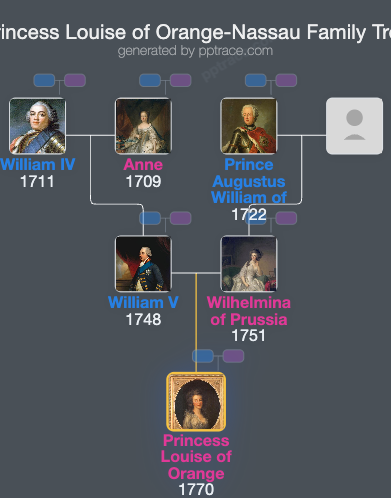
Princess Frederica Louise Wilhelmina of Orange-Nassau was born on 28 November 1770 and died on 15 October 1819. She was a member of the House of Orange-Nassau, the daughter of William V, Prince of Orange, and Wilhelmina of Prussia. Her upbringing was supervised personally by her mother, following the trends in childcare of the late 18th century, emphasizing close maternal involvement. She received her education from governess Victoire E. Hollard and professor Herman Tollius, with instruction in the Dutch language and Dutch religion. Her first language was French, in line with the customs of European royalty at that time.
Louise had interests in music, theater, and writing. She participated in amateur theatrical performances and received musical instruction from Johan Colizzi.
In 1789, her parents arranged her marriage to Hereditary Prince Karl Georg August of Brunswick-Wolfenbüttel, the eldest son of Charles William Ferdinand, Duke of Brunswick-Wolfenbüttel. The marriage took place on 14 October 1790 in The Hague. Following the wedding, Louise settled in Brunswick. The marriage was considered a diplomatic alliance and was partly a gesture of gratitude due to the assistance her family received from the Duke of Brunswick during the Dutch rebellion in 1787. Louise was aware of the limited prospects for finding another suitable spouse of her rank and religion and accepted the marriage proposal.
During her time in Brunswick, Louise experienced homesickness and difficulties adapting to local customs. She maintained a correspondence with her mother, her governess, and her former tutor, which provides historical insight into life at the Brunswick court. Her husband had an intellectual disability and was blind; Louise was largely responsible for his care, and their marriage was childless.
In 1795, her parents fled the Netherlands due to political upheaval, resulting in the loss of her personal income and financial dependence on her in-laws. Her husband's incapacity led to his renunciation of his position as heir to his younger brother.
In August 1799, Princess Hedwig Elizabeth Charlotte of Sweden visited Brunswick and documented her impressions of the family. She described the duke as a military figure and noted the health and behavior of the children, particularly the Hereditary Prince, who was described as fat, almost blind, and mentally challenged; her remarks indicated he was dependent on his wife. The other children exhibited various peculiar behaviors, and only one of the sons was considered to behave normally, though he was engaged in immoral conduct.
Following her husband's death in 1806, Louise’s mother joined her in Brunswick after the death of her father, William V. The same year, the Duchy of Brunswick was invaded by France, prompting Louise and her mother to travel to Switzerland with limited resources. They eventually moved to Prussia in 1807, settling with her maternal family. Later, she joined her former husband's family in England. From 1814, she resided in the Netherlands, dividing her time between The Hague in winters and the estate of Zorgvliet outside Haarlem during the summers.