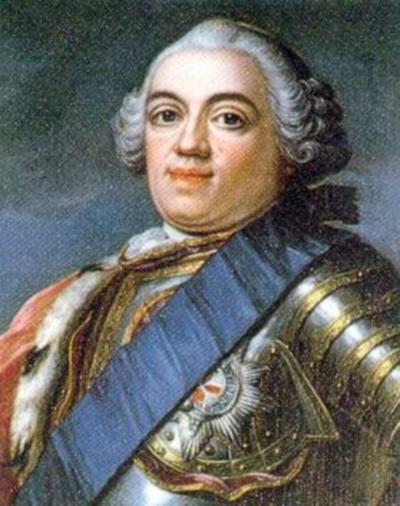
William IV, Prince Of Orange
| Name | William IV, Prince Of Orange |
| Title | hereditary stadtholder of the Netherlands (1711-1751) |
| Gender | Male |
| Birthday | 1711-09-01 |
| nationality | Dutch Republic |
| Source | https://www.wikidata.org/wiki/Q380949 |
| pptrace | View Family Tree |
| LastUpdate | 2025-11-12T01:16:12.292Z |
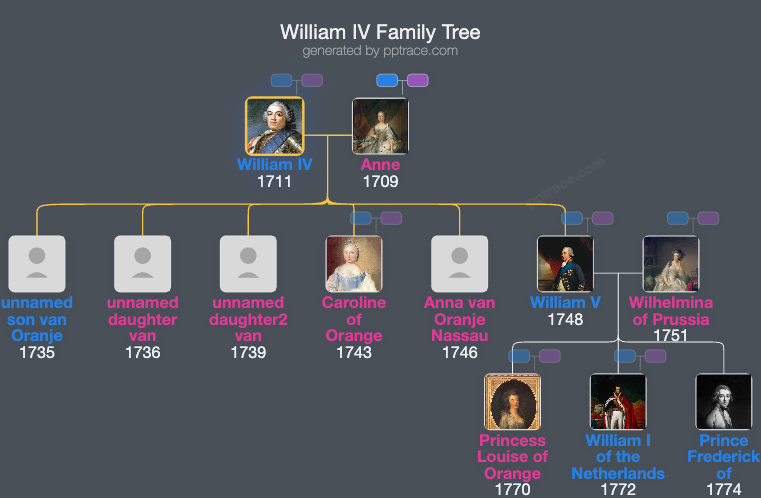
Family Tree
Tap  to expand more relatives
Introduction
William IV, also known as Willem Karel Hendrik Friso, was born on 1 September 1711 in Leeuwarden, Netherlands. He was the posthumous son of John William Friso, Prince of Orange, and Landgravine Marie Louise of Hesse-Kassel. His father died six weeks prior to his birth. William's full titles included Prince of Orange from birth and the first hereditary stadtholder of all the United Provinces of the Netherlands from 1747 until his death in 1751. During his lifetime, he also held rulership over the Principality of Orange-Nassau within the Holy Roman Empire.
In the early years, William succeeded his father as Stadtholder of Friesland and Groningen, initially under his mother's regency until 1731. In 1722, he was elected Stadtholder of Guelders. Following the death of William III in 1702, the other Dutch provinces—Holland, Zeeland, Utrecht, and Overijssel—opted not to appoint a stadtholder, leading to the Second Stadtholderless Period. However, in 1747, these provinces accepted William as their stadtholder, making his position hereditary.
William IV married Anne, Princess Royal, on 25 March 1734 at St James's Palace. Anne was the eldest daughter of King George II of Great Britain and Caroline of Ansbach. The couple had three children:
- Princess Carolina of Orange-Nassau (28 February 1743 – 6 May 1787), who married Karl Christian of Nassau-Weilburg.
- Princess Anna of Orange-Nassau (15 November 1746 – 29 December 1746), who died in infancy.
- William V, Prince of Orange (8 March 1748 – 9 April 1806), who married Princess Wilhelmina of Prussia.
In 1739, William inherited estates from the Nassau-Dillenburg branch of his family. In 1743, he also inherited properties from the Nassau-Siegen branch.
The War of the Austrian Succession began in 1740, involving Austria and France over the inheritance rights of Maria Theresa. In 1747, the Dutch Republic aligned with Austria to maintain a buffer zone from France. French troops invaded the Austrian Netherlands, and Dutch forces stationed in Zeelandic Flanders and other towns were overrun by French armies. During this period, the Dutch internal divisions prompted a move towards a stronger executive leadership, resulting in William and his family relocating from Leeuwarden to The Hague. On 4 May 1747, the States General appointed William as General Stadtholder of all seven Dutch provinces, establishing the position as hereditary for the first time.
William IV was known for his attractiveness, education, and accomplishments. Although he lacked extensive experience in governance, he gained initial popularity among the Dutch populace. His reforms included ending indirect taxation practices that enriched contractors. He also served as a Director-General of the Dutch East India Company, which aligned him closely with the commercial interests of the period. His influence extended into colonial naming, with the county of Orange in Virginia and the city of Orangeburg in South Carolina named in his honor.
William IV died of a stroke on 22 October 1751 in The Hague.