Daniel Finch, 2nd Earl Of Nottingham
| Name | Daniel Finch, 2nd Earl Of Nottingham |
| Title | British noble and politician |
| Gender | Male |
| Birthday | 1647-07-02 |
| nationality | Great Britain |
| Source | https://www.wikidata.org/wiki/Q2619683 |
| pptrace | View Family Tree |
| LastUpdate | 2025-11-26T23:23:41.590Z |
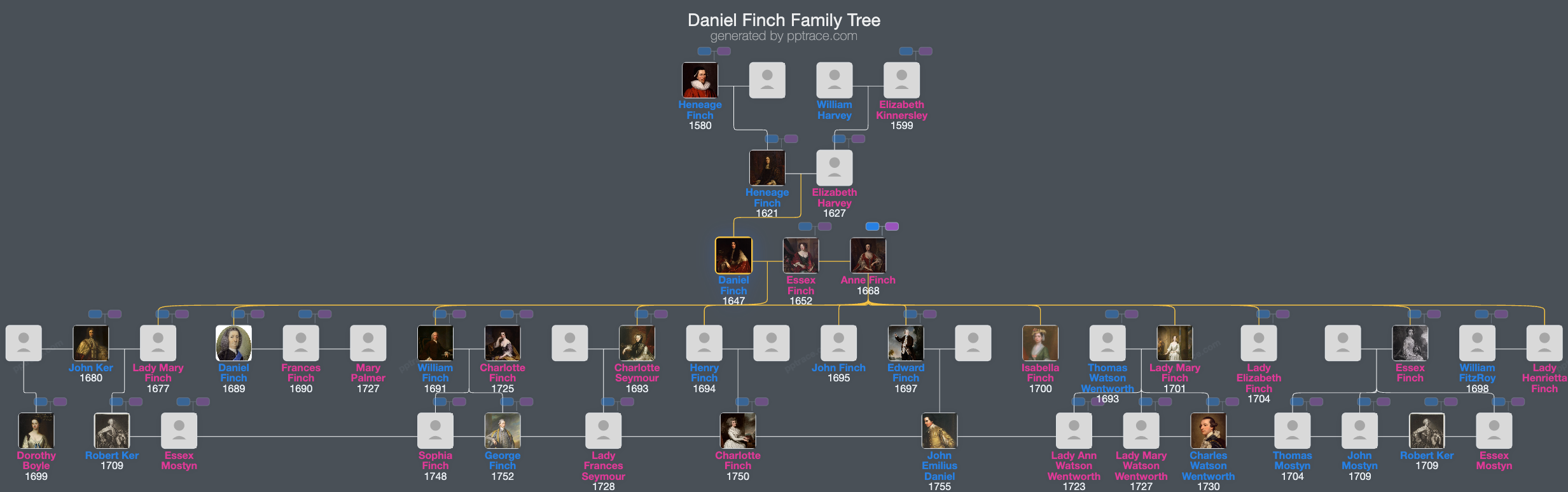
Family Tree
Tap  to expand more relatives
Introduction
Daniel Finch, 2nd Earl of Nottingham, 7th Earl of Winchilsea, was born on 2 July 1647 in London. He was the son of Heneage Finch, 1st Earl of Nottingham, who served as Lord Chancellor of England, and Elizabeth Harvey, daughter of Daniel Harvey. His great grandmother was Elizabeth Finch, 1st Countess of Winchilsea. Daniel had a brother named Heneage Finch, who became the 1st Earl of Aylesford.
Regarding his education, Finch entered Westminster School in 1658 and was under the tutelage of Dr. Richard Busby, the headmaster and former tutor to his father. He attended Christ Church, Oxford, matriculating as a Gentleman Commoner on 26 July 1662. He studied there until illness prompted him to leave before graduation. His studies were praised for their excellence, although his father expressed doubt about their authenticity. Between 1665 and 1668, Finch undertook the Grand Tour, visiting various European cities including Frankfurt, Munich, Venice, Florence, Naples, Rome, and Paris. Upon returning to England, he was appointed a Fellow of the Royal Society.
In April 1663, Finch's father advised him on religious observance and personal conduct, emphasizing the importance of religion in guiding wisdom and character.
In 1689, Finch sold Nottingham House in Kensington to King William and Queen Mary for £20,000. The house was subsequently expanded into Kensington Palace by Sir Christopher Wren.
Finch's political career began when he entered Parliament for Lichfield in 1679. He succeeded his father as the Earl of Nottingham in 1682. During the reign of James II, he was one of the privy councillors who signed the order for the proclamation of the Duke of York. However, he avoided court during the reign of James II and hesitated to fully support William of Orange at the time of James II’s flight. Following the Glorious Revolution, he led a faction advocating that James II remain king in name and that William act as regent. He was the author of the Act of Toleration in 1688.
Finch declined the position of Lord Chancellor under William and Mary but served as Secretary of State until December 1693. Under Queen Anne, he resumed this office in 1702 within the ministry of Lord Godolphin but retired in 1704. During the War of the Spanish Succession, in 1711, Finch proposed the “No peace without Spain” amendment, opposing treaties that would leave Spain and the West Indies in Bourbon control.
He constructed Burley House in Rutland, completing it in 1705. Finch was heavily involved in its design and construction, initially consulting Sir Christopher Wren but employing Henry Dormer as supervisor. The main building measures approximately 200 feet in length and was occupied by Finch and his family prior to its completion.
Upon the accession of King George I, Finch was appointed Lord President of the Council but withdrew from office in 1716. On 9 September 1729, he succeeded to the title Earl of Winchilsea after the death of his second cousin, John Finch, 6th Earl of Winchilsea. Finch was reluctant to accept the higher title due to family pride but eventually combined it with his existing titles.
He died on 1 January 1730 at Burley.
Finch married twice. His first marriage was on 16 June 1674 to Lady Essex Rich, daughter of Robert Rich, 3rd Earl of Warwick. They had eight children, but only Lady Mary Finch survived to adulthood. On 29 December 1685, he married Hon. Anne Hatton, daughter of Christopher Hatton, 1st Viscount Hatton, and Lady Cecilia Tufton. With Anne Hatton, Finch had at least twelve surviving children, including his heir Daniel Finch, 8th Earl of Winchilsea. Their children included William Finch, John Finch, Lady Essex Finch, Henry Finch, Edward Finch, Lady Charlotte Finch, Lady Cecilia Isabella Finch, Lady Mary Finch, Lady Henrietta Finch, Lady Elizabeth Finch, and others.
Among his descendants, the line of the Finch-Hatton family led to George Finch-Hatton, 10th Earl of Winchilsea. Finch's family relationships included notable marriages, such as Lady Charlotte Finch to Charles Seymour, 6th Duke of Somerset, and Lady Cecilia Finch to William Murray, 1st Earl of Mansfield.
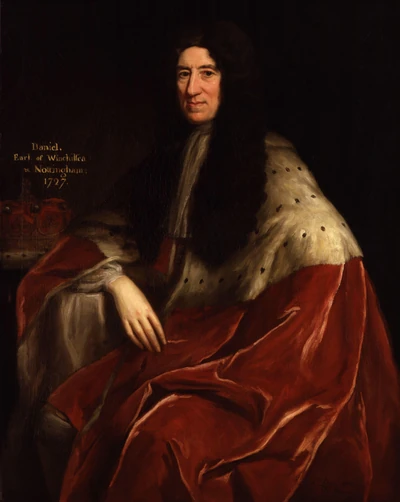
In 1848, the historian Lord Macaulay described Finch as an honorable and virtuous man, noting his impressive oratory and distinctive appearance.