Heneage Finch, 1st Earl Of Nottingham
| Name | Heneage Finch, 1st Earl Of Nottingham |
| Title | English politician |
| Gender | Male |
| Birthday | 1621-12-23 |
| nationality | Kingdom of England |
| Source | https://www.wikidata.org/wiki/Q3784808 |
| pptrace | View Family Tree |
| LastUpdate | 2025-11-26T23:23:48.884Z |
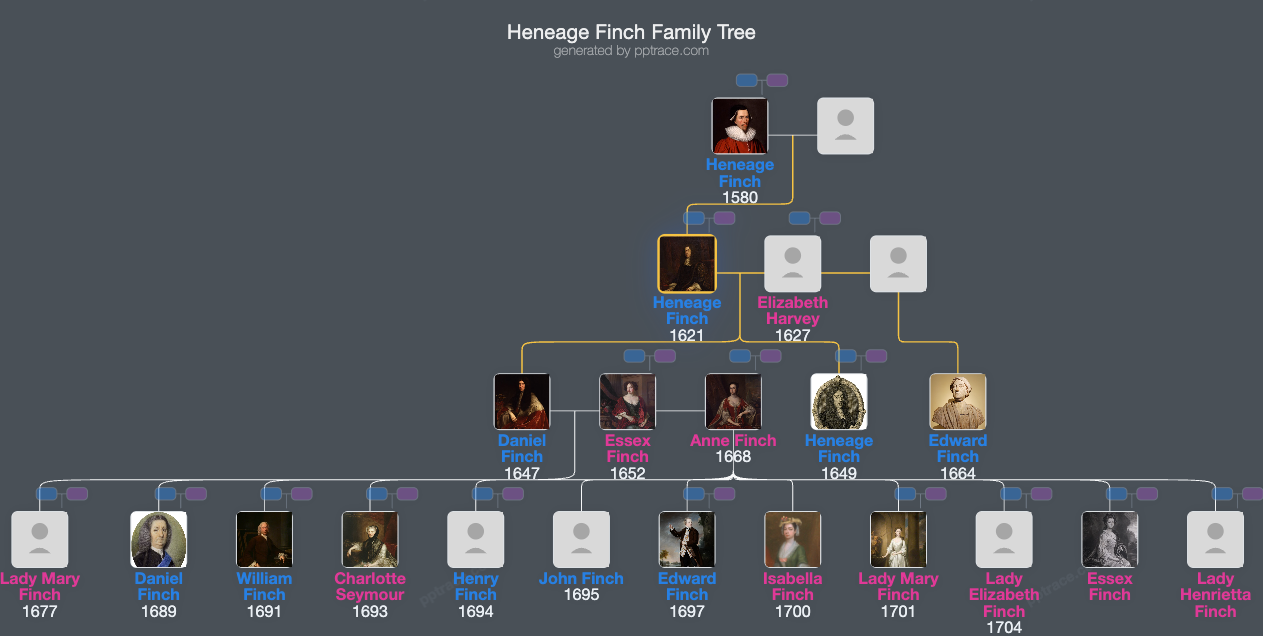
Family Tree
Tap  to expand more relatives
Introduction
Heneage Finch, 1st Earl of Nottingham, PC (23 December 1620 – 18 December 1682), was a legal and political figure in 17th-century England. He held the position of Lord Chancellor of England and was a member of the Privy Council. Finch was descended from the Finch family, which had attained prominence in legal circles; many members of the family had achieved high legal distinction. He was the eldest son of Sir Heneage Finch, Recorder of London, and his first wife, Frances Bell, daughter of Sir Edmond Bell of Beaupre Hall, Norfolk.
Finch was born in Kent, likely at Eastwell Park, the family’s ancestral seat. He received education at Westminster School and later at Christ Church, Oxford, where he remained until he joined the Inner Temple in 1638. He was called to the bar in 1645, after which he practiced law with notable success.
In April 1660, Finch was elected Member of Parliament (MP) for Canterbury and Mitchell in the Convention Parliament; he chose to sit for Canterbury. Subsequently, he was appointed Solicitor General, serving as the prosecutor of the regicides responsible for the execution of King Charles I. He was knighted and created a baronet the day after his knighthood. In May 1661, he was elected MP for Oxford University in the Cavalier Parliament, and in 1665, the university awarded him the degree of Doctor of Civil Law (D.C.L.).
Finch advanced to the position of Attorney General in 1670 and was appointed Lord Chancellor in 1675. He was elevated to the peerage as Baron Finch in January 1673 and later became the Earl of Nottingham in May 1681.
During the Popish Plot, a period of anti-Catholic hysteria, Finch participated in interrogations and preparations of evidence, maintaining a generally moderate stance. He is believed to have expressed skepticism about much of the testimony presented by Titus Oates. His conduct during the crisis was characterized by impartiality. As Lord High Steward, he presided over the trial of William Howard, 1st Viscount Stafford, demonstrating a balanced approach. Records indicate that Finch threatened Miles Prance, an informer, with the rack during questioning, although such threats were considered uncharacteristic and likely not serious, given the rack’s illegality since 1628.
Finch’s country residence was Nottingham House in Kensington, a property initially constructed in the early 17th century. Acquired by Finch’s heir in 1689, Kensington House was developed further by Sir Christopher Wren, who added pavilions to each corner of the central block. Wren also reoriented the house to face west and added wings, creating a courtyard approach. The residence, often referred to as Kensington House rather than a palace, included walled kitchen gardens supplying court provisions.
On 30 July 1646, Finch married Elizabeth Harvey, daughter of William Harvey’s younger brother Daniel and Elizabeth Kinnersley. They had six children, notably Daniel Finch, who became the 2nd Earl of Nottingham, and Heneage Finch, who became the 1st Earl of Aylesford. Other children included Margaret Finch, Elizabeth Finch, and William Finch.
Heneage Finch died in Great Queen Street, London, on 18 December 1682, and was buried in Ravenstone Church, Buckinghamshire. His son Daniel succeeded him, inheriting the earldom and later the Earldom of Winchilsea.
Finch’s reputation among his contemporaries was for integrity, moderation, and eloquence. He is recognized for contributions to English law, most notably the Statute of Frauds. As Attorney General, he supervised the publication of Sir Henry Hobart’s Reports and authored several speeches and writings, including reports on the trial of judges involved in the execution of Charles I. He also left manuscripts and notes on legal texts, reflecting his depth of legal scholarship.