John Finch
| Name | John Finch |
| Title | British Member of Parliament (died 1763) |
| Gender | Male |
| Birthday | 1695-00-00 |
| nationality | Great Britain |
| Source | https://www.wikidata.org/wiki/Q28797015 |
| pptrace | View Family Tree |
| LastUpdate | 2025-11-26T12:25:05.579Z |
Family Tree
Tap  to expand more relatives
Introduction
John Finch was born circa 1692 and died on 12 February 1763. He was associated with Bushey in Hertfordshire and was engaged in professional roles as a lawyer and politician in Britain. Finch served as a Member of Parliament (MP) in the House of Commons for a period spanning 23 years, from 1724 until 1747.
Early Life and Education
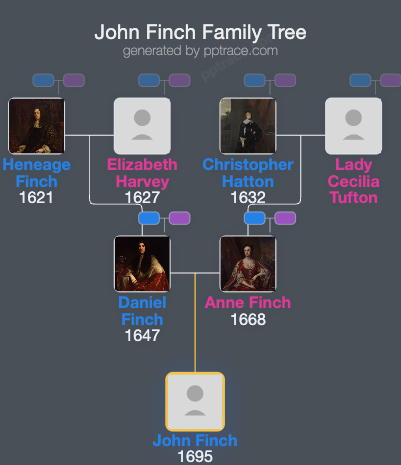
He was the third son of Daniel Finch and his second wife, Anne Hatton. Anne Hatton was the daughter of Christopher Hatton. Finch attended Eton College beginning in 1706 and completed his studies there in 1707. He matriculated at Christ Church, Oxford, on 26 January 1708, at the age of 15. In 1711, Finch was admitted to the Inner Temple, one of the four Inns of Court in London, and he was called to the bar in 1719.
Notable Incidents
Finch was involved in an incident on 18 December 1722 at the Three Tuns tavern in Chandos Street, where he was stabbed by Sally Salisbury, a prostitute named Sally Pridden. The attack was reportedly in a fit of passion during an argument over theatre tickets. Salisbury was convicted of assault and wounding, with no intent to kill, and was fined and imprisoned in Newgate Prison, where she died in 1724. Finch later married Elizabeth Younger, an actress, after she had an illegitimate daughter by him.
Political Career
Finch initially stood unsuccessfully in a by-election on 1 June 1723 at Maidstone, contesting the seat on the interest of his cousin Heneage Finch. The seat was held by another John Finch, who was a sitting member. In 1724, Finch was elected as MP for Higham Ferrers at a by-election, representing the interest of his brother-in-law, Thomas Watson-Wentworth.
He served as solicitor general to the Prince of Wales from 1726 to 1727. Following the accession of King George II in 1727, Finch was appointed King's Counsel (KC). In the general election of 1727, he was returned unopposed for Higham Ferrers. During his time in Parliament, he generally aligned with his brother Lord Finch, though he showed moments of opposition, such as in 1730. He was again returned unopposed at the 1734 election.
In 1739, Finch held the position of Treasure of his Inn. Before the 1741 general election, he stepped aside for his brother Henry at Higham Ferrers and transferred to represent Rutland, where he was elected unopposed with support from his elder brother, now Lord Winchilsea. After Sir Robert Walpole's fall in 1742, Finch and his brothers supported the government. In 1746, he was classified as one of Granville's followers.
At the 1747 general election, Lord Winchilsea intended to endorse Finch for Rutland again but concluded that Finch's chances of success were slim. Subsequently, Finch did not stand for Parliament again.
Death and Family
John Finch died on 12 February 1763. He had a daughter born before his marriage to Elizabeth Younger, which caused family controversy when she was presented at court in 1747. Finch's brothers, including Lord Finch, Henry, Edward, and William Finch, also served as Members of Parliament.
Ancestry and References
No detailed genealogical information is provided beyond his parents and siblings. The available references include historical records detailing his education, career, and family life.