William Finch
| Name | William Finch |
| Title | British diplomat |
| Gender | Male |
| Birthday | 1691-01-18 |
| nationality | Great Britain |
| Source | https://www.wikidata.org/wiki/Q8009036 |
| pptrace | View Family Tree |
| LastUpdate | 2025-11-26T23:23:43.482Z |
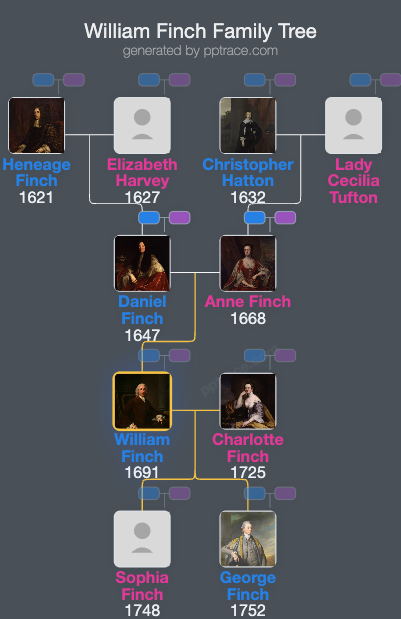
Family Tree
Tap  to expand more relatives
Introduction
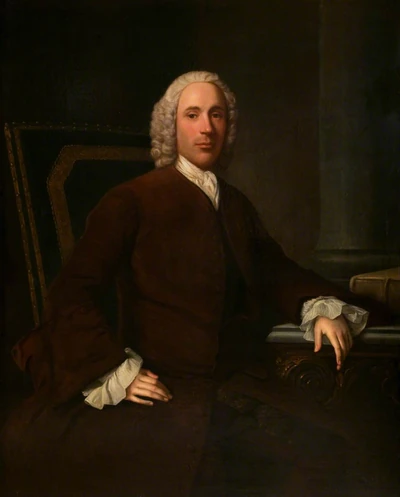
Honorable William Finch (18 January 1691 – 25 December 1766) was a British diplomat and politician associated with the Whig party. His residence was Charlewood in Hertfordshire. Finch served in the House of Commons from 1727 until 1761.
Born as the second son of Daniel Finch, 2nd Earl of Nottingham, and his second wife, Anne Hatton, William Finch was involved in diplomatic and political careers during the early 18th century. He enrolled at Christ Church, Oxford, on 4 March 1707, at the age of 16, and became a student at Inner Temple in 1710.
In his diplomatic career, Finch initially accompanied Lord Carteret as his secretary during Carteret's ambassadorship in Sweden from 1719 to 1720. Following Carteret's return to Britain, Finch was appointed as envoy to Sweden in Carteret's stead, serving until 1724. Subsequently, Finch was appointed as envoy to the United Provinces (Netherlands), a position he held until 1728.
Finch was elected Member of Parliament for Cockermouth in the 1727 general election, representing the interest of his brother-in-law, the Duke of Somerset. Throughout this period, he generally supported the government. In 1733–1734, he was dispatched as minister to the Netherlands, a mission during which he was critiqued for perceived lack of diligence. His tenure was marked by tensions stemming from diplomatic frustrations, notably when Walpole's envoy, Horace Walpole, was appointed to The Hague, leading Finch to request his recall.
He was returned unopposed for Cockermouth in the 1734 general election and aligned with opposition forces against Walpole. Finch was re-elected for Cockermouth at the 1741 election. After Walpole's fall from power in 1742, Finch, along with his brother Hon. Edward Finch, obtained government posts linked to Lord Carteret, notably serving as Vice-Chamberlain of the Household and a member of the Privy Council. He retained his position through subsequent administrations until 1765.
Legislative career changes occurred when, in 1747, Finch was re-elected as MP for Cockermouth. However, in 1754, he was encouraged to stand in a different constituency and was not re-elected for Cockermouth. On 5 February 1755, Finch was elected unopposed as MP for Bewdley on the Lyttelton interest. He did not seek re-election after this term.
In later years, Finch’s mental health declined, and by 1765, he was reportedly losing his sanity, leading to his pensioning from his royal household position.
Finch was married twice. His first marriage was to Lady Anne Douglas, daughter of James Douglas, 2nd Duke of Queensberry, on 25 January 1733. She died without issue on 26 October 1741. His second marriage was to Lady Charlotte Fermor, daughter of Thomas Fermor, 1st Earl of Pomfret, on 9 August 1746. They had one son, George Finch, who became the 9th Earl of Winchilsea, and four daughters: Charlotte Finch (b. 1 September 1747), Sophia Finch (b. 17 October 1748), Frances Finch (23 September 1749–1765), and Henrietta Finch (b. 28 December 1750).
Lady Charlotte Fermor served as a governess to the royal children. During Finch’s period of insanity, he reportedly beat her and threw her down stairs, leading to their separation, although they maintained civil relations.
William Finch died on 25 December 1766 and was succeeded by his son George Finch.