Edward Finch
| Name | Edward Finch |
| Title | British diplomat and politician |
| Gender | Male |
| Birthday | 1697-01-01 |
| nationality | Great Britain |
| Source | https://www.wikidata.org/wiki/Q5342901 |
| pptrace | View Family Tree |
| LastUpdate | 2025-11-26T23:23:48.028Z |
Family Tree
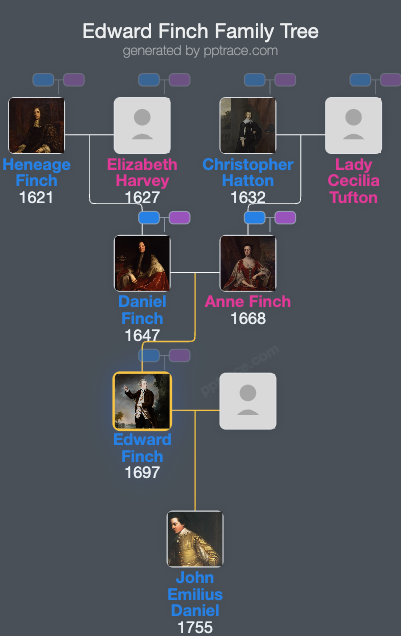
Tap  to expand more relatives
Introduction
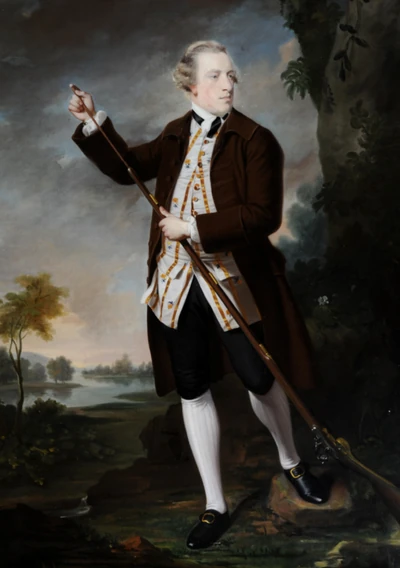
Honorable Edward Finch-Hatton (circa 1697 – 16 May 1771) was a British diplomat and politician. He resided at Kirby Hall, near Rockingham, Northamptonshire. Finch-Hatton served as a Member of Parliament for 41 years, from 1727 to 1768.
Early Life and Education
Edward Finch was born around 1697 as the fifth son of Daniel Finch, 2nd Earl of Nottingham and 7th Earl of Winchilsea. His mother was Hon. Anne Hatton, daughter and heiress of Christopher Hatton, 1st Viscount Hatton. He was one of twelve children. Finch-Hatton lived with his family at Burley on the Hill. His education included attendance at a school in Isleworth, followed by admission to Trinity College, Cambridge, on 10 October 1713, at age 16. He earned an M.A. degree in 1718. Between 1720 and 1723, he undertook the Grand Tour, traveling through France, Italy, and Hanover.
Diplomatic and Political Career
In 1724, Finch began his diplomatic career. He was appointed envoy-extraordinary to the Imperial Diet at Regensburg during the winter of 1724–1725. Subsequently, he served as Minister to Poland, Sweden, and Russia between 1725 and 1742. His diplomatic correspondence from Russia has been published by the Imperial Russian Historical Society, volume 85, detailing the diplomatic exchanges from 1740 to March 1741.
In politics, Finch was elected as Member of Parliament for Cambridge University in the 1727 general election. He held the seat for the longest period as Minister in Stockholm, from 1728 to 1739. During this period, he is recorded to have voted only once in Parliament. He was re-elected for Cambridge University in 1734 and 1741.
Following his return to England in 1742, Finch was appointed groom of the bedchamber to the King. He maintained this position through various government changes until 1756. He participated in parliamentary debates, including delivering an account of negotiations on 16 November 1742, and opposing motions such as the discontinuance of Hanoverian troops in 1743. Finch was returned unopposed in the 1747 and 1754 general elections, and he also stood unsuccessfully for Rutland.
His governmental roles included Master of the Robes and Keeper of the Privy Purse, starting in June 1757, and Surveyor of the King's Private Roads from November 1760. He was re-elected in 1761 but chose not to stand for election in 1768.
Marriage and Family
On 15 August 1746, Finch married Anne Palmer (b. 1709 – March 1795), daughter of Sir Thomas Palmer, 4th Baronet of Wingham, and sister to Mary Palmer, Countess of Winchilsea. The marriage took place at the home of Finch's elder brother, Daniel Finch, 8th Earl of Winchilsea, in Sackville Street, Mayfair. Their children were all double first cousins due to intermarriage within noble families.
In October 1764, Finch and his sons adopted the additional surname "Hatton" following the will of Anna Maria Hatton, his half-aunt, and inherited property including Kirby Hall.
The Finch-Hatton children included:
- George Finch-Hatton (1747–1823), who was a Member of Parliament and was married to Lady Elizabeth Murray, daughter of the 2nd Earl of Mansfield. He fathered George William Finch-Hatton, 10th Earl of Winchilsea.
- Anne Finch (b. 17 November 1750), who remained unmarried.
- Harriett Frances Charlotte Finch (1752–1821), known as Lady Gordon, married Sir Jenison William Gordon, 2nd Baronet.
- Mary Henrietta Elizabeth Finch (1754–1822), who remained unmarried.
- John Emilius Daniel Edward Finch-Hatton (b. 1755, d. 1841), unmarried.
Finch-Hatton's wife, Anne Palmer, died in March 1795 at Eastwell Park. Finch-Hatton himself passed away on 16 May 1771. He was succeeded by his son George, who became the 10th Earl of Winchilsea.