Prince William, Duke Of Gloucester
| Name | Prince William, Duke Of Gloucester |
| Title | son of Queen Anne |
| Gender | Male |
| Birthday | 1689-07-24 |
| nationality | England |
| Source | https://www.wikidata.org/wiki/Q744541 |
| pptrace | View Family Tree |
| LastUpdate | 2025-11-12T01:14:14.169Z |
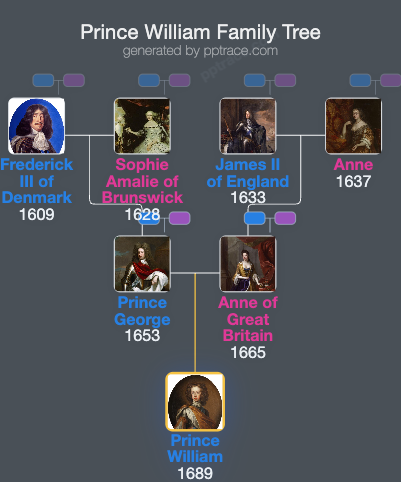
Family Tree
Tap  to expand more relatives
Introduction
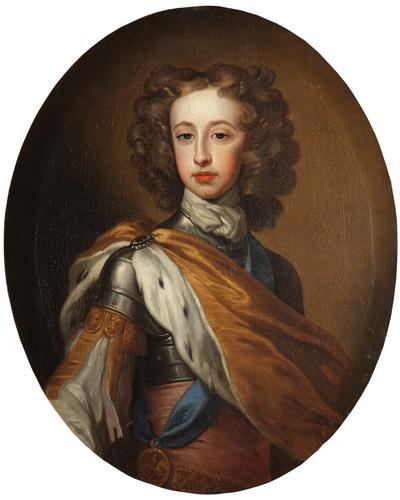
Prince William, Duke of Gloucester (William Henry), was born on 24 July 1689 and died on 30 July 1700. He was the only surviving child of Princess Anne, who later became Queen of England, Scotland, and Ireland in 1702, and her husband, Prince George of Denmark. The duke held the style of Duke of Gloucester, a title he was associated with during his lifetime.
William was born at Hampton Court Palace following a protracted series of pregnancies by Princess Anne, who experienced multiple stillbirths and smallpox-related infant deaths before his birth. His birth was regarded as significant in reinforcing the Protestant succession established after the Glorious Revolution of 1688-1689, which resulted in the deposition of his Catholic grandfather, James II & VII. William III and Mary II ascended to the throne as part of this revolution, and Princess Anne was designated as the heir presumptive due to the absence of surviving male heirs from her previous pregnancies.
He was baptized three days after his birth, with prominent figures such as Henry Compton, Bishop of London, acting as the officiant. His baptismal name, William Henry, reflected his familial ties to King William, and he was declared Duke of Gloucester, although the peerage was not formally created. His deepening political significance was recognized, and various congratulatory odes commemorated his birth.
From an early age, William’s health was fragile. He suffered from convulsions, possibly due to hydrocephalus resulting from meningitis, which was likely contracted at birth. His health issues led his mother to relocate him to Craven House in Kensington, where he received treatments aimed at improving his condition, including exposure to gravel pit air and daily outdoor activities. He was cared for by governess Lady Fitzhardinge and wet nurse Mrs. Pack, with Jenkin Lewis, his Welsh body-servant, being a notable attendant whose memoir remains a valuable historical source.
William's education was delayed due to developmental challenges. His tutor, Reverend Samuel Pratt, instructed him in geography, mathematics, Latin, and French. Throughout his childhood, he demonstrated a remarkable memory and understanding of his lessons, although his physical health limited his mobility and activity. He was granted the honor of being installed as a knight of the Order of the Garter on his seventh birthday in Windsor, and he was involved in political expressions of loyalty, such as signing a letter of allegiance during the trial of Sir John Fenwick.
In 1698, efforts to establish his household and education sparked tensions between Princess Anne and King William, reflecting political and religious differences. Despite these difficulties, Gloucester maintained close relationships with his family and courtiers. His upbringing included military training, and he was made honorary commander of a Dutch regiment.
William's health continued to decline as he approached his eleventh birthday. In late July 1700, he fell ill with symptoms including sore throat, fever, rash, and diarrhea. Despite treatment, his condition worsened, displaying swelling and fluid accumulation in his brain, and he died on 30 July 1700, with his parents beside him. The autopsy indicated severe swelling of lymph nodes and excess fluid in the brain ventricles. It is believed he may have died from smallpox or an acute bacterial infection associated with his hydrocephalus.
His death created a succession crisis, as Princess Anne was the sole remaining Protestant heir. The British Parliament responded by passing the Act of Settlement in 1701, which designated the Protestant Electress Sophia of Hanover and her heirs as heirs to the throne, thus establishing the line of succession that would lead to the Hanoverian dynasty. Anne succeeded William in 1702, and her reign lasted until her death in 1714, after which her son, George I, became king.
William held the style of His Royal Highness Prince William, Duke of Gloucester, a title that became extinct upon his death. He was honored as a Knight of the Garter on 6 January 1696 and bore arms differenced by an inescutcheon of the Danish coat of arms and a label of three points Argent with a central red cross.