Hirohito
| Name | Hirohito |
| Title | Emperor of Japan from 1926 to 1989 |
| Gender | Male |
| Birthday | 1901-04-29 |
| nationality | Japan |
| Source | https://www.wikidata.org/wiki/Q34479 |
| pptrace | View Family Tree |
| LastUpdate | 2025-11-17T06:48:05.264Z |
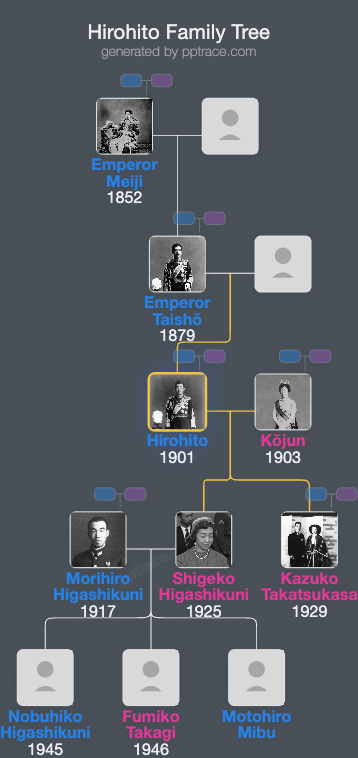
Family Tree
Tap  to expand more relatives
Introduction
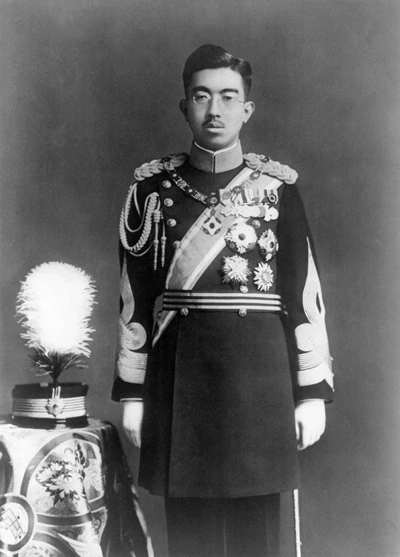
Hirohito (裕仁; 29 April 1901 – 7 January 1989) was the 124th emperor of Japan according to the traditional order of succession. He reigned from 1926 until his death in 1989, marking the longest tenure of any Japanese emperor and one of the longest reigns in world history. His tenure coincided with the Shōwa era, during which Japan experienced significant political, military, and economic developments.
Hirohito was born at Tōgū Palace in Aoyama, Tokyo, during the reign of his grandfather, Emperor Meiji. His parents were Crown Prince Yoshihito (later Emperor Taishō) and Crown Princess Sadako (later Empress Teimei). His childhood title was Prince Michi. At ten weeks old, he was removed from court care and was raised by Count Kawamura Sumiyoshi. Following Kawamura’s death when Hirohito was three, he and his brother Yasuhito returned to court and resided at the imperial mansion in Numazu, Shizuoka, before returning to the Aoyama Palace.
His elementary education began at the Gakushūin (Peers School) in 1908. Emperor Meiji appointed General Nogi Maresuke to oversee his education, and after Nogi’s death, Hirohito’s studies continued under Fleet Admiral Togo Heihachiro and Naval Captain Ogasawara Naganari. From the age of 11, Hirohito received military education, being commissioned as a Second Lieutenant in the Imperial Japanese Army and an Ensign in the Imperial Japanese Navy in 1912, and was awarded the Grand Cordon of the Order of the Chrysanthemum.
When Emperor Meiji died on 30 July 1912, Hirohito’s father ascended to the throne as Emperor Taishō, and Hirohito became the heir apparent. In 1916, he was formally proclaimed crown prince and heir apparent. That same year, he made an historic visit to Western Europe, including the United Kingdom, France, the Netherlands, Belgium, Italy, Vatican City, and Malta. This marked the first official visit abroad by a Japanese crown prince. The voyage lasted from March to September 1921 and involved diplomatic engagements, cultural visits, and receiving honorary degrees from the University of Cambridge and the University of Edinburgh.
In 1921, Hirohito was appointed regent due to his father’s ill health. He was promoted to rank of Lieutenant-Colonel in the army and Commander in the navy in 1923, and later to army Colonel and Navy Captain in 1925. That same year, he traveled to Taiwan, which had been a Japanese colony since 1895, marking the first time a Japanese emperor or crown prince visited a colony. The 12-day visit included cultural exchanges and was significant in emphasizing imperial integration policies.
Hirohito became emperor upon the death of Emperor Taishō in 1926. His reign was characterized by Japan’s militarization and imperial expansion, notably the invasion of Manchuria following the Mukden incident in 1931, and active engagement in the Second Sino-Japanese War beginning in 1937. On 1 December 1941, Hirohito formally sanctioned Japan’s entry into World War II by approving military plans leading to the attack on Pearl Harbor and other Allied territories.
Following Japan’s defeat, Hirohito announced Japan’s surrender on 15 August 1945 via a radio broadcast. His involvement in wartime decision-making remains debated among historians. Unlike many wartime leaders, he was not prosecuted for war crimes; the Allied occupation, led by Douglas MacArthur, believed maintaining Hirohito’s position fostered stability and postwar reconstruction. In 1946, under pressure from the Allies, Hirohito renounced his divine status. The 1947 Japanese constitution redefined his role as “the symbol of the State and of the unity of the People.”
Hirohito was married to Princess Nagako Kuni, with whom he had seven children. His eldest son, Akihito, succeeded him as emperor following Hirohito’s death on 7 January 1989.