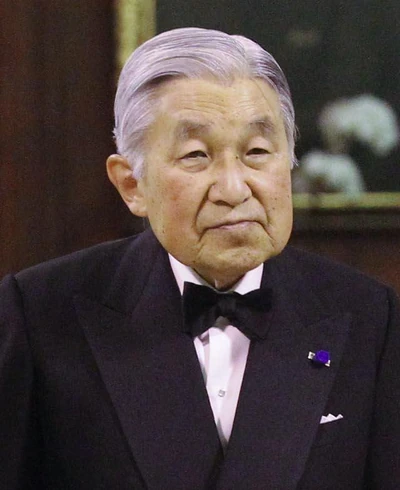
Akihito
| Name | Akihito |
| Title | Emperor of Japan from 1989 to 2019 |
| Gender | Male |
| Birthday | 1933-12-23 |
| nationality | Japan |
| Source | https://www.wikidata.org/wiki/Q37979 |
| pptrace | View Family Tree |
| LastUpdate | 2025-11-17T06:48:38.640Z |
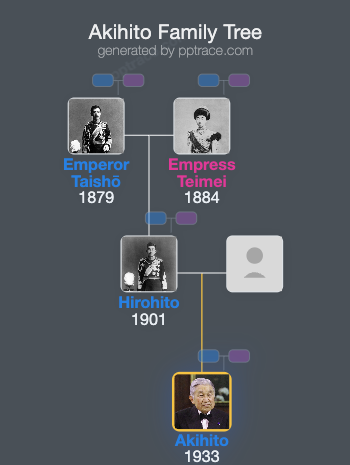
Family Tree
Tap  to expand more relatives
Introduction
Akihito was born on December 23, 1933, at the Tokyo Imperial Palace. He is a member of the Imperial House of Japan and served as the 125th Emperor of Japan from January 7, 1989, until his abdication on April 30, 2019. His reign was known as the Heisei era, a name conveying the aspiration for peace worldwide.
He was the fifth child and first son of Emperor Shōwa (Hirohito) and Empress Kōjun. During World War II, he relocated from Tokyo with his classmates to Nikkō and remained there until Japan's surrender. His early education was conducted by private tutors, followed by attendance at the Peers' School (Gakushūin) from 1940 to 1952. In March 1945, amidst the Allied firebombing of Tokyo, he and his younger brother Prince Masahito were evacuated from the city.
Akihito was tutored in English and Western manners by Elizabeth Gray Vining during the Allied occupation of Japan. He briefly studied political science at Gakushuin University in Tokyo but did not earn a degree. He was formally invested as Crown Prince (Rittaishi) on November 10, 1952.
In 1953, he represented Japan at the coronation of Queen Elizabeth II in London, marking his first international appearance. He completed his university coursework as a special student in 1956.
On August 10, 1959, Akihito married Michiko Shōda, a commoner. Their marriage was notable as the first televised imperial wedding in Japan, viewed by approximately 15 million viewers. Michiko was educated in Catholic schools, and her marriage to a member of the Imperial Family challenged traditional norms. The couple had three children: Crown Prince Naruhito, Fumihito, Prince Aya, and Sayako, Princess Nori. Federation of their personal and official lives included numerous international visits and efforts to connect the Imperial Family with the Japanese populace.
Following the death of Emperor Shōwa, Akihito ascended to the throne on January 7, 1989, at age 55. His enthronement ceremony was held on November 12, 1990. During his reign, he issued formal statements of remorse to Asian countries for Japan’s wartime actions, beginning with one to China in April 1989.
Akihito made notable visits abroad, including a 2005 trip to Saipan, the site of a World War II battle, which was his first visit to a battlefield overseas. He also visited multiple memorials in Japan and was known for efforts to humanize the imperial image and bring it closer to the Japanese people.
He has expressed a kinship with Koreans and addressed historical topics publicly, including discussions related to imperial ancestry. His tenure saw the service of 17 prime ministers over 25 terms, starting with Noboru Takeshita and ending with Shinzo Abe.
Akihito is recognized as the longest-lived verifiable Japanese emperor in recorded history, surpassing the age of 91. Following his abdication, he adopted the title Emperor Emeritus (Jōkō). He was succeeded by his elder son, Naruhito, who ascended the throne under the era name Reiwa in 2019.
As of November 15, 2024, Akihito is the oldest living member of the Imperial House of Japan, following the death of Yuriko, Princess Mikasa. During his reign, he was predominantly referred to as "His Majesty the Emperor" (Tennō Heika). Post-abdication, he is officially titled Jōkō.