Shigeko Higashikuni
| Name | Shigeko Higashikuni |
| Title | Former Japanese princess |
| Gender | Female |
| Birthday | 1925-12-06 |
| nationality | Japan |
| Source | https://www.wikidata.org/wiki/Q1030337 |
| pptrace | View Family Tree |
| LastUpdate | 2025-11-17T06:48:36.869Z |
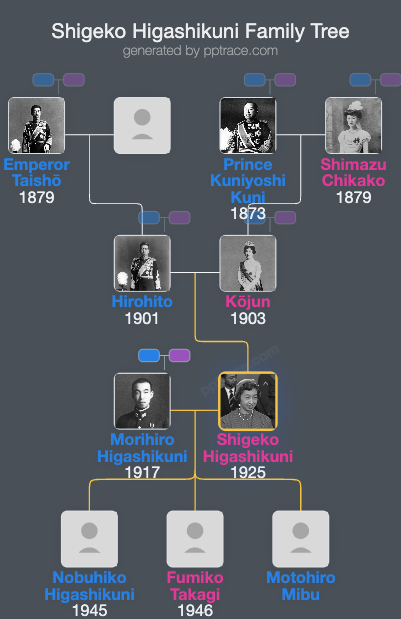
Family Tree
Tap  to expand more relatives
Introduction
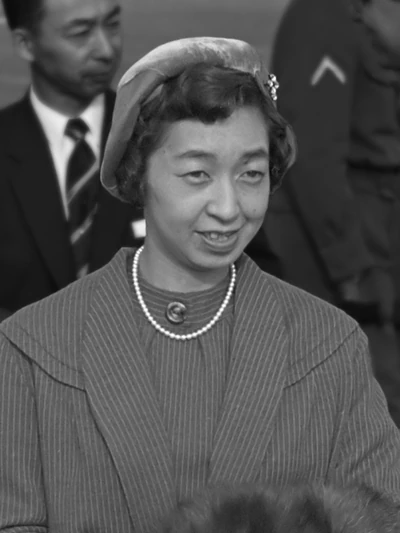
Shigeko Higashikuni (東久邇 成子, Higashikuni Shigeko) was born on December 6, 1925, at Akasaka Palace in Tokyo. She was the first child of Crown Prince Hirohito, who later became Emperor Shōwa, and Crown Princess Nagako, later Empress Kōjun. Her childhood appellation was Teru-no-miya (照宮), translating to "Princess Teru." She was the eldest sister of Emperor Emeritus Akihito and the paternal aunt of Emperor Naruhito.
Following imperial tradition, Princess Shigeko was not raised directly by her biological parents after the age of three. Instead, she was brought up by court ladies at a separate palace built for her and her younger sisters in the Marunouchi district of Tokyo beginning in 1930. Her father, Emperor Shōwa, was opposed to this arrangement but adhered to court customs. In 1932, she entered the girls' elementary department of the Gakushūin Peer's School and graduated from the secondary department in 1942, where she studied cooking and literature.
On May 9, 1939, Princess Shigeko participated in a school outing riding the Chōshi Electric Railway Line in Chiba Prefecture from Chōshi to Tōdaimae and back. In 1941, she became formally engaged to Prince Morihiro Higashikuni, the eldest son of Prince Naruhiko Higashikuni and Toshiko, Princess Yasu. Prince Morihiro was a member of a collateral branch of the imperial family, descending from Emperor Meiji. The engagement linked two double first cousins once removed through both the main imperial line and collateral lines, as the bride's maternal grandfather and the groom's father were siblings.
The couple was married on October 10, 1943. Due to the ongoing World War II, the wedding ceremonies were modest; Princess Shigeko wore a junihitoe kimono belonging to her mother, Empress Kōjun, instead of newly created wedding attire. In 1947, following the Allied occupation's abolition of noble titles, the Higashikuni family was reduced to commoner status. This change coincided with economic difficulties, including post-war inflation, high taxation, and unsuccessful business ventures.
In January 1958, Princess Shigeko participated as a television presenter for NHK, Japan's national broadcasting organization, where she explained royal ceremonies such as the New Year's poetry card reading contest. In 1960, she became ill with stomach pains and was diagnosed with stomach cancer. She was hospitalized at the Imperial Household Agency Hospital in Tokyo and died on July 23, 1961. Her remains are interred at Toshimagaoka Imperial Cemetery in Bunkyo, Tokyo.
Princess Shigeko and Prince Morihiro had five children. Their first three children were born while the family still held noble status, and the last two were born after the family was reclassified as commoners:
1. Prince Nobuhiko Higashikuni (March 10, 1945 – March 20, 2019), married Miss Shimada Yoshiko in 1972 and had one son, Higashikuni Masahiko, born in 1973.
2. Princess Fumiko Higashikuni (born December 23, 1946), married Mr. Omura Kazutoshi and later Mr. Daikichi Takagi.
3. Hidehiko Higashikuni (born June 30, 1949), adopted by the Mibu family as Mibu Motohiro.
4. Naohiko Higashikuni (born 1953), married Ms. Sato Kazuko; they have two sons, Teruhiko and Mutsuhiko.
5. Yūko Higashikuni (born 1954), married Mr. Naooki Azuma.
Her national honor included the Grand Cordon of the Order of the Precious Crown.
Her ancestry includes Emperor Shōwa and Empress Kōjun. She is also depicted in literary works, notably as a protagonist in the 2022 alternative history novel *Hydrogen Wars: Atomic Sunrise* by R.M. Christianson and its sequel.
References for her include works by Herbert P. Bix and Stephen S. Large, which provide biographical details about her family and imperial history.