Yanagiwara Naruko
| Name | Yanagiwara Naruko |
| Title | Japanese lady-in-waiting; concubine of Emperor Meiji; mother of Emperor Taishō |
| Gender | Female |
| Birthday | 1859-06-26 |
| nationality | Tokugawa shogunate |
| Source | https://www.wikidata.org/wiki/Q8193045 |
| pptrace | View Family Tree |
| LastUpdate | 2025-11-17T06:48:32.407Z |
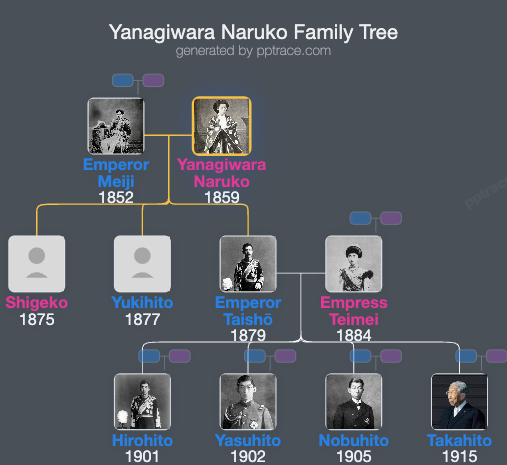
Family Tree
Tap  to expand more relatives
Introduction
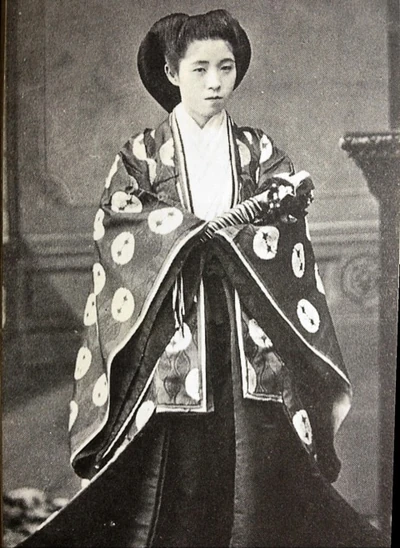
Yanagiwara Naruko (Japanese: 柳原愛子), also known by the court name Sawarabi no Tsubone, was born on June 26, 1855, in Kyoto. She was the second daughter of Yanagiwara Mitsunaru (1818–1885), an imperial chamberlain who held the rank of chūnagon and was later appointed dainagon in the imperial household. The Yanagiwara family belonged to the Reizei branch of the Fujiwara clan. Her elder brother was Count Yanagiwara Sakimitsu (1850–1894), a military and diplomatic figure who participated in the Boshin War on the imperial side, served as Lieutenant Governor of the Tōkaidō, Governor of Yamanashi Prefecture, and was involved in the drafting of the Imperial House Law. He was ennobled as a count and served as a privy councillor.
In 1870, Yanagiwara Naruko entered the imperial household as a lady-in-waiting to the Dowager Empress Eishō. She was appointed gon no tenji, or imperial concubine, on February 20, 1873. Both she and Emperor Meiji descended from the Ōgimachisanjō clan and shared a common ancestor, Ōgimachisanjō Sanetomo, making them third cousins.
On January 21, 1875, she gave birth to her first child, Shigeko, Princess Ume, at the Aoyama Palace. The princess died in 1876 of meningitis. She later gave birth to Yukihito, Prince Take, on September 23, 1877, who also died of meningitis before reaching one year of age in July 1878. Her third child, and the only one to survive into adulthood, was the future Emperor Taishō, born on August 31, 1879. The childbirth was difficult and, according to reports, caused her to become hysterical during delivery. The newborn was named Yoshihito and was later given the title Prince Haru.
Following her son's birth, Naruko experienced health issues related to the delivery. The infant contracted meningitis shortly after birth, but recovered in late December of 1879. Her health did not fully recover, and as a result, she did not serve as a physical concubine to the emperor again, although she retained her title. In 1902, she was officially appointed a lady-in-waiting to the imperial court.
Throughout her life, Yanagiwara Naruko was recognized for her intelligence and grace, and she was skilled in poetry and calligraphy. Despite her esteemed position, she was also noted to have a role in the health history of her son, Emperor Taishō, who suffered from increasingly poor mental health. She was granted several honors for her contributions to maintaining the imperial lineage, including the Grand Cordon of the Order of the Sacred Treasure in 1925, and the Grand Cordon of the Order of the Precious Crown in 1940. Her ranking within the court progressed from the fourth rank in 1892 to the first rank posthumously in October 1943.
In her later years, she was permitted to be present at her son's deathbed in December 1926. She outlived her son, Emperor Taishō, by nearly two decades, passing away on October 16, 1943, at the age of 84. At the time of her death, her grandson, Emperor Shōwa (Hirohito), reigned. She was buried in Nakameguro Yūtenji, located in Meguro-ku, Tokyo. Her descendants include her grandson, Prince Mikasa, through her great-grandniece, Takagi Yuriko, who married Prince Mikasa in 1941.