Nobuhito, Prince Takamatsu
| Name | Nobuhito, Prince Takamatsu |
| Title | Japanese prince; third son of Emperor Taishō and Empress Teimei |
| Gender | Male |
| Birthday | 1905-01-03 |
| nationality | Japan |
| Source | https://www.wikidata.org/wiki/Q1030368 |
| pptrace | View Family Tree |
| LastUpdate | 2025-11-17T06:48:28.118Z |
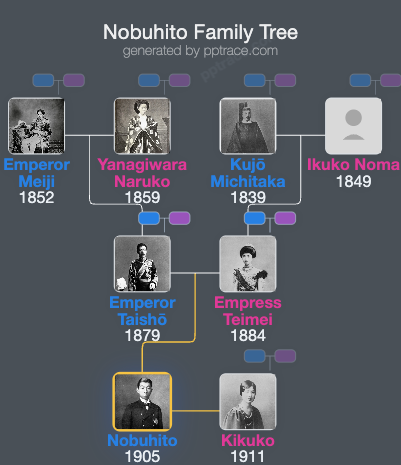
Family Tree
Tap  to expand more relatives
Introduction
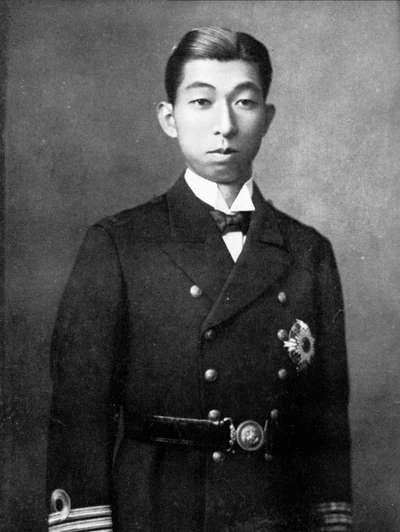
Nobuhito, Prince Takamatsu (高松宮宣仁親王, Takamatsu-no-miya Nobuhito Shinnō), was born on January 3, 1905, at the Aoyama Palace in Tokyo. He was the third son of Emperor Taishō (Yoshihito) and Empress Teimei (Sadako), and a younger brother of Emperor Shōwa (Hirohito). His childhood name was Teru-no-miya (Prince Teru).
Following the death of Prince Arisugawa Takehito in 1913, who had no male heir, Emperor Taishō designated Nobuhito to the collateral imperial house of Arisugawa-no-miya, which was later renamed Takamatsu-no-miya. He was a fourth cousin, four times removed, of Prince Takehito.
Prince Takamatsu received early education at the Gakushuin (Peers' School), attending both elementary and secondary programs. He was introduced into the Imperial Japanese Naval Academy in 1922, graduating in 1924. He was commissioned as an ensign on December 1, 1925, and served aboard the battleship Fusō. He studied at the Naval Torpedo School in 1926 and the Naval Aviation School at Kasumigaura in 1927. He also attended the Naval Gunnery School in Yokosuka from 1930 to 1931.
He was promoted to lieutenant in 1930 and assigned to the Imperial Japanese Navy General Staff. Subsequent ranks included lieutenant commander (promoted in 1935), commander (1940), and captain (1942). He commanded various naval units, such as the cruiser Takao and the Fusō, and held staff positions within the Naval General Staff from 1936 to 1945.
On February 4, 1930, he married Kikuko Tokugawa, born in 1911 and died in 2004. She was the second daughter of Yoshihisa Tokugawa, a granddaughter of the last shōgun Tokugawa Yoshinobu, and a granddaughter of Prince Takehito Arisugawa. The marriage was followed by a world tour through Europe and the United States aimed at fostering international goodwill. The couple had no children.
During the 1930s, Prince Takamatsu expressed reservations about Japan’s military aggressions in Manchuria and the broader Pacific War. After Japan’s defeat in World War II, he participated in efforts among aristocrats and officials to seek peace, including involvement with figures such as Prince Naruhiko Higashikuni and Prince Yasuhiko Asaka.
Following Japan's surrender, Prince Takamatsu occupied a largely ceremonial role and engaged in numerous philanthropic and cultural activities. He was the honorary president or patron of organizations including the Japan Fine Arts Society, the Denmark-Japan Society, the France-Japan Society, the Japan Basketball Association, and the Japanese Red Cross Society. He also contributed to the preservation of Japanese swords through the Nihon Bijutsu Token Hozon Kyokai (NBTHK). He served as the patron of the International Christian University (ICU) in Tokyo.
In 1970, Prince Takamatsu was the first member of the Japanese imperial family to visit South Korea after the end of Japanese colonial rule, attracting criticism when he planned to privately meet with vessels of the Maritime Self-Defense Force in 1973, leading to the cancellation of that visit.
He was known for his outgoing nature, often walking without guards and visiting social venues such as Ginza before the war, and engaging openly with the public after the war. In 1975, an interview published in Bungei Shunjū revealed that he had advised his brother, Emperor Shōwa, to seek peace after the Japanese naval defeat at Midway and that he had considered asking for the emperor’s abdication before Japan’s surrender. The interview highlighted perceived differences in wartime attitudes between the brothers.
Prince Takamatsu died from lung cancer on February 3, 1987, at the Japanese Red Cross Medical Center in Shibuya, Tokyo. His remains are interred at Toshimagaoka Cemetery in Bunkyō, Tokyo.
In 1991, his wife, Kikuko, along with an aide, discovered a twenty-volume diary written by Prince Takamatsu between 1921 and 1947. The diary was subsequently published in excerpts and in full from 1995 to 1997. It revealed his opposition to several military campaigns, including the Kwantung Army’s actions in Manchuria, and his warnings to Emperor Hirohito about Japan’s limited capacity for prolonged war against the United States.
Prince Takamatsu received numerous honors, including the Grand Cordon of the Order of the Chrysanthemum, the Order of the Rising Sun, and the Order of the Sacred Treasure from Japan. Foreign awards included the Grand Cordon of the Order of Leopold (Belgium), the Knight of the Royal Order of the Seraphim (Sweden), and the Collar of the Order of Charles III (Spain), among others.
He is associated with the Praemium Imperiale arts prize established in his memory.