Caroline Of Brunswick
| Name | Caroline Of Brunswick |
| Title | queen consort of King George IV of the United Kingdom (1768-1821) |
| Gender | Female |
| Birthday | 1768-05-17 |
| nationality | — |
| Source | https://www.wikidata.org/wiki/Q167433 |
| pptrace | View Family Tree |
| LastUpdate | 2025-11-12T01:16:15.585Z |
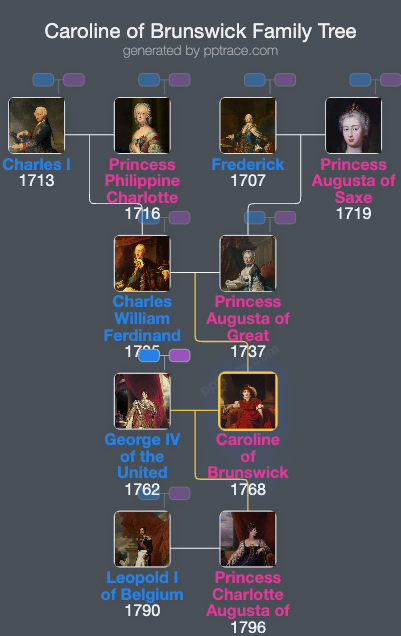
Family Tree
Tap  to expand more relatives
Introduction
Caroline of Brunswick-Wolfenbüttel (full name: Caroline Amelia Elizabeth), born on 17 May 1768 in Braunschweig (known in English as Brunswick), was a German princess and a member of the Brunswick family. She was the daughter of Charles William Ferdinand, Duke of Brunswick, and Princess Augusta of Great Britain, the elder sister of King George III. Caroline died on 7 August 1821 at Brandenburgh House in Hammersmith.
Her early life was characterized by limited family stability and education. Her mother resented her father's openly acknowledged infidelity, and Caroline was often kept isolated from social contact with the opposite sex, with strict supervision throughout her childhood. She was educated mainly in music by governesses, but her general education was limited. She understood English and French, but her father admitted she lacked formal education. From 1783 to 1791, Countess Eleonore von Münster was her governess, who favored her and tried to educate her in various subjects.
In 1794, Caroline was engaged to her first cousin, George, Prince of Wales, who later became King George IV. At the time of their engagement, they had never met; George was already in a clandestine marriage with Maria Fitzherbert. Caroline and George married on 8 April 1795 at the Chapel Royal, St. James's Palace, London. Their marriage was troubled from the outset; George regarded Caroline as unattractive and unhygienic, and their union produced a single child, Princess Charlotte, born on 7 January 1796. George's will shortly after her birth left her almost nothing, favoring his previous clandestine marriage with Maria Fitzherbert.
The marriage quickly became strained, and the couple separated in 1796. Caroline was well-liked by the public and considered a sympathetic figure, especially as George and his mistress Lady Jersey received public criticism. She resided separately from her husband, often hosting social gatherings and engaging in flirtations, and was rumored to have had various lovers, including Captain Thomas Manby and Admiral Sir Sidney Smith.
In 1806, a secret investigation known as the "Delicate Investigation" scrutinized claims that Caroline had been unfaithful and may have had an illegitimate child. The inquiry found no evidence to support allegations of adultery, although gossip persisted. During this period, Caroline adopted several children and was involved in social work, but her access to her daughter, Princess Charlotte, remained restricted. In 1814, she left Britain for Italy after negotiations with the government and political figures failed to resolve her status.
While in exile, Caroline traveled around the Mediterranean, visiting locations such as Elba, Sicily, and Jerusalem, often in the company of Bartolomeo Pergami, who became her confidant and household head. Rumors of an affair with Pergami circulated widely, though no conclusive proof was ever found. During her time abroad, she engaged in social activities and purchased properties, including Villa d'Este on Lake Como.
The death of her daughter, Princess Charlotte, in 1817 deeply affected Caroline. Her attempts to regain her position were met with opposition by her husband, who was intent on divorcing her. The government assembled evidence of alleged misconduct, leading to the introduction of the Pains and Penalties Bill in 1820, which sought to disqualify her from being queen and to dissolve her marriage. This culminated in a highly publicized trial, revealing personal details of her private life. Despite her unpopularity with the government, she remained popular with the public, who viewed her as a victim of political machinations.
In January 1820, George became king. Caroline returned to Britain to assert her rights but was excluded from her husband's coronation in July 1821, an event she attempted to attend but was prevented from entering Westminster Abbey. Following this, she fell ill and died three weeks later at the age of 53. Her funeral procession was marked by crowd unrest, and her body was ultimately taken to Brunswick for burial in Brunswick Cathedral.
Her legacy persisted as a symbol of resistance to royal authority and an advocate for reform. Caroline was buried in her native Brunswick, with a memorial inscription commemorating her as "the Injured Queen of England."