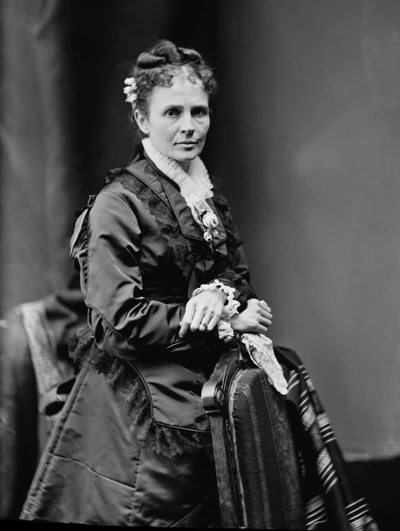
Lucretia Garfield
| Name | Lucretia Garfield |
| Title | First Lady of the United States from 1881 to 1881 |
| Gender | Female |
| Birthday | 1832-04-19 |
| nationality | United States of America |
| Source | https://www.wikidata.org/wiki/Q234261 |
| pptrace | View Family Tree |
| LastUpdate | 2025-11-17T06:40:56.663Z |
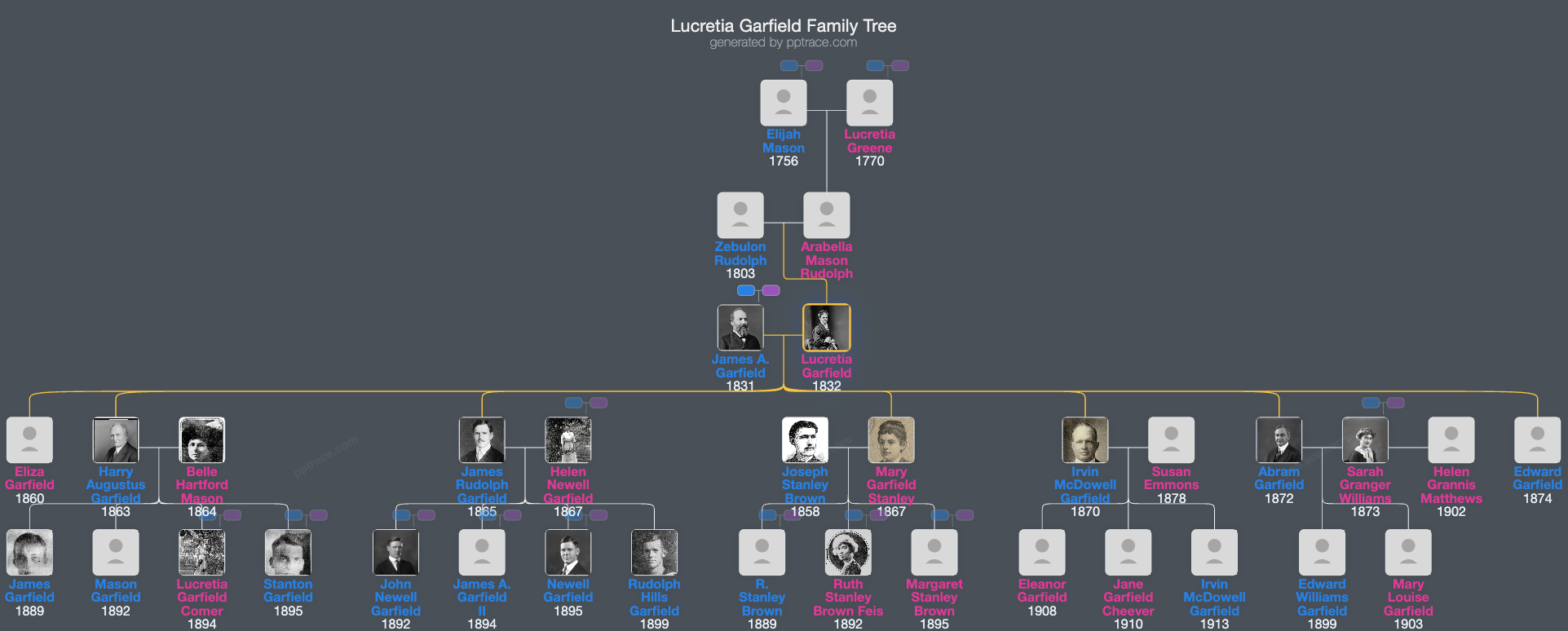
Family Tree
Tap  to expand more relatives
Introduction
Lucretia Garfield, née Rudolph, was born on April 19, 1832, in Garrettsville, Ohio. She was the daughter of Zebulon Rudolph, a carpenter, and Arabella Mason Rudolph. She was the oldest of four children and was raised as a member of the Disciples of Christ. During her childhood, she experienced frequent health issues, particularly respiratory ailments, resulting in extended periods of bedrest. Her family was characterized by reserved manners and limited displays of affection. Rudolph acquired household skills such as cleaning and cooking from her mother and also received formal education, including attendance at her town's grammar school and later at Geauga Seminary in Chester Township, Ohio.
Rudolph and James A. Garfield met at Geauga Seminary, which her father co-founded, in 1850. Rudolph showed an interest in literature, founding a literary group and contributing to a school magazine. Garfield, who also attended the seminary and briefly served as a teacher there, was notably impressed by her intelligence. Their correspondence began in November 1853, and they agreed to marry in early 1854. Rudolph initially believed women should have independent achievements and equal pay, although she later altered these views.
In 1858, Rudolph and Garfield married at her family home on November 11. Prior to marriage, both harbored reservations about the union, feeling societal pressure to marry and concerns over personal independence. Following their wedding, they moved into a boarding house, and Rudolph continued her career as a teacher. James Garfield's career was marked by his work as a preacher, a state legislator, and eventually as a Union Army officer during the American Civil War. During their early marriage, periods of separation were frequent, totaling less than 20 weeks together over five years, and Garfield expressed regrets about their distance. Rudolph managed her own social life and traveled independently during this period, and the couple's relationship was strained.
With the outbreak of the Civil War, Garfield served in the Union Army, and Rudolph returned to her parents' home in Ohio. After her husband's illness and temporary return from service, they moved to a farmhouse in Howland Springs, Ohio, which is often described as a brief "honeymoon" period in their marriage. They experienced further distance when Garfield rejoined the military, during which time he sought romantic interests elsewhere, including Lucia Calhoun and Kate Chase. Rudolph gave birth to their second child, Harry, in 1863, suffering the loss of their firstborn, who died of diphtheria two months after birth.
Following the death of their child, James Garfield was elected to the U.S. House of Representatives. Rudolph remained in Ohio and experienced emotional distress from her husband's extramarital affairs, which included romantic correspondence with Lucia Calhoun. To repair their relationship, James traveled to Washington, D.C., to meet his wife, and their marriage gradually improved. During this period, Rudolph bore three more children: James (born 1865), Mary (born 1867), Irvin (born 1870), Abram (born 1872), and Edward (born 1874). Their youngest son died in 1876. The same year, the Garfields purchased a farm in Ohio, and in 1869, they moved permanently to Washington, D.C., where they built a home—their first owned residence—to live together for an extended period. They also maintained a summer home in Ohio.
Rudolph and Garfield had a total of seven children, five of whom survived to adulthood. She was involved in advising her husband during his political career and attended congressional sessions to observe his speeches. She held progressive beliefs about women's capabilities but generally adhered to traditional domestic expectations.
In the 1880 presidential election, Garfield was initially seen as a compromise candidate; he was the first presidential candidate to appear on a campaign poster. Rudolph became a close advisor during his campaign, notably advocating for the inclusion of specific cabinet members and cautioning against certain political factions. After Garfield's election, Rudolph supported her husband through the presidential transition, arriving in Washington in March 1881 to prepare for his inauguration.
James A. Garfield was inaugurated as the 20th president of the United States in March 1881. Rudolph served briefly as the First Lady, actively participating in White House duties before contracting malaria. She traveled to Long Branch, New Jersey, for recovery. On July 2, 1881, President Garfield was shot by Charles J. Guiteau and succumbed to infections related to his wounds two months later, on September 19, 1881. During his illness, Rudolph remained at his bedside, receiving public sympathy. Following her husband's death, she returned to Ohio and dedicated much of her subsequent years to preserving his papers and establishing what was effectively the first presidential library. Rudolph passed away on March 13, 1918.