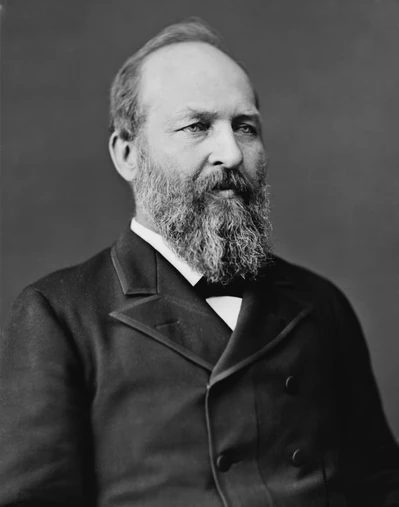
James A. Garfield
| Name | James A. Garfield |
| Title | president of the United States in 1881 |
| Gender | Male |
| Birthday | 1831-11-19 |
| nationality | United States of America |
| Source | https://www.wikidata.org/wiki/Q34597 |
| pptrace | View Family Tree |
| LastUpdate | 2025-11-17T06:40:50.968Z |
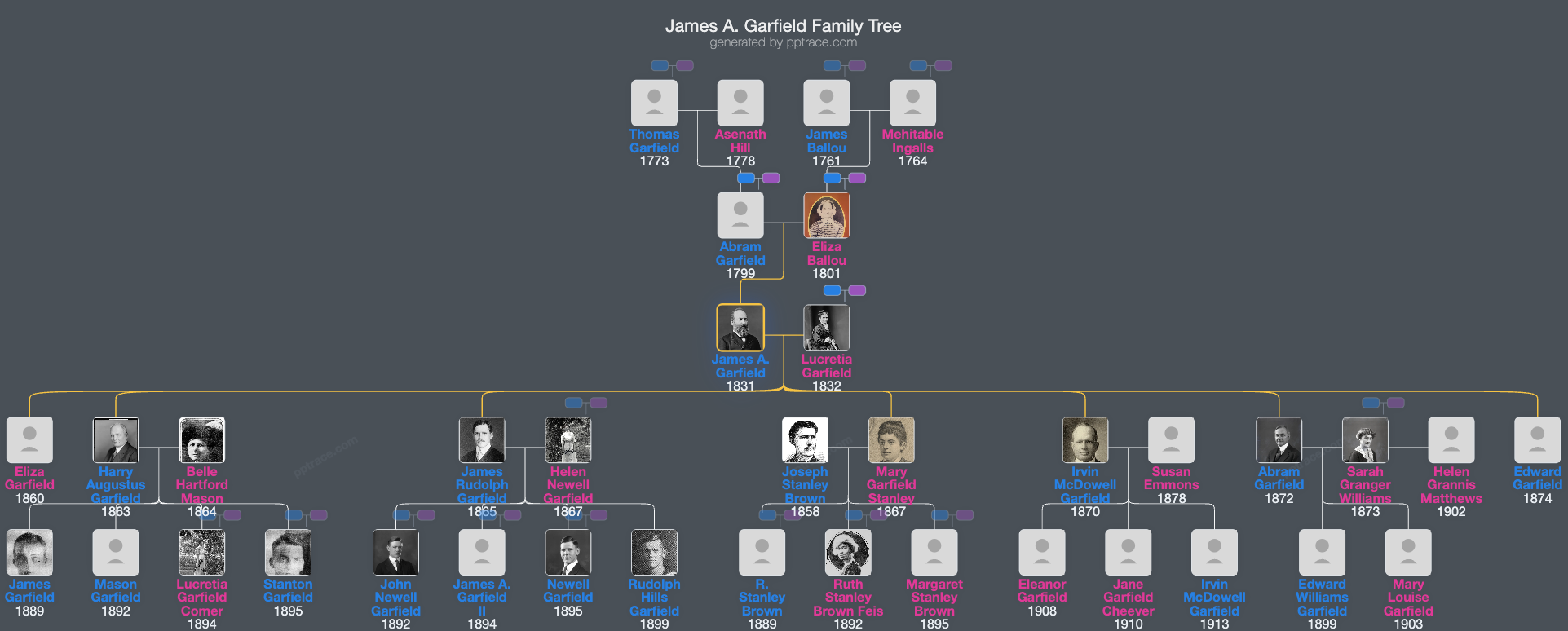
Family Tree
Tap  to expand more relatives
Introduction
James Abram Garfield was born on November 19, 1831, in a log cabin in Orange Township, now known as Moreland Hills, Ohio. He was the youngest of five children in his family. His paternal ancestor, Edward Garfield, migrated from Hillmorton, Warwickshire, England, to Massachusetts around 1630. Garfield's father, Abram Garfield, was born in Worcester, New York, and moved to Ohio to pursue his romantic interests. He married Eliza Ballou, Eliza's sister, after initially seeking Eliza herself. James was named after an earlier son of Eliza and Abram who had died in infancy.
In early 1833, Abram and Eliza Garfield joined a Stone-Campbell church, which influenced James’s early religious upbringing. Abram Garfield died later that year, leaving the family in poverty. His mother, Eliza, remarried in 1842 but was later divorced in 1850; Garfield sided with his mother in the family's disputes. The family faced social stigma due to the divorce, and Garfield endured mockery from peers during his childhood. He was particularly sensitive to slights and sought solace in reading.
Garfield left home at the age of 16 in 1847. He initially found work managing mules on a canal boat but fell ill after six weeks. During his recuperation, his mother and a local school official encouraged him to pursue education, sparking his interest in schooling. In 1848, Garfield began attending Geauga Seminary in Chester Township, Ohio, where he excelled in languages and elocution. At Geauga Seminary, he was attracted to his classmate Lucretia Rudolph, whom he later married.
To support himself, Garfield worked as a carpenter’s assistant and teacher. His experiences with teaching and his dislike of “place-seeking” motivated him to pursue further education. He underwent a religious awakening in his late teens, being baptized into Christ on March 4, 1850.
Garfield later attended the Western Reserve Eclectic Institute (later Hiram College) in Hiram, Ohio, from 1851 to 1854. While there, he studied Greek and Latin, worked as a janitor, and earned a teaching position. During this period, he continued his religious activities through preaching. In 1854, Garfield transferred to Williams College in Massachusetts, where he entered as a third-year student and graduated Phi Beta Kappa in August 1856. He was named salutatorian and delivered the commencement address.
After graduating from Williams College, Garfield taught penmanship in Pownal, Vermont, and continued to pursue his higher education. His years at Williams broadened his social understanding and established his reputation as a well-rounded scholar. His early career also included work in law and teaching, establishing a foundation for his later political and military roles.
Garfield entered political life as a member of the Ohio State Senate in 1859, serving until 1861. He was elected to the U.S. House of Representatives in 1862, representing Ohio’s 19th district, and served nine terms. He served as a major general in the Union Army during the American Civil War and participated in battles such as Middle Creek, Shiloh, and Chickamauga.
In 1880, Garfield was chosen as the Republican candidate for president at the party’s national convention, largely as a compromise candidate. He was elected president in the 1880 election, narrowly defeating Democrat Winfield Scott Hancock. His presidency commenced in March 1881 but was cut short when he was shot by Charles J. Guiteau on July 2, 1881. Garfield died from infections related to his gunshot wounds on September 19, 1881.