Harry Augustus Garfield
| Name | Harry Augustus Garfield |
| Title | American lawyer and academic (1863-1942) |
| Gender | Male |
| Birthday | 1863-10-11 |
| nationality | United States of America |
| Source | https://www.wikidata.org/wiki/Q591629 |
| pptrace | View Family Tree |
| LastUpdate | 2025-11-17T06:40:51.876Z |
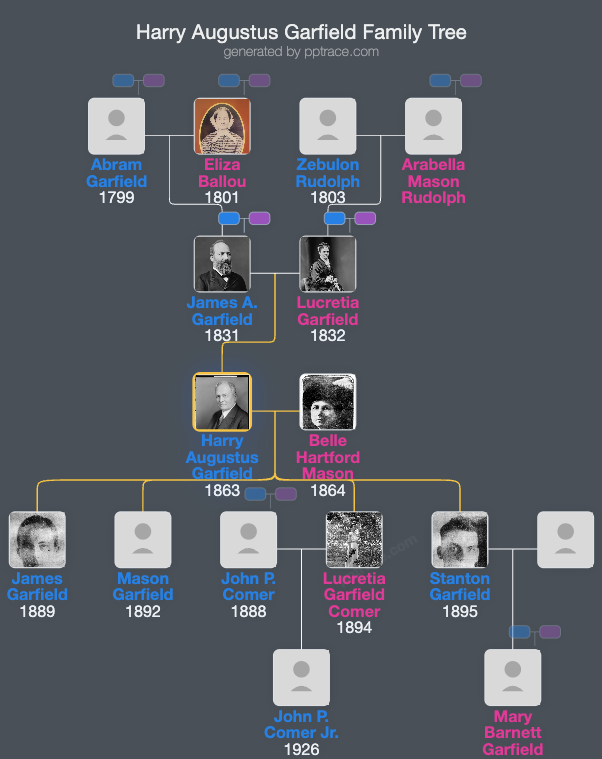
Family Tree
Tap  to expand more relatives
Introduction
Harry Augustus "Hal" Garfield was born on October 11, 1863, in Hiram, Ohio. He was the son of James A. Garfield, who later became the 20th President of the United States, and Lucretia Garfield. In May 1864, his mother named him, influenced by two friends of James Garfield, and he received the nickname "Hal." His early education included attendance at public schools, a private academy, and homeschooling. The Garfield family relocated in 1876 to what is now the James A. Garfield National Historic Site in Mentor, Ohio. In 1879, he enrolled at St. Paul's School in Concord, New Hampshire. During his final year there, he relocated to Washington, D.C., and was taught by a private tutor at the White House.
At age 17, Garfield witnessed the assassination of his father by Charles Guiteau; his father died two months later from infections related to the gunshot wounds. Garfield graduated from Williams College in 1885 with a Bachelor of Arts degree, where he was a member of the fraternity Alpha Delta Phi. He pursued legal studies at Columbia Law School, with additional study years spent at All Souls College in Oxford and the Inns of Court in London.
After graduation, Garfield taught Roman history and Latin at St. Paul's School for one year. His professional career included practicing law with his brother James in Cleveland from 1888 to 1895, under the firm Garfield, Garfield & Howe. He served as a professor of contracts at Western Reserve Law School from 1891 to 1897 and helped establish and lead the Cleveland Municipal Association in 1896, serving as its first president. He was also president of the Cleveland Chamber of Commerce from 1898 to 1899.
From 1900 to 1906, Garfield managed a railroad syndicate in Ohio. Concurrently, he was a professor of politics at Princeton University from 1903 until 1908, during which time he befriended Woodrow Wilson. In 1908, he was appointed the eighth president of Williams College, his alma mater.
During World War I, Herbert Hoover, then head of the U.S. Food Administration, appointed Garfield as chairman of the price-fixing committee for the Food Administration. He also contributed to the War Industries Board’s price regulation efforts. In August 1917, President Woodrow Wilson appointed him head of the United States Fuel Administration. His task was to conserve coal supplies and regulate prices amid wartime shortages.
Garfield's administration faced challenges, notably a severe winter causing coal shortages, which led to criticism. An investigation revealed that railroad failures contributed significantly to the shortage, resulting in the federal control of railroads on December 28, 1917. Garfield issued the "idle Mondays" order in January 1918, which mandated the closure of non-essential industries for five consecutive days each week until March 25, 1918. The order was suspended in February 1918 after protests from manufacturers.
He disapproved of the resolution of the coal strike in December 1919 and resigned his position, returning to his role as president of Williams College. After the war, he contributed to the institution, notably helping establish the Institute of Politics. He served as president of Williams College until his retirement in June 1934.
Garfield also served as president of the American Political Science Association from 1921 to 1922. In 1935, he studied international issues while living in Washington, D.C. Later, in 1941, he was appointed to the War Department Defense Board to analyze applications of the Excess Profits Law during World War II.
On June 14, 1888, Garfield married Belle Hartford Mason, his second cousin, in a double wedding with his sister Mollie. They had four children: James, Mason, Lucretia, and Stanton. Following his retirement, he traveled around the world with his wife for a year, then moved to Washington, D.C., in 1935. Garfield was a hereditary companion of the Ohio Commandery of the Military Order of the Loyal Legion of the United States, through his father’s service in the Union Army.
Harry Augustus Garfield died on December 12, 1942, at his home in Williamstown, Massachusetts. He was interred at Williams College in the faculty cemetery. His contributions earned him the Distinguished Service Medal in 1921, awarded by Secretary of War Newton D. Baker. He received honorary degrees from several institutions, including Dartmouth, Princeton, Amherst, Wesleyan, William and Mary, and Whitman College.
His published works include "America’s Coal Problem" (1918), "The Fuel Situation at the Beginning of Winter 1918–19" (1918), "Recent Political Developments, Progress or Change?" (1924), and "Lost Visions" (1944).