Abram Garfield
| Name | Abram Garfield |
| Title | American architect (1872-1958) |
| Gender | Male |
| Birthday | 1872-11-21 |
| nationality | United States of America |
| Source | https://www.wikidata.org/wiki/Q4669355 |
| pptrace | View Family Tree |
| LastUpdate | 2025-11-17T06:40:52.736Z |
Family Tree
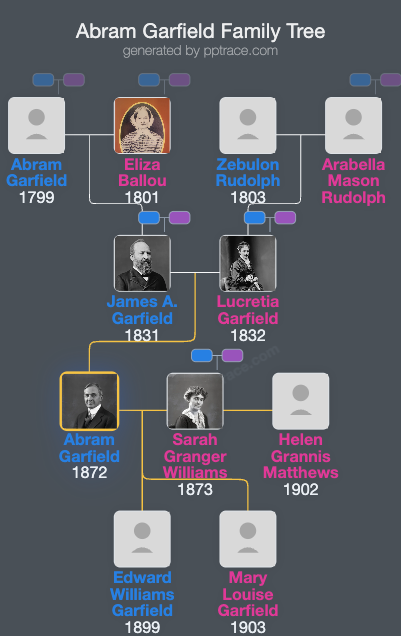
Tap  to expand more relatives
Introduction
Abram Garfield (November 21, 1872 – October 16, 1958) was an American architect based in Cleveland, Ohio. He was born in Washington D.C. and was the sixth son of James A. Garfield, the 20th President of the United States, and Lucretia Rudolph Garfield. In 1876, his family moved to the area now designated as the James A. Garfield National Historic Site in Mentor, Ohio.
Garfield obtained a Bachelor of Arts degree from Williams College in Williamstown, Massachusetts, in 1893. He further pursued education in architecture, earning a Bachelor of Science degree from the Massachusetts Institute of Technology in Cambridge, Massachusetts, in 1896.
His professional career began in 1897 when he started working as an architect. In 1898, he co-founded the firm Meade & Garfield with Frank Meade in Cleveland, Ohio. This firm was recognized for its residential design work. Following the dissolution of the partnership in 1905, Garfield established his own architectural practice. In 1926, he co-founded a new firm alongside Rudolph Stanley-Brown, George R. Harris, and Alexander Robinson. This firm was renamed Garfield, Harris, Robinson and Schafer in 1935, a name it maintained until Garfield's death in 1958. The firm underwent further changes and was known as Westlake, Reed, Leskosky Architects until its acquisition by DLR Group in 2016.
Garfield's architectural work primarily focused on residential designs, notably large houses in Cleveland suburbs such as Shaker Heights. His portfolio also included smaller residences for the Cleveland Metropolitan Housing Authority, as well as institutional buildings like schools and hospitals. Several of his works have been listed on the National Register of Historic Places.
In addition to his practice, Garfield served as chairman of the Cleveland Planning Commission from 1930 to 1942. He was a founding member and the first president of the Cleveland School of Architecture, which became part of Western Reserve University in 1941. He was appointed a trustee of the university that same year and was granted an honorary lifetime board membership in 1943. The university awarded him an honorary doctorate in 1945.
His professional affiliations included serving as a director of the American Institute of Architects from 1919 to 1922 and participating in the U.S. Commission of Fine Arts from 1925 to 1930, where he served as vice chairman from 1929 to 1930. In 1949, he was elected as an Associate Academician of the National Academy of Design.
Garfield resided in Bratenahl, Ohio. He married Sarah Grainger Williams, with whom he had two children, Edward W. and Mrs. William R. Hallaran. Following her death, he married Helen Matthews. He passed away at his residence in Cleveland on October 16, 1958, and was buried at Lake View Cemetery in Cleveland.
Notable works designed by Abram Garfield include the W. H. Warner House (1898) in Cleveland Heights, Ohio; the Jerome Zerbe-Samuel Halle House (1905) in Cleveland Heights; the Mather House at Case Western Reserve University (1913–1915); Casa Apava in Palm Beach, Florida (built 1918); the Elizabeth B. and Dudley S. Blossom Estate Service Compound in Lyndhurst, Ohio; the Faxon-Thomas Mansion, now the Hunter Museum of American Art, in Chattanooga, Tennessee; the Garfield Library in Mentor, Ohio; The Hangar in Beachwood, Ohio; the College Club of Cleveland/Alexander House in Cleveland Heights; as well as the Hay-McKinney and Bingham-Hanna House, the Jared A. Smith House, and the John G. Oliver House in Ohio. His design work extended to institutions like Leonard Hall at Kenyon College and Pebble Hill Plantation near Thomasville, Georgia, all of which are listed on the National Register of Historic Places.