James Rudolph Garfield
| Name | James Rudolph Garfield |
| Title | American lawyer and politician (1865–1950) |
| Gender | Male |
| Birthday | 1865-10-17 |
| nationality | United States of America |
| Source | https://www.wikidata.org/wiki/Q935721 |
| pptrace | View Family Tree |
| LastUpdate | 2025-11-17T06:40:54.292Z |
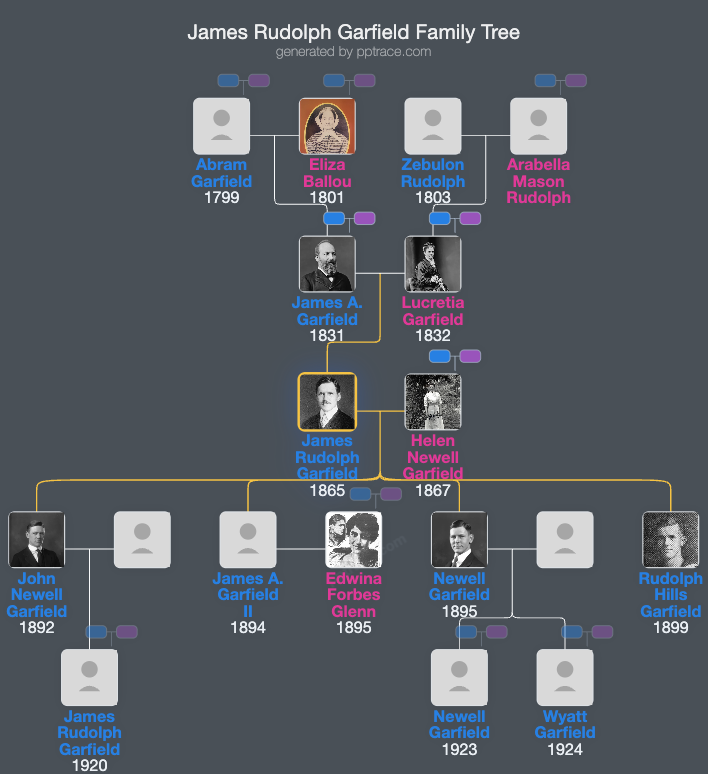
Family Tree
Tap  to expand more relatives
Introduction
James Rudolph Garfield was born on October 17, 1865, in Hiram, Ohio. He was the third of seven children born to James Abram Garfield, who later became the 20th President of the United States, and Lucretia Rudolph Garfield. In 1876, his family relocated to what is now the James A. Garfield National Historic Site in Mentor, Ohio.
Garfield attended St. Paul's School in Concord, New Hampshire, for a year before his father became president. On July 2, 1881, at the age of 15, he and his brother Harry Augustus Garfield, then 17, witnessed the assassination of President James A. Garfield at the Baltimore and Potomac railroad station in Washington, D.C. The incident occurred while they were waiting for a train to Williams College in Massachusetts, where Garfield had recently been accepted. The President died from infections related to his wounds two months after the shooting.
After his father's death on September 19, 1881, Garfield enrolled at Williams College, earning an A.B. degree in 1885. He subsequently attended Columbia Law School. In 1888, he was admitted to the Ohio bar and co-founded the law firm Garfield and Garfield in Cleveland, Ohio, with his brother Harry Augustus Garfield.
Garfield was married to Helen Newell in 1890. The couple had four sons: John, James, Newell, and Rudolph. His grandson, Newell Garfield, married Jane Harrison Walker, a granddaughter of President Benjamin Harrison and of Harrison’s second wife, Mary Dimmick Harrison; this granddaughter was also a great-grandniece of James G. Blaine.
Garfield's political career included service in the Ohio State Senate from 1896 to 1899. He was an advisor to President Theodore Roosevelt and held several federal positions. From April 24, 1902, to February 25, 1903, he served as a member of the United States Civil Service Commission, alongside John Robert Procter and William Dudley Foulke. From 1903 to 1907, he was the Commissioner of Corporations in the Department of Commerce and Labor, where he investigated various industries including meat-packing, petroleum, steel, and railroads.
He served as the Secretary of the Interior from 1907 to 1909 under President Theodore Roosevelt. During his tenure, he promoted the conservation of natural resources but authorized the damming of the Hetch Hetchy Valley in Yosemite National Park, a decision that remains controversial. On March 4, 1909, he left this position and resumed his law practice in Cleveland. In 1909, Garfield received an honorary LL.D. degree from the University of Pittsburgh.
Garfield was a potential candidate for Ohio governor in 1910 but withdrew when the Republican convention endorsed William Howard Taft. He was a supporter of Theodore Roosevelt's 1912 presidential bid and ran unsuccessfully for governor of Ohio on the Progressive Party ticket in 1914.
During World War I, Garfield was chosen by Theodore Roosevelt to help raise volunteer infantry divisions for service in France in 1917. These units, known as Roosevelt's World War I volunteers, were disbanded without seeing combat due to opposition from President Woodrow Wilson.
James Rudolph Garfield died in Cleveland, Ohio, on March 24, 1950, at the age of 84. At the time of his death, he was the last surviving member of President Theodore Roosevelt's cabinet. He outlived his father by approximately 68 and a half years and was interred beside his wife Helen in Mentor Municipal Cemetery, Mentor, Ohio.