Eliza Garfield
| Name | Eliza Garfield |
| Title | daughter of James Garfield (1860-1863) |
| Gender | Female |
| Birthday | 1860-07-03 |
| nationality | United States of America |
| Source | https://www.wikidata.org/wiki/Q5362138 |
| pptrace | View Family Tree |
| LastUpdate | 2025-11-16T10:16:20.628Z |
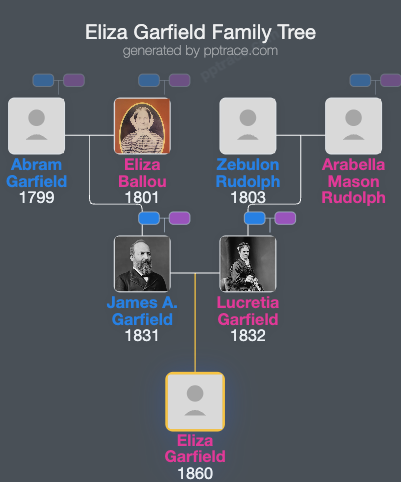
Family Tree
Tap  to expand more relatives
Introduction
James Abram Garfield was born on November 19, 1831, in a log cabin in Orange Township, which is now known as Moreland Hills, Ohio. His paternal ancestors, including Edward Garfield, migrated from Hillmorton, Warwickshire, England, to Massachusetts around 1630. Garfield's father, Abram Garfield, was born in Worcester, New York, and moved to Ohio to pursue a romantic interest, but he ultimately married Eliza Ballou, her sister. James was the youngest of five children, and his mother, Eliza, played a significant role in his upbringing following the death of his father in 1833.
Garfield's early life was marked by poverty and hardship. He was raised in a household led by his mother, who was characterized as strong-willed. The family joined a Stone-Campbell church in 1833, an affiliation that influenced Garfield's religious development. His childhood was also shaped by financial struggles, and he faced social mockery and emotional sensitivity as a result of his impoverished and fatherless background. Garfield was particularly interested in reading and sought to escape his circumstances through education.
At age 16, in 1847, Garfield left home to work on a canal boat in Ohio, managing mules that pulled the vessel. His health issues compelled him to return home, where his mother and a local school official encouraged him to pursue formal schooling. He entered Geauga Seminary in Chester Township, Ohio, in 1848, excelling in academics, especially languages and elocution. During this period, Garfield became engaged to Lucretia Rudolph, whom he later married.
After completing his studies at Geauga Seminary in 1850, Garfield worked as a teacher and carpenter's assistant while developing an interest in religion, experiencing a religious awakening in his late teens. He was baptized into the Christian faith on March 4, 1850. He then sought higher education and attended the Western Reserve Eclectic Institute (later Hiram College) from 1851 to 1854, where he studied Greek and Latin and worked as a janitor and teacher to support himself.
In 1854, Garfield enrolled at Williams College in Massachusetts as a third-year student, having received credits from his previous studies. He graduated in August 1856, Phi Beta Kappa and as salutatorian. His years at Williams exposed him to diverse social backgrounds and broadened his perspectives.
Following graduation, Garfield taught penmanship in Vermont and pursued further studies. He also became involved in religious activities, preaching at churches and earning small sums for his sermons. With aspirations for a professional career, Garfield studied law and was admitted to the bar, becoming an attorney.
In terms of political career, Garfield was elected to the Ohio State Senate as a Republican in 1859 and served until 1861. During the American Civil War, he served as a Major General in the Union Army, participating in battles such as Middle Creek, Shiloh, and Chickamauga. He was elected to the U.S. House of Representatives in 1862 for Ohio’s 19th district, serving nine terms and establishing a reputation as a skilled orator.
Garfield initially aligned with Radical Republicans on Reconstruction but later adopted a more moderate stance on civil rights for freedmen. He supported the gold standard and was an advocate for civil service reform. In 1880, indirectly sought the presidency and was chosen as the Republican nomination on the 36th ballot at the convention. He won the 1880 presidential election, defeating Democrat Winfield Scott Hancock.
Garfield's presidency, beginning in March 1881, was brief. His notable actions included asserting presidential authority, combatting postal corruption, and proposing reforms, notably the Pendleton Civil Service Reform Act. He was affiliated with the "Half-Breed" faction of the Republican Party, which opposed the "Stalwart" faction led by Senator Roscoe Conkling.
On July 2, 1881, Garfield was shot by Charles J. Guiteau, an office-seeker with delusions. He died on September 19, 1881, due to infection resulting from the surgical treatment of his wound. His presidency lasted only a few months, and due to limited significant achievements during his term, historians often rank him as a below-average president, although some acknowledge his anti-corruption efforts.