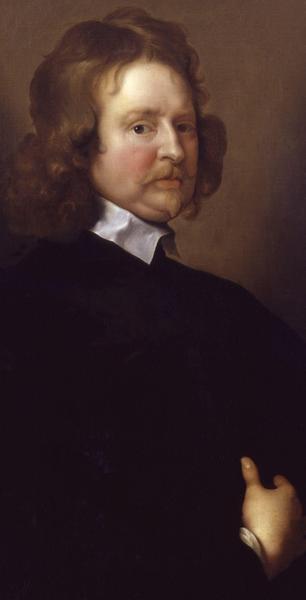
Edward Hyde, 1st Earl Of Clarendon
| Name | Edward Hyde, 1st Earl Of Clarendon |
| Title | English politician and historian (1609–1674) |
| Gender | Male |
| Birthday | 1609-02-18 |
| nationality | Kingdom of England |
| Source | https://www.wikidata.org/wiki/Q335173 |
| pptrace | View Family Tree |
| LastUpdate | 2025-11-12T01:14:16.614Z |
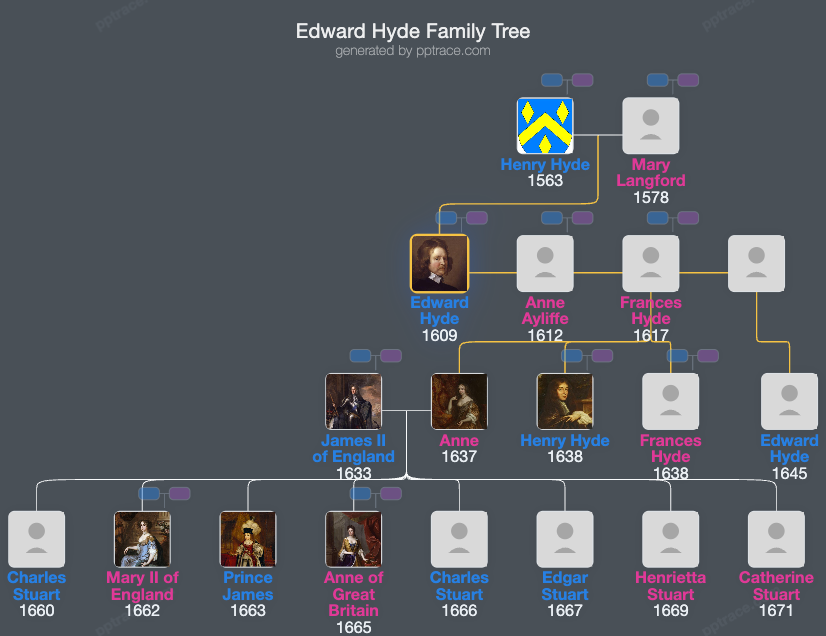
Family Tree
Tap  to expand more relatives
Introduction
Edward Hyde, 1st Earl of Clarendon, was born on 18 February 1609 in Dinton, Wiltshire. He was the sixth of nine children of Henry Hyde and Mary Langford. His father and uncles were involved in the legal profession; notably, Nicholas Hyde became Lord Chief Justice, and Lawrence Hyde served as a legal advisor to Anne of Denmark, wife of James I. Hyde was educated at Gillingham School and was admitted to Hertford College, Oxford (then known as Magdalen Hall) in 1622, graduating in 1626. Originally intended for a career in the Church of England, the death of his elder brothers made him his father’s heir, leading him to study law at the Middle Temple.
Hyde married twice; firstly in 1629 to Anne Ayliffe, who died six months later from smallpox, and secondly in 1634 to Frances Aylesbury. He had six children who survived infancy: Henry (1638–1709), Laurence (1642–1711), Edward (1645–1665), James (1650–1681), Anne (1637–1671), and Frances, who married Thomas Keightley. His daughter Anne became the mother of two queens, Mary II and Anne.
Hyde’s early career was marked by association with prominent intellectuals, including Ben Jonson, John Selden, and Lord Falkland, with whom he was connected through the Great Tew Circle—a gathering of thinkers at Lord Falkland’s country estate. He was called to the bar on 22 November 1633 and quickly established a reputable legal practice. In December 1634, he was appointed keeper of the writs and rolls of the Court of Common Pleas. His performance in legal matters earned him the friendship of Archbishop William Laud, although Laud’s religious and political views differed from Hyde’s.
Hyde entered Parliament in April 1640, elected as a Member for Wootton Bassett in the Short Parliament and for Saltash in the Long Parliament. Initially a moderate critic of King Charles I, he gradually shifted toward royalist sympathies, opposing parliamentary legislation that restricted the king's prerogative and defending the Anglican Church against Puritan reforms. By 1641, Hyde was an informal adviser to Charles I. As tensions escalated, he left London in May 1642 to rejoin the king at York. He was knighted and appointed to the Privy Council in 1643, and in 1644, he became Chancellor of the Exchequer. During this period, he contributed to the Royalist war effort and the governance of the West Country, serving on the governing council of Charles's son, the future Charles II.
Following the collapse of Royalist resistance and the surrender of the king’s forces in 1646, Hyde went into exile with Charles II, who was considered king-in-exile from 1649. He abstained from participation in the later Civil Wars to avoid alliances with Scots Covenanters and Irish Catholics, serving as a diplomat in Paris and Madrid during the Interregnum. During this period, he authored *The History of the Rebellion*, which initially aimed to defend Charles I but was later revised to include more critical assessments of his contemporaries.
After the monarchy's restoration in 1660, Hyde returned to England. Charles II appointed him Lord Chancellor and raised him to the peerage as Baron Hyde, of Hindon, in 1660. Later, he was created Viscount Cornbury and Earl of Clarendon in 1661. His daughter Anne’s marriage to the Duke of York (later James II) linked him to the royal family, making him the grandfather of Queens Mary II and Anne.
As Lord Chancellor from 1660 to 1667, Clarendon played a pivotal role in consolidating the restored monarchy's policies. He was involved in key events such as Charles II’s marriage to Catherine of Braganza and the drafting of the so-called "Clarendon Code," though he reportedly disapproved of much of its content. He also received land grants in North America, including parts of the Province of Carolina.
His political influence waned due to health issues and the military failures of the Second Anglo-Dutch War (1665–1667), including the devastating raid on the Medway in 1667. His opposition to war and other policies made him unpopular, and he was increasingly at odds with the king and court factions. Following his impeachment and accusations of corruption, he was forced into exile in France in November 1667. During his exile, he continued to work on his historical writings, notably expanding *The History of the Rebellion*, which remains a significant account of the English Civil War period. He also authored his autobiography, essays, and a critique of Thomas Hobbes's *Leviathan*.
Hyde suffered from gout and health problems during his exile. He was assaulted by English sailors in Évreux in 1668 but survived and continued his work and correspondence. He died in Rouen, France, on 9 December 1674. His remains were later transported to England, and he was buried privately in Westminster Abbey on 4 January 1675. His writings, especially his historical works, remain notable contributions to the historiography of 17th-century England.