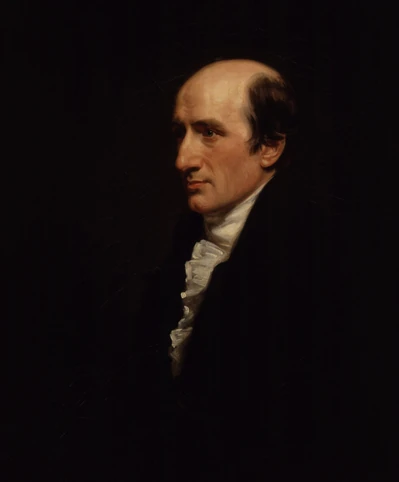
Charles Stanhope, 3rd Earl Stanhope
| Name | Charles Stanhope, 3rd Earl Stanhope |
| Title | British scientist (1753-1816) |
| Gender | Male |
| Birthday | 1753-08-03 |
| nationality | Great Britain |
| Source | https://www.wikidata.org/wiki/Q334067 |
| pptrace | View Family Tree |
| LastUpdate | 2025-11-26T23:24:08.747Z |
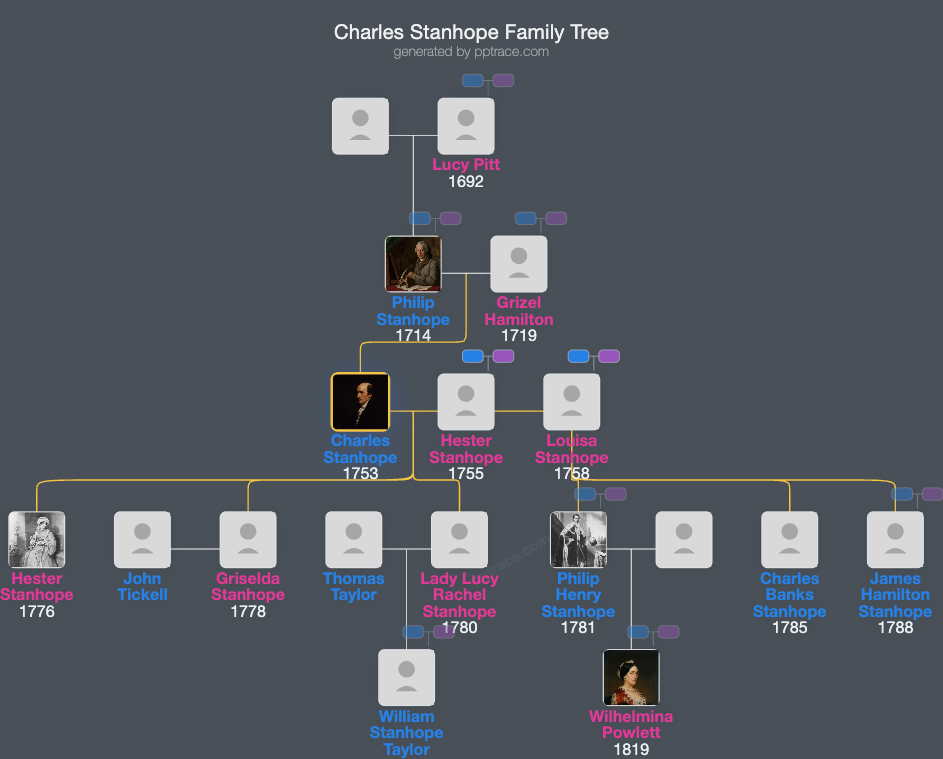
Family Tree
Tap  to expand more relatives
Introduction
Charles Stanhope, 3rd Earl Stanhope, born Charles Mahon on August 3, 1753, and deceased December 15, 1816, was a British statesman, inventor, and scientist. He was the son of Philip Stanhope, 2nd Earl Stanhope. Stanhope was educated at Eton College and the University of Geneva, where he studied mathematics under Georges-Louis Le Sage. During his time in Geneva, he developed an interest in the study of mathematics and an appreciation for liberty.
In his political career, Stanhope held democratic views. He unsuccessfully contested the Westminster constituency in 1774, although he was just of age at the time. From the general election of 1780 until he inherited the earldom on March 7, 1786, he represented the Buckinghamshire borough of High Wycombe, influenced by Lord Shelburne. During the sessions of 1783 and 1784, he supported William Pitt the Younger. Stanhope married Lady Hester Pitt, daughter of William Pitt, 1st Earl of Chatham, on December 19, 1774. His political alliances shifted when Pitt diverged from the liberal principles of his early career; Stanhope then opposed certain government measures, including those perceived as arbitrary.
Stanhope was a founding member of the "Revolution Society," established in honor of the Glorious Revolution of 1688. In 1790, the society expressed sympathy with the aims of the French Revolution. In 1794, Stanhope supported Thomas Muir, an Edinburgh politician transported to Botany Bay, and in 1795, he introduced a motion in the House of Lords opposing interference in France’s internal affairs. This stance led to his being characterized as a "minority of one," and he subsequently withdrew from parliamentary activity for five years.
As a scientist, Stanhope conducted extensive experiments in science and philosophy. He studied electricity, publishing "Principles of Electricity" in 1779, which laid foundational ideas about the "return stroke" in lightning. His scientific pursuits earned him election as a fellow of the Royal Society in November 1772. His inventions include a method for fireproofing buildings (which proved impractical), the first iron printing press, a process for creating plaster molds and metal printing plates (stereotype matrices), and a lens design. He also designed a monochord for tuning musical instruments, made improvements to canal lock systems, and conducted experiments in steam navigation between 1795 and 1797. Additionally, he devised two calculating machines in 1775. He was also a member of the American Philosophical Society, elected in 1774, and the American Antiquarian Society, elected in 1816.
Stanhope's property acquisitions in Devon inspired him to project a canal connecting the Bristol Channel and the English Channel, which he personally surveyed. He authored literary works including a reply to Edmund Burke’s "Reflections on the French Revolution" (1790) and an "Essay on the rights of juries" (1792). He had plans to compile a digest of statutes.
He married twice. His first marriage was on December 19, 1774, to Lady Hester Pitt; they had three daughters: Lady Hester Lucy Stanhope (a traveler and Arabist), Lady Griselda Stanhope, and Lady Lucy Rachel Stanhope. Lady Hester Pitt died in 1780. His second marriage was in 1781 to Louisa Grenville, daughter of the Hon. Henry Grenville. They had three sons: Philip Henry Stanhope, who became the 4th Earl Stanhope; Major Hon. Charles Banks Stanhope, who was killed at the Battle of Corunna; and Lt. Col. Hon. James Hamilton Stanhope.
Charles Stanhope died at Chevening, Kent, and was succeeded by his eldest son, Philip. His monument at Chevening was sculpted by Josephus Pinnix Kendrick.