James Hamilton Stanhope
| Name | James Hamilton Stanhope |
| Title | British Army officer |
| Gender | Male |
| Birthday | 1788-01-01 |
| nationality | United Kingdom of Great Britain and Ireland |
| Source | https://www.wikidata.org/wiki/Q17423786 |
| pptrace | View Family Tree |
| LastUpdate | 2025-11-26T12:26:11.421Z |
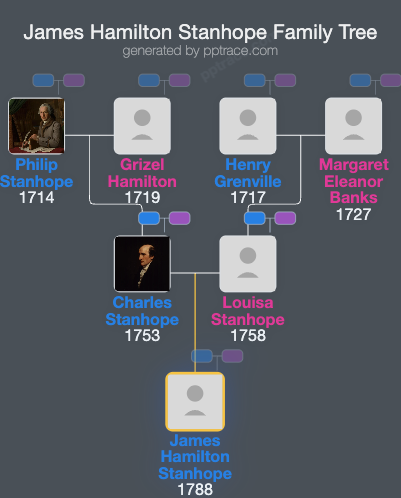
Family Tree
Tap  to expand more relatives
Introduction
James Hamilton Stanhope (1788 – 5 March 1825) was a British Army officer and politician. He participated in the Peninsular War and the Battle of Waterloo. Stanhope served as a Member of Parliament (MP) for multiple constituencies: Buckingham from 1817 to 1818, Fowey from 1818 to 1819, and Dartmouth from 1822 until his death in 1825.
Born in 1788, he was the youngest of six children of Charles Stanhope, 3rd Earl Stanhope, and Louisa Grenville. Louisa was the niece of John Norris, the 2nd Earl Temple. His siblings included Philip Stanhope and Lady Hester Stanhope, his half-sister. He was raised at the family estate in Chevening.
At age 15, Stanhope joined the British Army, despite his father's wishes, influenced by William Pitt the Younger, who was the 3rd Earl Stanhope’s second cousin through family connections involving Pitt’s grandfather. His initial rank was Ensign in the 1st Foot Guards, which he attained on 26 December 1805. He was promoted to Lieutenant and Captain on 14 January 1808, brevet Major on 21 June 1813, and subsequently became Captain and Lieutenant-Colonel in the 1st Foot Guards on 25 July 1814.
His military service included campaigns in Spain, Portugal, Flanders, and France. In 1809, he served as an aide-de-camp to General Sir John Moore. Between 1810 and 1814, he acted as an extra aide-de-camp to Lord Lynedoch. In 1812, he was appointed Deputy Assistant Quarter Master General, and in 1813, he became Assistant Quarter Master General in the Peninsula. During the Siege of San Sebastián in 1813, Stanhope was wounded by a grape-shot in the spine; the projectile was not removed due to the risk involved, leading to lifelong suffering from the injury.
In 1815, he served as an assistant to the Duke of Wellington during the Waterloo Campaign, participating in the Battle of Waterloo and the subsequent march on Paris. From 1815 until his death, he was aid-de-camp to Prince Frederick.
Stanhope entered Parliament in 1817. He was elected in the 1818 general election for Fowey but was not re-elected in 1820. In that year, following the death of his relative Joseph Banks, Stanhope was appointed one of Banks's executors. He re-entered Parliament in 1822 as MP for Dartmouth and served until his death.
He married Lady Frederica Louisa Murray on 9 July 1820 at Kenwood House, in a ceremony conducted by her uncle, Robert Markham, Archdeacon of York. Lady Frederica was the eldest daughter of David William Murray, 3rd Earl Mansfield, and Frederica Markham. The marriage produced a son, James Stanhope, born in 1821. Lady Frederica died on 14 January 1823. In her memory, Stanhope commissioned a large tomb and monument in Chevening Church, created by Sir Francis Chantrey at a cost of 1,500 guineas.
Following his wife’s death, Stanhope moved into Kenwood House, the residence of his father-in-law. By 1825, he was suffering from depression and physical pain stemming from his war wound. His mental state was described as melancholic, with episodes of stupor and sudden agitation. On 5 March 1825, he committed suicide by hanging himself in a shed on the estate. His body was discovered after a search initiated by his father-in-law, Lord Mansfield. A coroner’s jury returned a verdict of "temporary insanity."
In his will, Stanhope requested a simple burial with his wife and child, and he left bequests to his half-sisters—£1500 a year to Lady Hester Stanhope, £500 a year to Lady Griselda, and £10,000 to Lady Lucy's child. The remainder of his estate was bequeathed to his son, James Banks Stanhope.