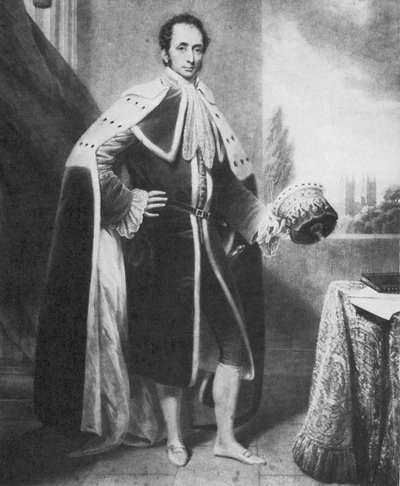
Philip Henry Stanhope, 4th Earl Stanhope
| Name | Philip Henry Stanhope, 4th Earl Stanhope |
| Title | British politician (1781-1855) |
| Gender | Male |
| Birthday | 1781-12-07 |
| nationality | United Kingdom of Great Britain and Ireland |
| Source | https://www.wikidata.org/wiki/Q334196 |
| pptrace | View Family Tree |
| LastUpdate | 2025-11-26T23:24:13.011Z |
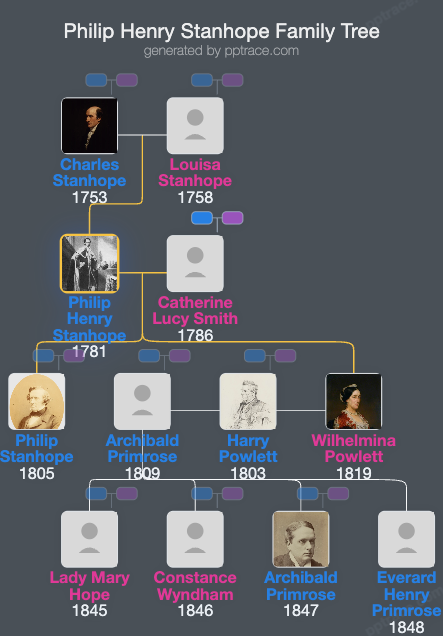
Family Tree
Tap  to expand more relatives
Introduction
Philip Henry Stanhope, 4th Earl Stanhope, was born on 7 December 1781 and died on 2 March 1855. He was a member of the English aristocracy and was notably involved in the Kaspar Hauser case during the early 1830s.
Family Origins:
He was the eldest son of Charles Stanhope, 3rd Earl Stanhope (born 1753, died 1816), and his second wife Louisa Grenville (born 1758, died 1829). Louisa was the daughter and sole heiress of Hon. Henry Grenville, who served as Governor of Barbados in 1746 and as ambassador to the Ottoman Porte in 1762. Henry Grenville was a younger brother of Richard Temple-Nugent-Brydges-Chandos-Grenville, 1st Duke of Buckingham and Chandos.
Political and Scientific Career:
Using his father's courtesy title, Viscount Mahon, he served as a Whig Member of Parliament for Wendover from 1806 to 1807, for Kingston upon Hull from 1807 to 1812, and for Midhurst from 1812 until his accession to the peerage in 1816. Upon inheriting his father's titles, he took his seat in the House of Lords.
He shared scientific interests with his family and was elected a Fellow of the Royal Society on 8 January 1807. Additionally, he served as president of the Medico-Botanical Society and was vice-president of the Society of Arts.
Personal Life:
Stanhope studied in Germany and traveled extensively across Europe. Despite some accounts suggesting he lived beyond his means, evidence indicates he remained wealthy after inheriting his father's estates in 1816. His upbringing was unconventional; his father refused to send him to school, instead keeping him at Chevening. This education method may have contributed to his eccentric reputation.
Family:
On 19 November 1803, he married Hon. Catherine Lucy Smith, daughter of Robert Smith, 1st Baron Carrington. They had three children:
- Philip Stanhope, 5th Earl Stanhope (1805–1875), a historian.
- Hon. George Joseph Stanhope (1806–1828), a diplomat who died in Rio de Janeiro.
- Catherine Lucy Wilhelmina Stanhope (1819–1901), known as the "Duchess of Cleveland," a historian and author of the Battle Abbey Roll. She married twice, first to Archibald Primrose, Lord Dalmeny, with whom she had children including Archibald Primrose, 5th Earl of Rosebery, who served as Prime Minister of the United Kingdom. Her second marriage was in 1854 to Harry Powlett, 4th Duke of Cleveland; this marriage produced no children.
Kaspar Hauser Case:
Stanhope became involved with the story of Kaspar Hauser, a youth who appeared in Nuremberg in 1828 claiming to have been raised in isolation. Hauser exhibited unusual behavior and claimed to remember Hungarian and Slavic words, prompting speculation about his origins. Stanhope first met Hauser in 1831 and developed a strong attachment, providing financial support and initiating inquiries into Hauser's background, including efforts in Hungary.
In December 1831, Stanhope became Hauser’s foster-father and later transferred him to a schoolmaster’s care. After Hauser’s return to England in 1832, Stanhope corresponded with officials concerning his case. His beliefs about Hauser's aristocratic origins proved unfounded when further inquiries failed to confirm any noble lineage.
Hauser was found mortally wounded in December 1833 and died three days later. Stanhope initially believed Hauser had been murdered but later speculated that Hauser may have inflicted the wound upon himself. In 1836, Stanhope published "Tracts Relating to Caspar Hauser," detailing the evidence he had collected. His involvement and conclusions in the case drew criticism, and some accused him of conspiracy, though some contemporary historians described him as seeking the truth.
References:
Stanhope’s contributions in Parliament are recorded in Hansard from 1803–2005. Various biographical and historical sources document his life, scientific pursuits, and involvement with the Kaspar Hauser case, including works by Aubrey Newman, Jean Mistler, and others.