
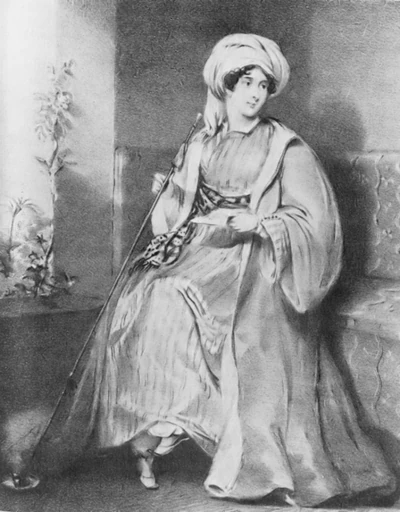
Hester Stanhope
| Name | Hester Stanhope |
| Title | noblewoman; British aristocrat, antiquarian and archaeologist (1776–1839) |
| Gender | Female |
| Birthday | 1776-01-01 |
| nationality | Great Britain |
| Source | https://www.wikidata.org/wiki/Q73980 |
| pptrace | View Family Tree |
| LastUpdate | 2025-11-26T23:24:07.936Z |
Family Tree
Tap  to expand more relatives
Introduction
Lady Hester Lucy Stanhope was born on 12 March 1776 in Chevening, Kent, England. She was the eldest child of Charles Stanhope, 3rd Earl Stanhope, and Lady Hester Pitt. Her early education and upbringing took place at Chevening until early 1800, after which she was sent to live with her grandmother, Hester Pitt, Countess of Chatham, at Burton Pynsent.
In August 1803, Stanhope moved into the household of her uncle, William Pitt the Younger, who was then the British Prime Minister. She held responsibilities such as managing his household and acting as his hostess, overseeing social interactions and welcoming guests. She also served as Pitt’s private secretary when he was out of office. During her uncle's tenure, she contributed to the development of the gardens at Walmer Castle, where Pitt was the Lord Warden of the Cinque Ports.
Following William Pitt’s death in January 1806, Stanhope was awarded an annual pension of £1200 by the British government. She resided briefly in Montagu Square, London, and later relocated to Wales. Her brother's death in February 1810 prompted her decision to leave Britain permanently. Prior to her departure, she experienced a series of romantic disappointments, including her former lover Granville Leveson-Gower, 1st Earl Granville, who married another woman in 1809, and the death of Sir John Moore, with whom she had maintained correspondence during the Peninsular War.
In February 1810, Stanhope embarked on a voyage with her brother James Hamilton Stanhope, whom she accompanied to Rhodes. Her entourage included her physician Charles Lewis Meryon, who later authored her biography, as well as maids Elizabeth Williams and Ann Fry. During her travels, she met Michael Bruce, an adventurer and future Member of Parliament, who became her lover and traveling companion. The party traveled through Athens, Istanbul, and other locations in the Ottoman Empire, with Byron commenting on her wit and independence.
Stanhope traveled extensively in the Near and Middle East over two years, visiting Gibraltar, Malta, the Ionian Islands, Peloponnese, Athens, Constantinople, Rhodes, Egypt, Palestine, Lebanon, and Syria. She refused to wear a veil in Damascus and was known for her unconventional attire, including dressing as a Bedouin during a visit to Palmyra. She was recognized by Emir Mahannah el Fadel as "Queen Hester."
In 1815, Stanhope initiated an archaeological expedition based on a medieval Italian manuscript she acquired, which detailed the location of a hidden treasure beneath a mosque in Tel Ashkelon. She organized an excavation there, which is considered one of the earliest archaeological digs employing modern principles. The excavation uncovered a headless marble statue, which she ordered destroyed to prevent its looting, asserting her intention to return any cultural artifacts to the Ottoman authorities. Her careful documentation and stratigraphic analysis during the excavation are viewed as pioneering techniques in archaeology.
Her brother James Hamilton Stanhope died by suicide in 1825 at Kenwood House, leaving her an annuity of £1500 annually. She subsequently settled near Sidon in modern Lebanon, residing initially at the disused Mar Elias monastery at Abra and later at Deir Mashmousheh, southwest of Jezzine. Her companions included Miss Williams and Dr. Charles Meryon, who remained with her until her departure from the region in 1838. Stanhope's later years involved residence among the Lebanese population, where she continued her pursuits until her death on 23 June 1839.
