Frederick III, German Emperor
| Name | Frederick III, German Emperor |
| Title | German Emperor and King of Prussia from March to June 1888 |
| Gender | Male |
| Birthday | 1831-10-18 |
| nationality | Kingdom of Prussia |
| Source | https://www.wikidata.org/wiki/Q58600 |
| pptrace | View Family Tree |
| LastUpdate | 2025-11-12T01:17:57.861Z |
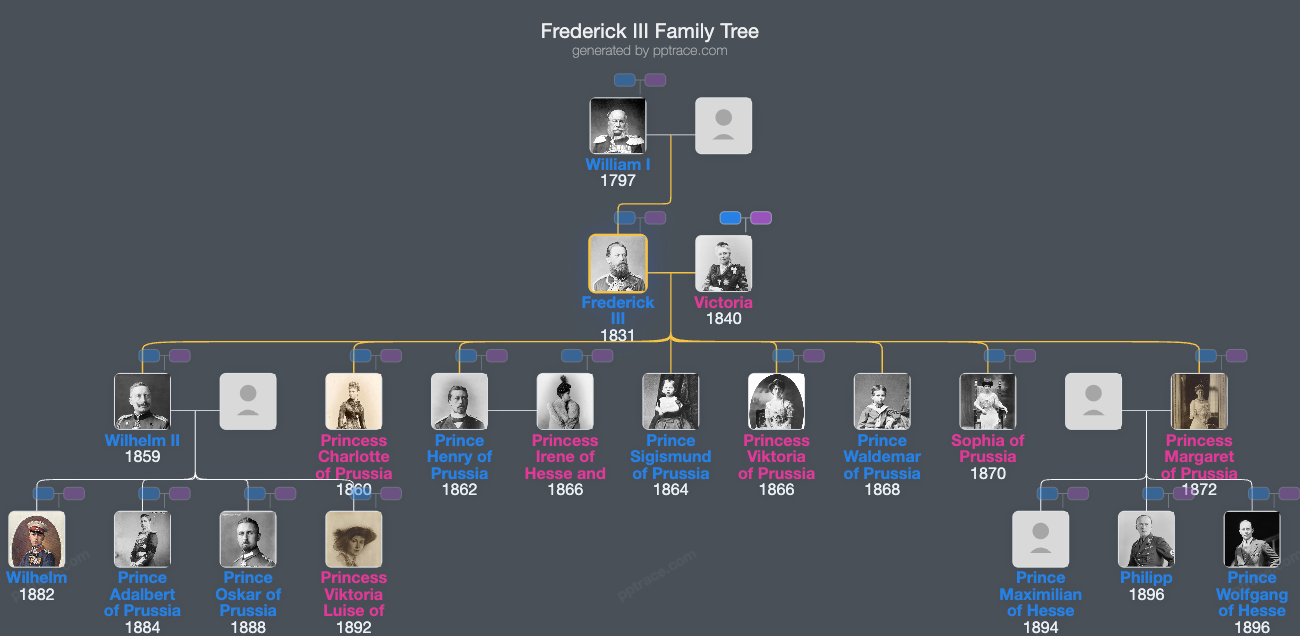
Family Tree
Tap  to expand more relatives
Introduction
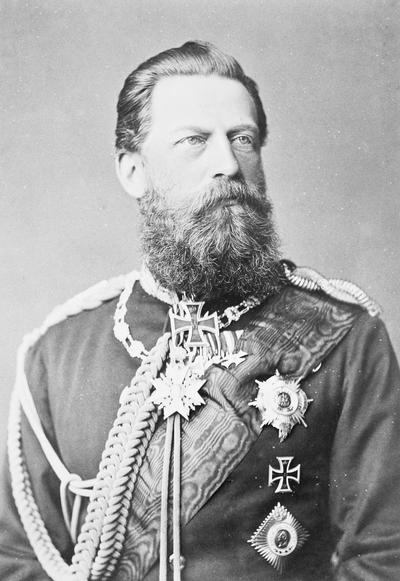
Frederick III, full name Friedrich Wilhelm Nikolaus Karl, was born on 18 October 1831 in the New Palace at Potsdam, Prussia. He was a member of the House of Hohenzollern, a royal family that ruled Prussia and later the German Empire. Frederick was the only son of Emperor Wilhelm I and his wife, Augusta of Saxe-Weimar. Raised in a household emphasizing military discipline, Frederick's early education included instruction in military traditions, liberal arts, and languages. His private tutor was Ernst Curtius, a noted archaeologist, and Frederick became fluent in English and French, studying Latin, history, geography, physics, music, and religion. He was also physically active, becoming proficient in gymnastics and riding skills.
Frederick's family background was marked by contrasting influences: his father was a strict disciplinarian, while his mother, known for her liberal views, sought a more intellectual and politically engaged upbringing for him. His parents' marriage was unhappy, which left Frederick with a sense of loneliness and troubled family relations. He had a younger sister, Louise, with whom he maintained a close relationship, and he was particularly close to his uncle, King Frederick William IV.
In 1850, Frederick entered the University of Bonn, where he studied history, law, and governance. His studies, along with his familial influences, contributed to his liberal outlook. In 1853, he was initiated into Freemasonry, later becoming Master of the Grand Landlodge of the Freemasons of Germany.
Frederick married Victoria, Princess Royal, the eldest daughter of Queen Victoria of the United Kingdom, on 25 January 1858 in London. The marriage was arranged but compatible, sharing liberal ideals, and they had eight children—Wilhelm, Charlotte, Henry, Sigismund, Victoria, Waldemar, Sophia, and Margaret. Notably, their eldest son Wilhelm inherited the throne after Frederick's death but was considered less inclined toward liberal reforms.
Following the death of his father Wilhelm I on 9 March 1888, Frederick succeeded him as German Emperor and King of Prussia. His reign lasted only 99 days, ending with his death on 15 June 1888 from laryngeal cancer at the age of 56. During his brief rule, he attempted to pursue liberal reforms, including establishing a responsible government and limiting the powers of the chancellor and the monarch under the constitution. However, his illness prevented significant political action, and the movement toward a more liberal German Empire was largely halted.
Frederick's health issues began earlier, with persistent hoarseness and throat problems diagnosed as laryngeal cancer in 1887. Despite multiple treatments, including biopsies, cauterizations, and eventually a tracheotomy in February 1888, his condition worsened. He spent his final months in Italy, primarily in Toblach and Baveno, where his illness was closely monitored. When the cancer was conclusively diagnosed in March 1888, his prospects for recovery were bleak.
He died in Potsdam on 15 June 1888 and was buried in a mausoleum attached to the Friedenskirche in Potsdam. His death marked a brief and tumultuous period in German history, often viewed as a missed opportunity for potential liberalization. Frederick's legacy is debated among historians, with some suggesting that a longer reign could have altered Germany's political trajectory, potentially preventing the militarism that led to the World Wars.