Wilhelm II
| Name | Wilhelm II |
| Title | German Emperor and King of Prussia from 1888 to 1918 |
| Gender | Male |
| Birthday | 1859-01-27 |
| nationality | Kingdom of Prussia |
| Source | https://www.wikidata.org/wiki/Q2677 |
| pptrace | View Family Tree |
| LastUpdate | 2025-11-12T01:17:54.411Z |
Family Tree
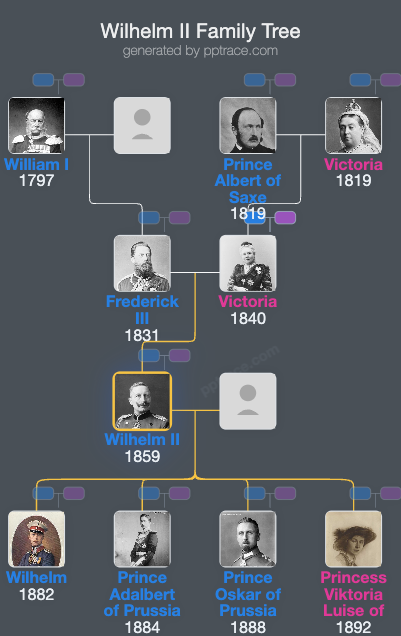
Tap  to expand more relatives
Introduction
Wilhelm II (full name: Frederick William Victor Albert; German: Friedrich Wilhelm Viktor Albert) was born on 27 January 1859 in Berlin and died on 4 June 1941 in Doorn, Netherlands. He was the last German Emperor and King of Prussia, reigning from 1888 until his abdication in 1918. His accession marked the end of the German Empire and concluded the Hohenzollern dynasty's 500-year rule over Prussia and Brandenburg.
Early Life and Family Background:
Wilhelm was the eldest son of Prince Frederick William of Prussia (later Frederick III) and Victoria, Princess Royal, the eldest daughter of Queen Victoria of the United Kingdom. His birth occurred during the reign of his granduncle, Frederick William IV of Prussia. His mother, Victoria, Princess Royal, was one of Queen Victoria’s 42 grandchildren, making Wilhelm the first cousin to several European royals, including King George V of the United Kingdom.
Birth and Medical History:
Wilhelm’s birth involved complications; he was in breech presentation, which, along with a heavy dose of chloroform administered during delivery, caused hypoxia and resulted in minimal to mild brain damage, along with an injury called Erb's palsy, leading to his withered left arm. Medical assessments suggest these conditions affected his social and emotional development.
Early Childhood:
In 1863, Wilhelm was taken to England for his aunt's wedding, where he displayed a rebellious streak, threatening his uncle Prince Alfred. Queen Victoria considered him a clever but restless child. His mother emphasized equestrian skills, and Wilhelm was trained rigorously in riding from age eight despite his physical handicap. He was educated at Kassel and later at the University of Bonn, studying law and politics.
Accession to the Throne:
Following the death of Kaiser Wilhelm I on 9 March 1888, his son Wilhelm II succeeded him at age 29. His father, Frederick III, had a short reign of only 99 days due to illness. Wilhelm’s rise to power was marked by a desire for personal control over Germany's policy, which led to conflicts with Chancellor Otto von Bismarck.
Dismissal of Bismarck:
In 1890, Wilhelm II dismissed Bismarck, ending the latter’s careful diplomatic and domestic policies. Wilhelm’s “New Course” emphasized rapid expansion, including territorial acquisitions in China and the Pacific, and a significant naval buildup aimed at challenging Britain’s maritime supremacy. His foreign policy, characterized by tactless and provocative statements, increased tensions among European powers.
Domestic and Foreign Policy:
Wilhelm promoted German scientific research and supported modernization efforts in education and social welfare. He was passionate about arts, sciences, and military expansion, commissioning research institutes and advocating for a powerful navy. His foreign policy was often impulsive and confrontational, exemplified by the Moroccan Crisis of 1905, the Daily Telegraph Affair of 1908, and the naval arms race with Britain. His leadership style lacked consistency, often reflecting his volatile personality.
World War I:
Wilhelm’s role during the war was largely ceremonial as military affairs were managed by generals Ludendorff and Hindenburg. His support for Austria-Hungary's invasion of Serbia was pivotal, but he became increasingly isolated as the war progressed. The failure of the Schlieffen Plan and the deteriorating military situation led to his loss of influence and rejection by the German public and military leaders.
Abdication and Exile:
In late 1918, amid widespread unrest and revolution, Wilhelm was persuaded to abdicate on 9 November. He fled to the Netherlands, where he remained in exile at Huis Doorn. His abdication officially ended the Hohenzollern rule over Prussia and Germany. During his exile, Wilhelm published memoirs defending his actions, remained engaged with monarchist circles, and expressed hope for a restoration, which did not materialize.
Later Life:
In exile, Wilhelm learned Dutch, engaged in archaeology, and maintained a substantial personal estate. He grew a beard and adopted a style similar to other European monarchs. His views showed increasing admiration for Germany’s early military successes and a complex attitude toward the Nazi regime, which he viewed with suspicion and disdain.
Death:
Wilhelm died of a pulmonary embolism at Huis Doorn in 1941, aged 82. His funeral was modest, and he was buried in the mausoleum on the estate. Despite his controversial role in history, references to him in historical discourse have ranged from portraits of recklessness and flawed leadership to interpretations emphasizing his influence on the course of German and European history prior to World War I.