Princess Viktoria Of Prussia
| Name | Princess Viktoria Of Prussia |
| Title | Prussian princess (1866-1929) |
| Gender | Female |
| Birthday | 1866-04-12 |
| nationality | Germany |
| Source | https://www.wikidata.org/wiki/Q60382 |
| pptrace | View Family Tree |
| LastUpdate | 2025-11-12T01:17:51.284Z |
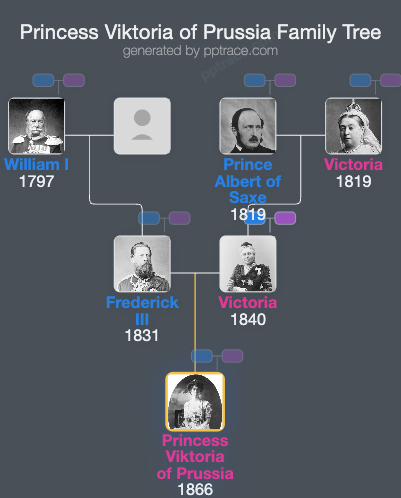
Family Tree
Tap  to expand more relatives
Introduction
Princess Viktoria of Prussia, born Friederike Amalia Wilhelmine Viktoria on April 12, 1866, in the New Palace in Potsdam, was the second daughter of Frederick III, German Emperor, and Victoria, Princess Royal, daughter of Queen Victoria of the United Kingdom. Her father was the son of King Wilhelm I of Prussia and Princess Augusta of Saxe-Weimar. Viktoria was baptized on May 24, 1866, with her grandmother Queen Victoria as one of her godparents. Her birth was noted by Queen Victoria in a letter expressing her pleasure that her granddaughter was named after her.
Her early childhood was marked by significant family tragedy; her two-month-old brother Sigismund died of meningitis in June 1866. Following this, her mother chose to personally raise Viktoria and her younger siblings—Waldemar, Sophie, and Margaret—rather than delegating their upbringing to tutors and governesses. Viktoria and her siblings shared close relationships with their parents and received an education inspired by British practices, including living with British nannies and traveling to visit family in Britain.
Viktoria's childhood was characterized by active interests in riding, gardening, and cooking, though her privileged upbringing limited her experience of kitchen work. She was raised in a liberal, anglophile environment with close ties to British traditions.
In her young adult years, Viktoria developed affection for Alexander of Battenberg, Prince of Bulgaria, whom her mother and Queen Victoria considered a potential match. She met him during a visit to the Prussian court in 1881 and fell in love with him. Despite her family's opposition—particularly from her grandfather Wilhelm I, Chancellor Otto von Bismarck, and her elder siblings—the couple maintained their courtship until 1888, when political and dynastic concerns led to its cessation.
During this period, Viktoria experienced depression and struggled with body image issues, attempting to improve her appearance through dieting. She was also considered legally and socially inconspicuous, especially due to her perceived lack of attractiveness and her family's disapproval. Her subsequent suitors included various European princes and royalty, but none led to marriage.
In June 1890, Viktoria became engaged to Prince Adolf of Schaumburg-Lippe during a visit to her cousin Marie of Nassau. She married Adolf on November 19, 1890, in Berlin. The marriage was childless, and Viktoria reportedly did not love her husband, though it was described as mutually respectful. Adolf died in 1916 during World War I.
Following her husband's death, Viktoria lived primarily in Bonn, where she enjoyed hobbies such as gardening and decorating. She experienced periods of loneliness and depression, and her mental health reportedly declined. Her brother Wilhelm II, German Emperor, prohibited her from marrying Adolf's nephews, and her financial situation worsened over time.
In 1927, Viktoria caused a scandal by marrying Alexander Anatolievitch Zoubkoff, a Russian law student 35 years her junior. The marriage was short-lived; she renounced her titles, married him secretly, and later filed for divorce amid financial difficulties. She spent her final years in relative poverty and died on November 13, 1929, at the age of 63 in Bonn. She was buried at Schloss Friedrichshof, the estate of her sister Margaret.
Her letters to her sister Margaret are archived in the House of Hesse in Fasanerie Palace, Eichenzell, Germany. Over her lifetime, her titles included Princess Viktoria of Prussia, Princess Adolf of Schaumburg-Lippe, and Mrs. Viktoria Zoubkoff.