Sophia Of Prussia
| Name | Sophia Of Prussia |
| Title | Queen consort of Greece (1870–1932) |
| Gender | Female |
| Birthday | 1870-06-14 |
| nationality | Germany |
| Source | https://www.wikidata.org/wiki/Q155822 |
| pptrace | View Family Tree |
| LastUpdate | 2025-11-12T01:17:53.664Z |
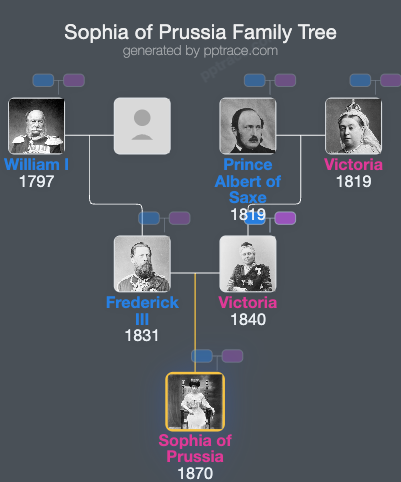
Family Tree
Tap  to expand more relatives
Introduction
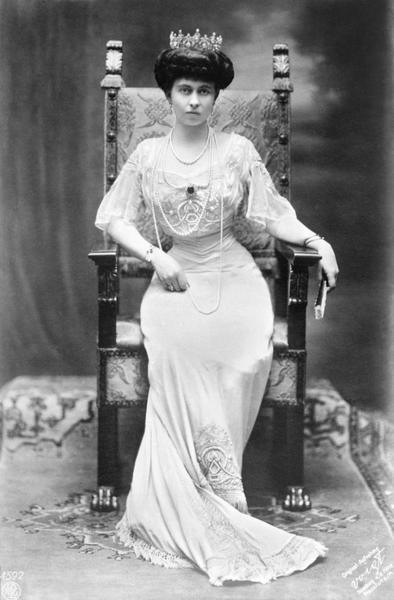
Sophia of Prussia (Sophie Dorothea Ulrike Alice; Greek: Σοφία Δωροθέα Ουλρίκη Αλίκη), born on 14 June 1870, was a member of the House of Hohenzollern and served as Queen of Greece during two periods: from 18 March 1913 to 11 June 1917 and again from 19 December 1920 to 27 September 1922, as the wife of King Constantine I. She died on 13 January 1932.
Early Life and Family Background
Sophia was born at the Neues Palais in Potsdam, Prussia, as the daughter of Frederick William, Crown Prince of Prussia, and Victoria, Princess Royal of the United Kingdom. Her paternal grandfather was King William I of Prussia, and her mother was the eldest child of Queen Victoria and Prince Albert. Sophia was educated with a liberal and Anglophile orientation, under the supervision of her mother Victoria, Princess Royal.
Marriage and Childhood
In 1889, less than a year after her father’s death, Sophia married her third cousin Constantine, heir apparent to the Greek throne, in Athens. The marriage was celebrated with significant public festivities. She initially faced difficulties adjusting to Greece but eventually learned Modern Greek and became involved in social and charitable activities. She had six children with Constantine.
Religious Conversion and Social Work
After her marriage, Sophia converted from Lutheranism to the Greek Orthodox faith, with the blessing of her family and religious authorities. Her conversion was met with some opposition from her German relatives but was completed on 2 May 1891. Throughout her life, Sophia engaged actively in social work, including founding the Union of Greek Women and participating in aid efforts during various conflicts, notably the Thirty Days’ War and the First Balkan War. She established field hospitals, trained nurses, and assisted wounded soldiers, receiving decorations such as the Royal Red Cross for her efforts.
Political and Military Events
Her tenure as queen saw significant historical events, including the assassination of King George I in 1913 and the subsequent expansion of Greece after the Balkan Wars. During World War I, her close ties to the German Emperor William II raised suspicion and mistrust among the Greek population and the Allied powers, leading to the deposition of Constantine I in June 1917. Sophia and her family went into exile in Switzerland.
Second Reign and the Greco-Turkish War
In 1920, the royal family was restored to the throne after political shifts and the abdication of her son, King Alexander I, due to illness. Sophia returned to Greece with Constantine I, and her second tenure as queen lasted until 1922, witnessing the disastrous outcome of the Greco-Turkish War and the subsequent political upheaval. Following the defeat and the abdication of Constantine I in September 1922, she went into exile again.
Later Life and Death
Sophia lived the remainder of her life in exile, residing in various locations including Tuscany, Switzerland, and Germany. She remained actively interested in religious and charitable activities, and maintained correspondence with family members and religious figures. Ill with cancer, she died in Frankfurt on 13 January 1932 at the age of 61. Her remains were initially interred at Friedrichshof in Austria and later transferred to the royal burial ground at Tatoi Palace following her son King George II’s restoration to the Greek throne in 1936.
Her archives include letters to her sister Margaret, which are preserved at the Archive of the House of Hesse in Germany.