
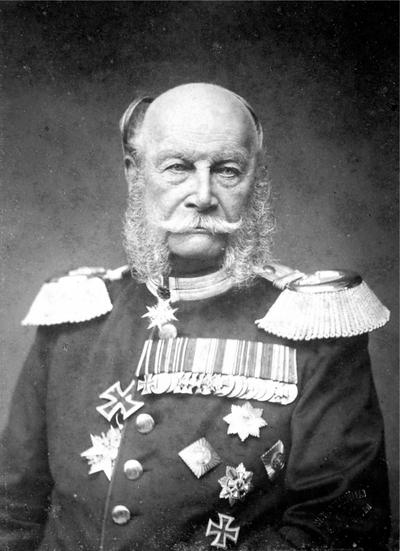
William I, German Emperor
| Name | William I, German Emperor |
| Title | 19th-century German Emperor and King of Prussia |
| Gender | Male |
| Birthday | 1797-03-22 |
| nationality | Kingdom of Prussia |
| Source | https://www.wikidata.org/wiki/Q150652 |
| pptrace | View Family Tree |
| LastUpdate | 2025-11-12T01:18:22.153Z |
Family Tree
Tap  to expand more relatives
Introduction
Wilhelm I (William I; full name William Frederick Louis; German: Wilhelm Friedrich Ludwig) was born on 22 March 1797 and died on 9 March 1888. He was a member of the House of Hohenzollern and served as King of Prussia from 1861 until his death. In 1871, he assumed the title of German Emperor, holding this position until 1888. Wilhelm I was the first head of state of a united Germany and was known during his grandson Wilhelm II’s reign as Emperor Wilhelm the Great (Kaiser Wilhelm der Große).
Wilhelm I was the second son of Prince Frederick William and Louise of Mecklenburg-Strelitz. His grandfather, King Frederick William II, died in the year Wilhelm was born, leading to his father’s accession as King Frederick William III. Wilhelm’s early education was overseen by Johann Friedrich Gottlieb Delbrück from 1801 to 1809, and he was appointed an officer in the Prussian army at age twelve.
He participated in the Napoleonic Wars, notably in the War of the Sixth Coalition, fighting against Napoleon I of France with distinction. Wilhelm served in the army from 1814, earning promotions and awards such as the Iron Cross for actions at Bar-sur-Aube. He also fought under Gebhard Leberecht von Blücher at the Battles of Ligny and Waterloo in 1815.
In 1817, Wilhelm traveled to Saint Petersburg with his sister Charlotte for her marriage to Emperor Nicholas I. He became the commander of the Stettiner Gardelandwehrbataillon in 1816 and was promoted to Generalmajor in 1818. He was appointed inspector of the VII. and VIII. Army Corps, emphasizing the importance of a well-trained and equipped military.
Through marriage in 1829, Wilhelm became the son-in-law of Grand Duke Karl Friedrich of Saxe-Weimar-Eisenach, marrying Princess Augusta of Saxe-Weimar-Eisenach. Their marriage was considered outwardly stable, and they had two children.
Initially not expected to inherit the throne, Wilhelm’s elder brother ascended to become King of Prussia in 1840. Wilhelm became heir presumptive as his brother was childless and was given the title Prinz von Preußen. He played a significant role in the suppression of the Revolutions of 1848 in Germany, briefly exiling himself to England. Wilhelm was appointed governor-general of the Rhine Province and Westphalia in 1849, residing at Koblenz.
In 1858, following his brother’s stroke and subsequent incapacity, Wilhelm was named Prince Regent. He swore an oath to the Prussian constitution and initially appointed a liberal Minister President, Karl Anton von Hohenzollern-Sigmaringen. On 2 January 1861, Wilhelm succeeded his brother as King Wilhelm I of Prussia.
His reign was marked by conflicts over military reforms and expansion. Wilhelm appointed Otto von Bismarck as Minister President to advance his military proposals, which faced opposition from the Prussian Landtag. Under Bismarck’s leadership, Wilhelm oversaw victories in the Second Schleswig War in 1864 and the Austro-Prussian War in 1866, establishing Prussia’s dominance among German states.
Following these conflicts, Wilhelm facilitated the unification of Germany after the Franco-Prussian War, resulting in the proclamation of the German Empire on 18 January 1871 at the Palace of Versailles. Wilhelm was proclaimed German Emperor, although he was initially reluctant to accept the title. His reign saw the consolidation of the empire with Bismarck as Chancellor, with Wilhelm largely delegating governance.
His later years included surviving assassination attempts in 1878, which led to the enactment of the Anti-Socialist Laws. Despite political power, Wilhelm left most governance to Bismarck. He participated in diplomacy, including arbitration between the United Kingdom and the United States in 1872, and was involved in the organization of Germany’s colonial empire, including the 1884–85 Berlin Conference.
Wilhelm I died on 9 March 1888 at age 90 after a short illness. He was succeeded by his son Frederick, who died 99 days later, leading to Wilhelm II’s accession. Several monuments and memorials were erected in his honor, including the Kyffhäuser monument and the Deutsches Eck statue. Wilhelm I was Lutheran and held numerous national and foreign honors throughout his life.
