Takatsukasa Masamichi
| Name | Takatsukasa Masamichi |
| Title | Kugyō or Japanese court noble of the late Edo (1789-1868) |
| Gender | Male |
| Birthday | 1789-08-22 |
| nationality | Japan |
| Source | https://www.wikidata.org/wiki/Q594626 |
| pptrace | View Family Tree |
| LastUpdate | 2025-11-17T09:47:26.560Z |
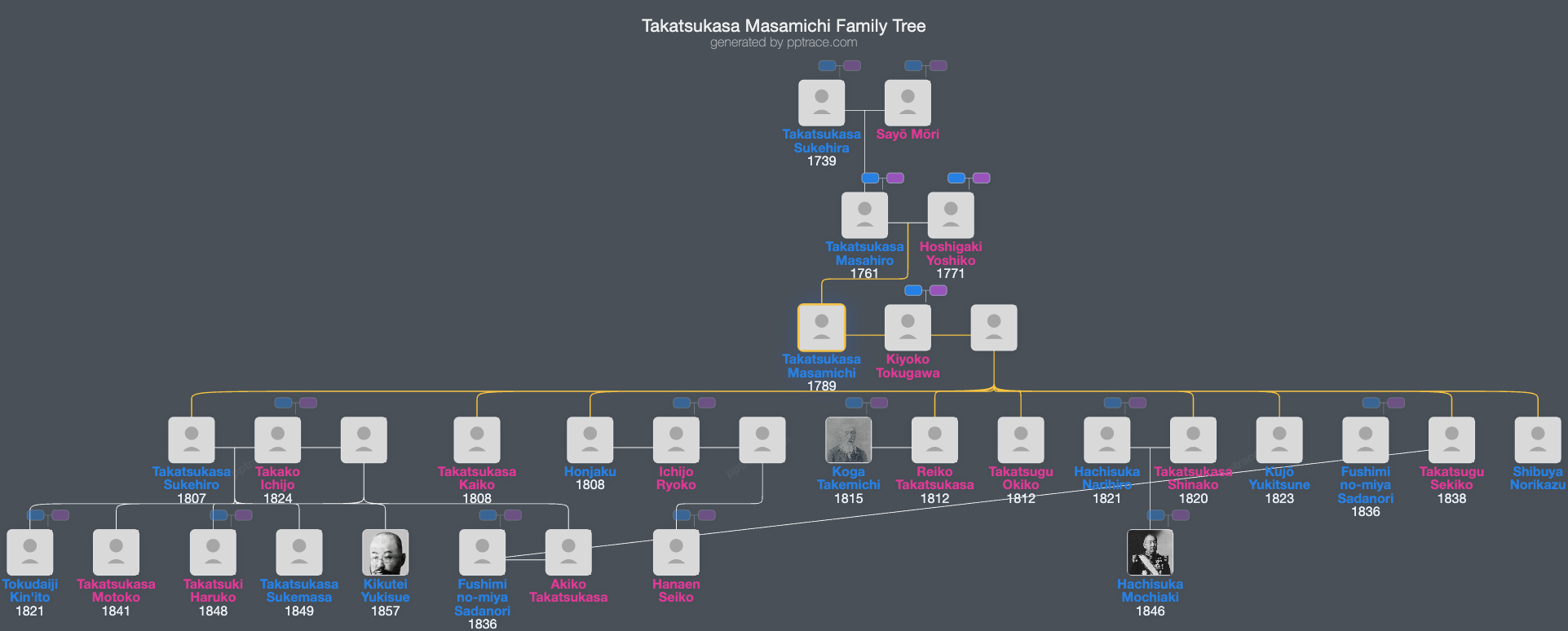
Family Tree
Tap  to expand more relatives
Introduction
Takatsukasa Masamichi (鷹司 政通, 22 August 1789 – 29 November 1868) was a Japanese court noble during the late Edo period. He was a member of the Fujiwara-derived Takatsukasa family, a kuge (imperial court noble) family which held the regent position of kampaku.
Born in 1789, Masamichi was the son of Takatsukasa Masahiro, who also served as a regent. Masamichi's tenure as kampaku began in 1823 and continued until 1856. His period of service corresponds with the late Edo era, a time marked by internal political stability and increasing external pressures on Japan.
In 1856, during the event known as the Ansei Purge, Masamichi was prosecuted. The Ansei Purge was a political crackdown initiated by the shogunate, targeting those involved in political dissent or opposition. Following his prosecution, Masamichi became a priest.
Regarding his family, Takatsukasa Masamichi had children with notable marriages. He had a son named Sukehiro, whose mother was the daughter of Tokugawa Harutoshi, the seventh head of the Mito Domain. He also had daughters; one of them married Hachisuka Narihiro, the 13th head of the Tokushima Domain.
The Takatsukasa family has a long-standing history as part of the Japanese aristocracy, holding significant influence at court. As a regent, Masamichi played a role in court governance during a period of significant political changes in Japan.
References for his biography include historical records of the Takatsukasa family and Japanese-language sources.