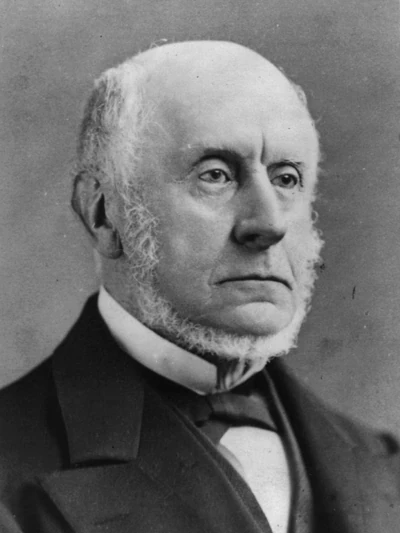
Charles Francis Adams, Sr.
| Name | Charles Francis Adams, Sr. |
| Title | American historical editor, politician and diplomat from Massachusetts (1807-1886) |
| Gender | Male |
| Birthday | 1807-08-18 |
| nationality | United States of America |
| Source | https://www.wikidata.org/wiki/Q75174 |
| pptrace | View Family Tree |
| LastUpdate | 2025-11-17T06:37:04.179Z |
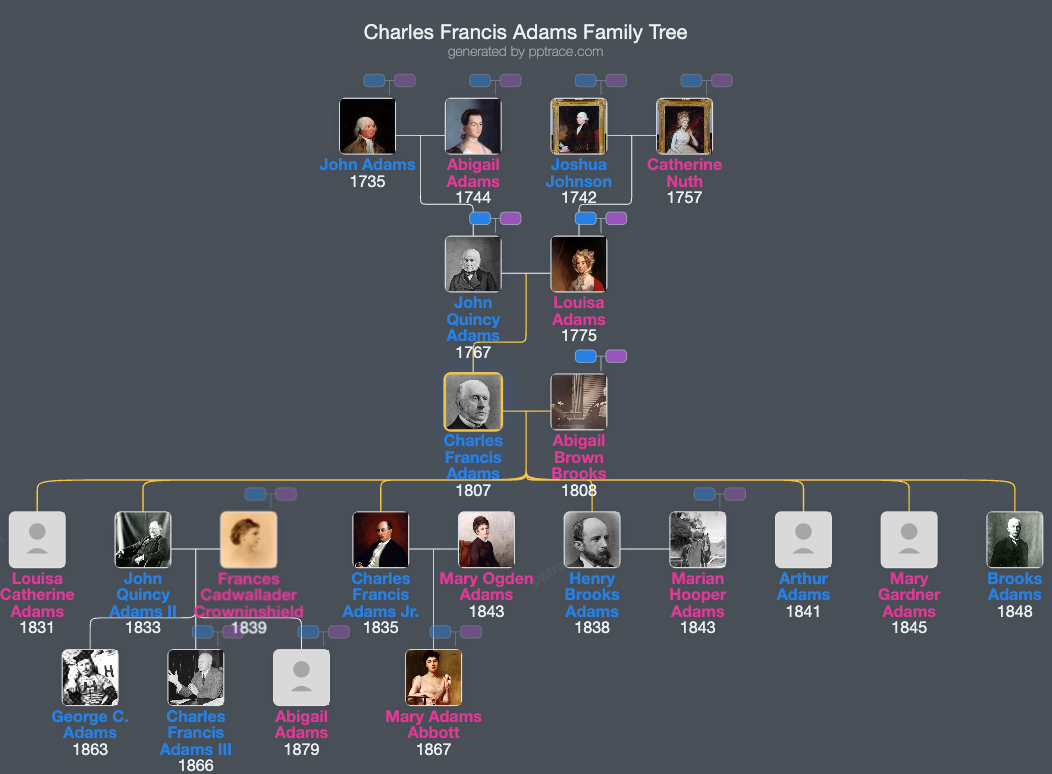
Family Tree
Tap  to expand more relatives
Introduction
Charles Francis Adams Sr. was born in Boston on August 18, 1807. He was the son of John Quincy Adams, the sixth President of the United States, and Louisa Catherine Johnson. His grandfather was John Adams, the second President of the United States. Adams had three siblings: George Washington Adams, John Adams II, and Louisa Adams, who died in childhood. His family was part of a prominent political lineage in U.S. history.
Adams attended Boston Latin School and graduated from Harvard College in 1825. He pursued legal studies under Daniel Webster, was admitted to the bar, and practiced law in Boston. His early literary contributions included reviews of historical works for the North American Review.
In 1828, Charles Quincy Adams was among family members who declined to attend the marriage of his father, John Quincy Adams, to Mary Hellen at the White House. During the 1830s, Adams served in the Massachusetts House of Representatives from 1840 to 1841 and again in 1843–1844. He was a member of the Massachusetts Senate from 1843 to 1845 and purchased a Boston newspaper, becoming its editor in 1846.
In 1848, Adams was the vice-presidential candidate for the Free Soil Party, running on a ticket with Martin Van Buren. That year, his father suffered a stroke and died in the Capitol. Adams was deeply involved in historical editing, notably working on the biography of his father, John Quincy Adams, and publishing volumes of John Adams's writings, diaries, and correspondence between 1850 and 1856. He was elected a Fellow of the American Academy of Arts and Sciences in 1857.
As a member of the U.S. House of Representatives elected in 1858, Adams chaired the Committee on Manufactures. He was re-elected in 1860 but resigned after being appointed U.S. Minister to the United Kingdom, serving from 1861 to 1868. During his diplomatic tenure, he aimed to maintain British neutrality during the American Civil War and was involved in resolving the Trent Affair in 1861. He was instrumental in preventing British recognition of the Confederacy and monitored Confederate diplomatic activities and shipbuilding efforts, including the operations of the CSS Alabama.
Adams' diplomatic efforts contributed to the resolution of the Alabama Claims, with Britain later agreeing in 1872 to pay $15 million in damages related to Confederate-built warships. His correspondence and reports provided key evidence leading to arbitration.
In 1844, Adams visited Nauvoo, Illinois, where he met Joseph Smith, the founder of the Church of Jesus Christ of Latter-day Saints. During this meeting, Smith showed Adams and Josiah Quincy Egyptian mummies and papyri, and Adams noted his skepticism about Smith's claims in his diary.
Throughout his later years, Adams declined the presidency of Harvard University but engaged in other scholarly and public service activities, including serving as an overseer of Harvard University. He built the Stone Library at Peacefield, his family home in Quincy, Massachusetts, which now forms part of the Adams National Historical Park.
Adams was married and had seven children, including John Quincy II, Charles Jr., Henry, and Brooks. He passed away on November 21, 1886, in Quincy, Massachusetts.