Brooks Adams
| Name | Brooks Adams |
| Title | American political writer (1848-1927) |
| Gender | Male |
| Birthday | 1848-06-24 |
| nationality | United States of America |
| Source | https://www.wikidata.org/wiki/Q929695 |
| pptrace | View Family Tree |
| LastUpdate | 2025-11-17T06:37:13.099Z |
Family Tree
Tap  to expand more relatives
Introduction
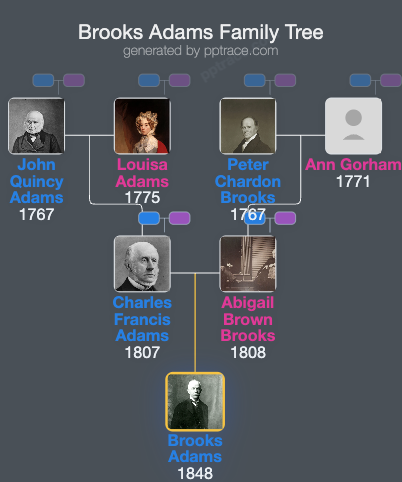
Peter Chardon Brooks Adams (June 24, 1848 – February 13, 1927) was an American attorney, historian, political scientist, and critic of capitalism. He was born in Quincy, Massachusetts, the son of Charles Francis Adams and Abigail Brown Brooks. Adams was a direct descendant of notable American figures, being a great-grandson of President John Adams and a grandson of President John Quincy Adams. His family included other prominent members such as his brother Charles Francis Adams Jr. and his brother Henry Adams, the latter of whom was a philosopher, historian, and novelist influenced by Brooks Adams's work. His maternal grandfather was Peter Chardon Brooks, noted as the wealthiest man in Boston at the time of his death.
Adams received his education in the United States and Europe. He graduated from Harvard University in 1870 and attended Harvard Law School during 1870 and 1871. In 1872, he served as secretary to his father in Geneva during the arbitration concerning the Alabama claims under the Treaty of Washington. He was admitted to the bar in 1873 and practiced law in Boston until 1881. Subsequently, Adams dedicated his career to literary and scholarly pursuits.
Throughout his career, Adams developed social and historical theories regarding the rise and fall of civilizations. He posited that commercial civilizations rise and decline in cyclical patterns. According to his analysis, large populations gather in urban centers and engage in commerce, which over time leads to the diminishment of spiritual and creative values due to greed and dishonesty. The society eventually disintegrates and is replaced by a newer, more economically driven civilization. His notable work, "The Law of Civilization and Decay" (1896), explores themes of societal cycles and shifts in centers of trade, tracing historical shifts from Constantinople to Venice, Amsterdam, and London.
Adams also predicted in his 1900 publication, "America's Economic Supremacy," that an "Anglo-Saxon alliance" would oppose China and that New York City would become a pivotal hub of global trade. He believed that societal acceleration results in consolidations and profound intellectual changes, where energy shifts from creative imagination to capital formation, influencing the development of civilizations.
In his personal life, Adams married Evelyn Davis in 1889; the marriage produced no children. Evelyn was the daughter of Admiral Charles Henry Davis. Notably, her sisters included Anna (wife of Henry Cabot Lodge) and Louisa (wife of John Dandridge Henley Luce).
Adams was elected a Fellow of the American Academy of Arts and Sciences in 1918. He was the last Adams family member to reside at Peacefield in Quincy, Massachusetts. Following his death in 1927, the house was turned into a museum per his wishes and is now part of the Adams National Historical Park.
His written works include "The Emancipation of Massachusetts" (1919), "The Gold Standard: An Historical Study" (1894), "The Law of Civilization and Decay" (1895), "America's Economic Supremacy" (1900), "The New Empire" (1902), "Railways as Public Agents" (1910), and "Theory of Social Revolutions" (1913). Adams contributed essays to various periodicals covering topics such as the Spanish-American War, international trade, and legal issues.
He died on February 13, 1927, and his contributions are documented through various scholarly references and biographies.