John Quincy Adams
| Name | John Quincy Adams |
| Title | president of the United States from 1825 to 1829 |
| Gender | Male |
| Birthday | 1767-07-11 |
| nationality | United States of America |
| Source | https://www.wikidata.org/wiki/Q11816 |
| pptrace | View Family Tree |
| LastUpdate | 2025-11-17T06:37:00.664Z |
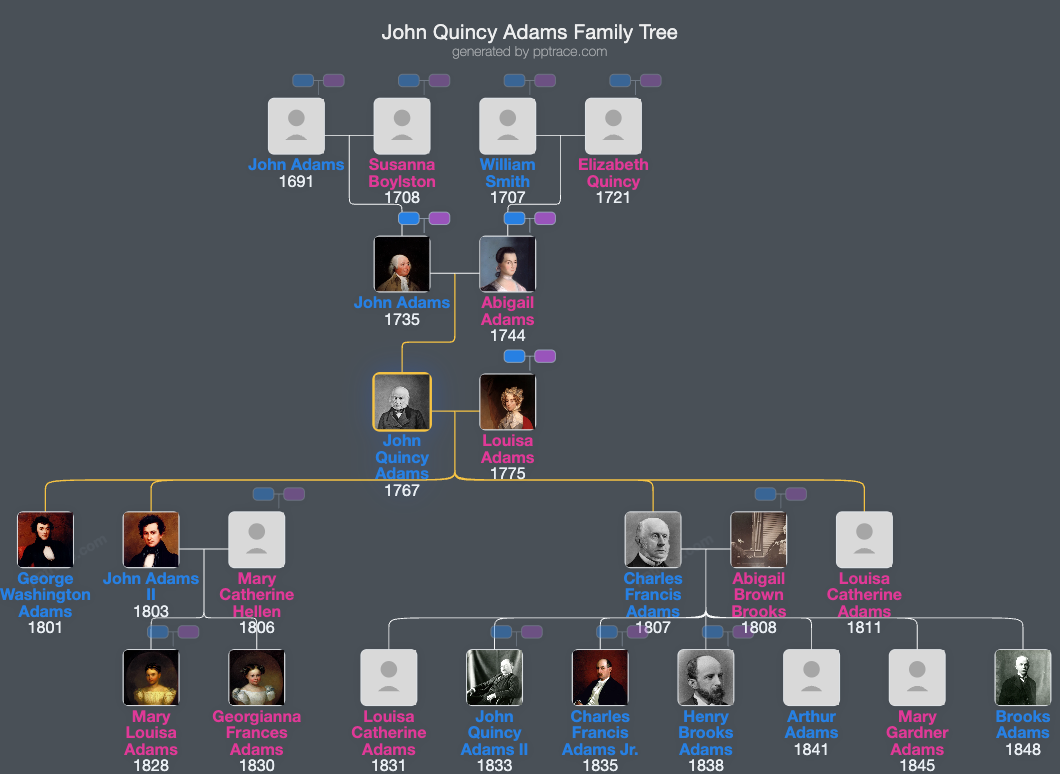
Family Tree
Tap  to expand more relatives
Introduction
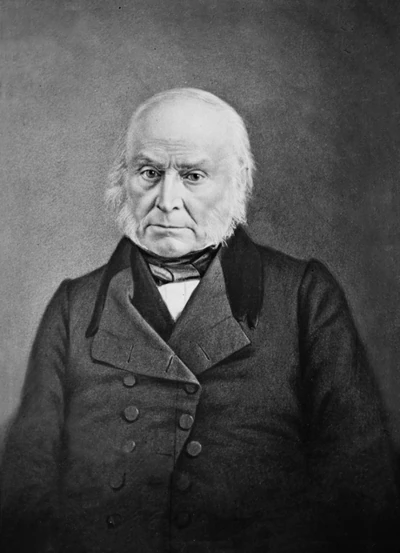
John Quincy Adams was born on July 11, 1767, in Braintree, Massachusetts, which is now known as Quincy. He was the son of John Adams, the second President of the United States, and Abigail Adams, the First Lady. Adams was named after his maternal grandfather, Colonel John Quincy. During his childhood, Adams was primarily educated by tutors, including his cousin James Thaxter and Nathan Rice, his father's law clerk. At a young age, he demonstrated literary talent and began maintaining a diary in 1779, which he kept until shortly before his death in 1848.
From the age of ten, Adams grew up mainly on the family farm in Braintree, with his mother overseeing his early education. His father’s diplomatic duties, which often required travel abroad, resulted in Adams spending significant time in Europe. Between 1778 and 1784, Adams traveled through France, the Netherlands, and Russia, studying law, languages, and classical literature, and serving as a secretary to American diplomats in Saint Petersburg and the Netherlands.
Adams returned to the United States in 1785 and enrolled at Harvard College, where he joined Phi Beta Kappa and graduated second in his class in 1787. Following his graduation, he studied law under Theophilus Parsons in Massachusetts from 1787 to 1789. Although initially opposed to the ratification of the U.S. Constitution, Adams accepted it and, in 1789, his father was elected as the first Vice President of the United States.
In 1790, Adams established a legal practice in Boston and became financially independent. He initially avoided politics, focusing on his law career and writing essays under pseudonyms, including critiques of British and French policies. His early diplomatic career began in 1794 when President George Washington appointed him as the U.S. ambassador to the Netherlands. He supported the Jay Treaty with Britain and spent the winter of 1795–1796 in London, where he met Louisa Catherine Johnson, whom he married in 1797 despite his parents' disapproval regarding her English origins.
Adams also served as the U.S. ambassador to Portugal and Prussia during the late 1790s and early 1800s. In 1802, Federalist leaders in Massachusetts arranged for Adams’s election to the U.S. Senate, but his break with the Federalist Party over foreign policy issues led to his rejection for re-election. During James Madison’s presidency, Adams served as ambassador to Russia from 1809 to 1814 and played a role in negotiating the end of the War of 1812 as part of the American delegation.
In 1817, Adams was appointed Secretary of State by President James Monroe. As Secretary of State, he negotiated the Adams–Onís Treaty (1819), acquiring Florida from Spain, delineating western boundaries, and contributing to the formulation of the Monroe Doctrine. He also became a member of the American Philosophical Society in 1818.
Adams was the Democratic-Republican candidate in the 1824 presidential election. The election resulted in a contingent election held by the House of Representatives, which Adams won with the support of Henry Clay, who was subsequently appointed Secretary of State. Adams served as the sixth President of the United States from 1825 to 1829. His presidency was marked by efforts to implement infrastructure projects, establish a national university, and foster relations with Latin America, though many of these initiatives did not advance through Congress.
Following his presidency, Adams was defeated in the 1828 election by Andrew Jackson. He then served in the U.S. House of Representatives from 1831 until his death in 1848. During his congressional tenure, he became an outspoken advocate against slavery, opposing the annexation of Texas and the Mexican-American War, and led the effort to repeal the House’s “gag rule” on abolition petitions. Adams died on February 23, 1848, in Washington, D.C.