Charles Francis Adams Jr.
| Name | Charles Francis Adams Jr. |
| Title | American author and historian (1835–1915) |
| Gender | Male |
| Birthday | 1835-05-27 |
| nationality | United States of America |
| Source | https://www.wikidata.org/wiki/Q1064413 |
| pptrace | View Family Tree |
| LastUpdate | 2025-11-17T06:37:11.362Z |
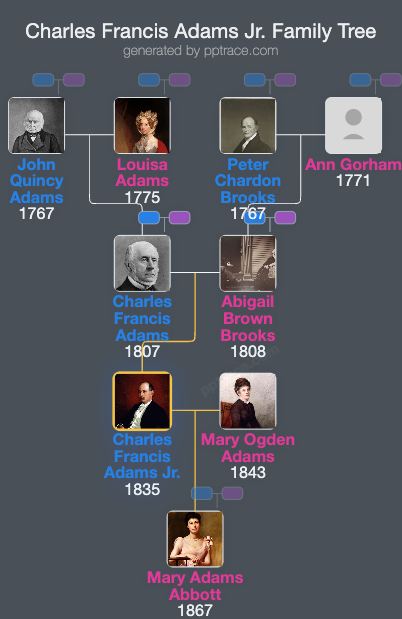
Family Tree
Tap  to expand more relatives
Introduction
Charles Francis Adams Jr. was born on May 27, 1835, in Boston, Massachusetts. He was part of a prominent American family with a significant political legacy; he was a great-grandson of President John Adams and a grandson of President John Quincy Adams. His father, Charles Francis Adams Sr., was a lawyer, politician, diplomat, and writer. Adams had several siblings, including historian Henry Brooks Adams, brother John Quincy Adams II, and historian Peter Chardon Brooks Adams.
Adams graduated from Harvard University in 1856. Following his graduation, he studied law in the office of Richard Henry Dana Jr., gaining admission to the bar in 1858. In 1895, Harvard awarded him an LL.D. degree.
During the American Civil War, Adams served in the Union Army. He was commissioned as a first lieutenant in the 1st Massachusetts Volunteer Cavalry on December 28, 1861. He was promoted to captain on December 1, 1862. Adams participated in the Gettysburg campaign and fought in the Battle of Aldie. His regiment's initial enlistment was three years, but after it was reduced to a battalion, Adams was mustered out on September 1, 1864. Subsequently, on September 8, 1864, Adams was commissioned as lieutenant colonel of the 5th Massachusetts Cavalry, officially known as the "5th Massachusetts Colored Volunteer Cavalry." He was promoted to colonel and assumed command of the regiment on March 14, 1865. Under his command, the regiment was initially tasked with guarding Confederate prisoners at Point Lookout, Maryland, but Adams sought to lead his troops in combat. During the final stages of the war, he arranged for his regiment to be assigned to front-line duty near Richmond and led his unit into the city after its fall in April 1865. Due to illness, likely dysentery, Adams returned to Massachusetts in May and resigned from the Army on August 1, 1865. President Andrew Johnson nominated Adams for the honorary rank of brevet brigadier general of United States Volunteers on July 9, 1866, recognizing his gallantry and service at various battles, including Secessionville, South Carolina, and South Mountain and Antietam, Maryland. The U.S. Senate confirmed this appointment on July 23, 1866. Adams was a Veteran Companion of the Massachusetts Commandery of the Military Order of the Loyal Legion of the United States (MOLLUS).
Following his military service, Adams was appointed to the Massachusetts Railroad Commission, where he employed a policy of persuasion to regulate railroads, earning the nickname "the Sunshine Commission" for its transparency and efforts to expose corrupt practices. He also authored "Chapters of Erie," reflecting his regulatory philosophy. As a reform-minded figure, he prioritized protecting investors and business interests over consumer protections.
In 1884, Adams was appointed president of the Union Pacific Railroad at congressional behest, despite limited practical management experience. His tenure was marked by efforts to improve the company’s public image, including establishing libraries along the railroad's route. His management faced difficulties: he struggled to deal effectively with labor unrest, exemplified by the 1885 Rock Springs massacre, where violence against Chinese workers occurred. His inability to stabilize the railroad financially led to his resignation in 1890, due to pressure from the railroad's owner, Jay Gould.
Adams was elected a Fellow of the American Academy of Arts and Sciences in 1871 and became a member of the American Antiquarian Society in 1891. He dedicated much of his later career to historical research and writing; he served as vice-president of the Massachusetts Historical Society in 1890, president of the society in 1895, and president of the American Historical Association in 1901. His notable publications include "Railroads, Their Origin and Problems" (1878), a critique of railroad monopolies, and "Richard Henry Dana: A Biography" (1890). His autobiography was completed in 1912 and published posthumously in 1916.
From 1893 to 1895, Adams chaired the Massachusetts Park Commission, contributing to the development of the state's park system, including the Blue Hills Reservation and Middlesex Fells Reservation. In 1900, he publicly supported the social reform principles of Henry George, advocating for the single tax, a concept associated with Georgism. In December 1901, he served on the arbitration board of the National Civic Confederation in New York City.
Adams married Mary Hone Ogden on November 8, 1865. They had five children: three daughters—Mary Ogden Adams, Louisa Catherine Adams, and Elizabeth Ogden Adams—and twin sons, John Francis Adams and Henry Quincy Adams. All five children attended Harvard University, with the sons graduating in 1898.
Charles Francis Adams Jr. died on March 20, 1915. He was interred in Mount Wollaston Cemetery in Quincy, Massachusetts.