Henry Brooks Adams
| Name | Henry Brooks Adams |
| Title | American journalist, historian, academic, novelist (1838-1918) |
| Gender | Male |
| Birthday | 1838-02-16 |
| nationality | United States of America |
| Source | https://www.wikidata.org/wiki/Q458390 |
| pptrace | View Family Tree |
| LastUpdate | 2025-11-17T06:37:10.592Z |
Family Tree
Tap  to expand more relatives
Introduction
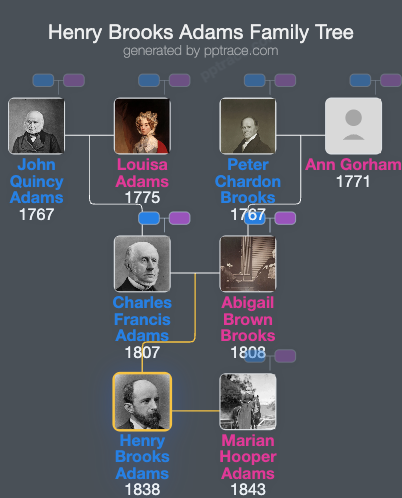
Henry Brooks Adams was born on February 16, 1838, in Boston, Massachusetts, to Charles Francis Adams Sr. and Abigail Brown Adams. He was a member of the Adams family, which included two U.S. Presidents—John Adams and John Quincy Adams—who were his great-grandfather and grandfather, respectively. His maternal grandfather was Peter Chardon Brooks, a prominent and wealthy merchant, and Nathaniel Gorham, a signer of the Constitution, was also among his maternal ancestors.
Adams attended the Dixwell School, where he was among the earliest students, and graduated from Harvard University in 1858. Following his graduation, he undertook a grand tour of Europe and attended lectures in civil law at the University of Berlin. In 1859, he was initiated into the Phi Kappa Psi fraternity as an honorary member during the Columbian Exposition.
During the American Civil War, Adams returned to the United States and briefly practiced law with Judge Horace Gray’s Boston firm. His father, Charles Francis Adams Sr., was re-elected to the U.S. House of Representatives, and Adams served as his father’s private secretary. He also worked as an anonymous correspondent for the Boston Daily Advertiser and later for The New York Times while in Britain.
In 1861, Adams accompanied his father to London when Charles Francis Adams Sr. was appointed U.S. Ambassador to the United Kingdom by President Abraham Lincoln. Adams served as his father’s private secretary and became the anonymous London correspondent for The New York Times. During this period, he engaged with notable intellectuals and social figures, read extensively—including works by John Stuart Mill—and developed an interest in democracy and political philosophy. His observations in Britain influenced his ideas about leadership and governance.
Adams returned to the United States in 1868 and settled in Washington, D.C., where he became a political journalist. In 1870, he was appointed professor of medieval history at Harvard University, a position he held until 1877. He was elected a Fellow of the American Academy of Arts and Sciences in 1875. His academic work included pioneering seminars in U.S. history and mentoring students such as Henry Cabot Lodge.
Adams authored the nine-volume “The History of the United States of America 1801–1817,” published between 1889 and 1891, which was recognized for its detailed portrayal of the Jefferson and Madison administrations, with an emphasis on diplomacy. His literary style and extensive use of documentary evidence earned widespread acclaim, although some critique his interpretation of the early 1800s.
In the late 19th century, Adams wrote two novels, “Democracy” (published anonymously in 1880) and “Esther,” the latter under the pseudonym Frances Snow Compton. Both novels addressed themes of political corruption and social critique. He also edited the North American Review with his brother Charles Francis Adams, publishing essays critical of finance, corporations, and government malpractices, foreshadowing the muckraking movement.
Adams was active in various scholarly organizations, including the American Antiquarian Society, which elected him as a member in 1884. He received an LL.D. from Western Reserve University in 1892 and served as president of the American Historical Association in 1894, delivering an influential address titled “The Tendency of History.”
Throughout his life, Adams was also a poet, combining literary pursuits with his scholarly work. His notable poems include "Buddha and Brahma" and "Prayers to the Virgin and the Dynamo." Adams died on March 27, 1918, having contributed significantly to American historiography and intellectual life.