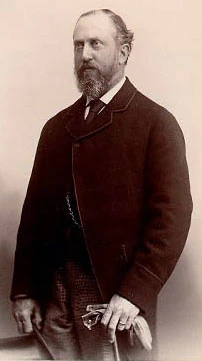
Frederick Stanley, 16th Earl Of Derby
| Name | Frederick Stanley, 16th Earl Of Derby |
| Title | British politician, founder of the Stanley Cup (1841–1908) |
| Gender | Male |
| Birthday | 1841-01-15 |
| nationality | United Kingdom of Great Britain and Ireland |
| Source | https://www.wikidata.org/wiki/Q222458 |
| pptrace | View Family Tree |
| LastUpdate | 2025-11-26T23:29:14.464Z |
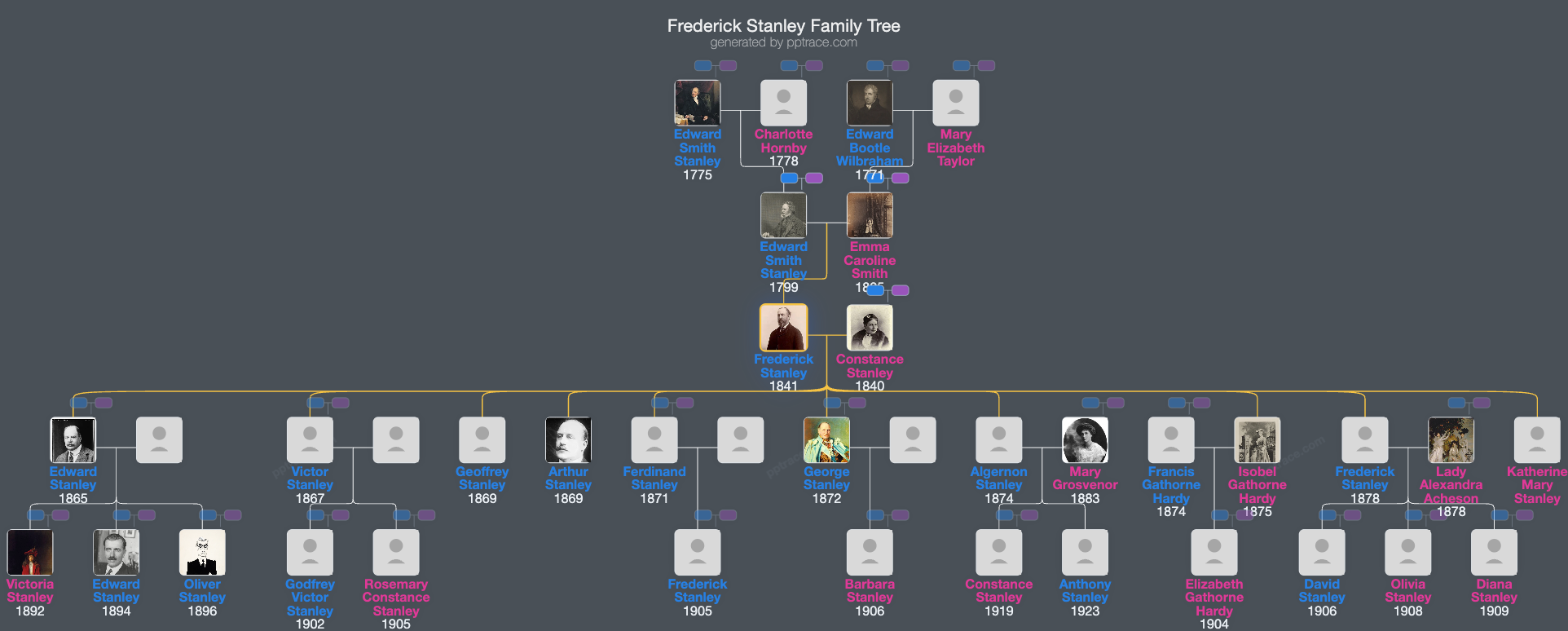
Family Tree
Tap  to expand more relatives
Introduction
Frederick Arthur Stanley, 16th Earl of Derby, was born on 15 January 1841 in St James's Square, Westminster. He was the second surviving son of Edward Smith-Stanley, Lord Stanley, and Emma Caroline, Lady Stanley, daughter of Edward Bootle-Wilbraham, 1st Baron Skelmersdale. In 1851, his father succeeded as the 14th Earl of Derby. Stanley was educated at Harrow School and the Royal Military College, Sandhurst.
He initially pursued a military career, receiving a commission in the Grenadier Guards and attaining the rank of Captain before transitioning to a political career. He served as Lieutenant-Colonel Commandant of the 1st Royal Lancashire Militia from 1874, though his political duties often limited his military involvement. Later, he was Honorary Colonel of the 3rd and 4th Battalions, King's Own (Royal Lancaster Regiment), from 1886 until his death. He also held the Hon Colonelcy of the 1st Volunteer Battalion, King's (Liverpool Regiment), appointed in 1894.
Stanley's political career involved serving as a Conservative Member of Parliament for Preston (1865–68), North Lancashire (1868–85), and Blackpool (1885–86). His governmental roles included Civil Lord of the Admiralty (1868), Financial Secretary to the War Office (1874–78), Secretary to the Treasury in 1878, War Secretary from 1878 to 1880, and Colonial Secretary from 1885 to 1886. In 1886, he was created Baron Stanley of Preston, in the County Palatine of Lancaster. Subsequently, he served as President of the Board of Trade from 1886 to 1888 before being appointed Governor General of Canada.
In his capacity as Governor General, Stanley was appointed on 1 May 1888 and served until 1893. His term included a wide travel throughout Canada, with notable visits to western regions in 1889, where he admired the natural landscape and met with First Nations, ranchers, and farmers. During his tenure, he dedicated Stanley Park in Vancouver, which bears his name. He was granted the power of granting pardons and remitting sentences by Queen Victoria, making him one of the few to hold such authority during his vice-regal office.
Following the death of Prime Minister John A. Macdonald in 1891, Stanley experienced a shift in political relations; he subsequently supported John Abbott and John Thompson in their respective tenures. He upheld the principle of political neutrality, notably refusing to disallow the Jesuits' Estates Act of Quebec in 1891, citing constitutional boundaries. His wife, Lady Constance Villiers, was noted for her contributions during his office, including the establishment of the Lady Stanley Institute for Trained Nurses in Ottawa and her enthusiasm for hockey.
Stanley’s sons developed an interest in ice hockey, an outdoor sport popular in Canada. In 1892, he donated the Stanley Cup (originally the Dominion Hockey Challenge Cup) as a challenge trophy for Canadian amateur hockey teams. After his term, he succeeded his elder brother as the 16th Earl of Derby in 1893, prompting his return to England. The family estate was associated with various locations, including Stanley Park in Liverpool.
In England, he held civic and academic roles, serving as the Lord Mayor of Liverpool and the first Chancellor of the University of Liverpool. He was also the Mayor of Preston in 1902. His philanthropic activities included supporting the construction of Liverpool Cathedral and funding local parks. He married Lady Constance Villiers on 31 May 1864; they had ten children, including Edward George Villiers Stanley, who succeeded as the 17th Earl of Derby.
Frederick Arthur Stanley died on 14 June 1908.