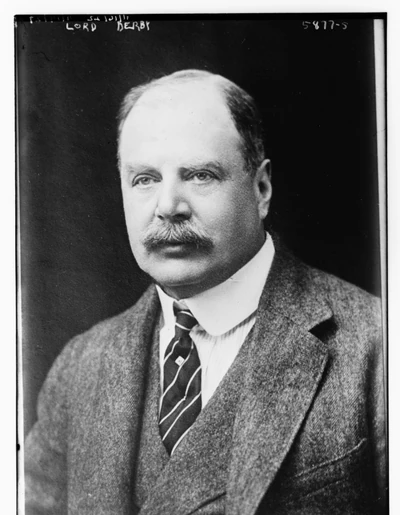
Edward Stanley, 17th Earl Of Derby
| Name | Edward Stanley, 17th Earl Of Derby |
| Title | British politician and diplomat (1865–1948) |
| Gender | Male |
| Birthday | 1865-04-04 |
| nationality | United Kingdom |
| Source | https://www.wikidata.org/wiki/Q338427 |
| pptrace | View Family Tree |
| LastUpdate | 2025-11-26T23:29:20.862Z |
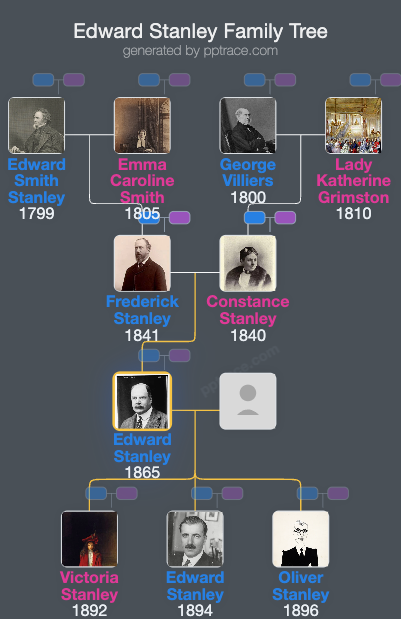
Family Tree
Tap  to expand more relatives
Introduction
Edward George Villiers Stanley, 17th Earl of Derby (4 April 1865 – 4 February 1948), was a British peer and politician. He was born at 23 St James's Square in London. He was the eldest son of Hon. Frederick Stanley, who later became the 16th Earl of Derby, and Lady Constance Villiers. His paternal grandfather was Edward Smith-Stanley, the 14th Earl of Derby, who served three terms as Prime Minister of the United Kingdom. His mother was the daughter of the Liberal politician George Villiers, 4th Earl of Clarendon.
Stanley was educated at Wellington College in Berkshire, where he boarded at Stanley House, named after his paternal grandfather.
His military career began with a lieutenant’s commission in the militia unit, the 3rd Battalion, King's Own Royal Regiment (Lancaster), commanded by his father, on 4 May 1882. He subsequently joined the Grenadier Guards as a lieutenant in May 1885 and served as aide-de-camp to his father, then Governor General of Canada, from August 1889 to 1891. He was seconded from his regiment in July 1892 to take his seat in the House of Commons and resigned his commission in April 1895.
In 1899, he was commissioned as a lieutenant in the reserve of officers. During the Second Boer War, he served on the staff in Cape Town and was appointed Chief Press Censor at Cape Town on 18 January 1900. He accompanied Lord Roberts's headquarters as Press Censor when Roberts left Cape Town. Roberts mentioned him in despatches on 31 March 1900 for his "tact and discretion." He was appointed Roberts' private secretary in July 1900 and was again mentioned in despatches on 2 April 1901 for his knowledge of men and affairs. Over the years, he received multiple honorary colonelships, including of the 6th Battalion, Manchester Regiment, and of units within the Loyal North Lancashire Regiment and the Royal Artillery.
In politics, Stanley entered Parliament representing Westhoughton in 1892. He served under Lord Salisbury as a Lord of the Treasury from 1895 to 1900 and as Financial Secretary to the War Office from 1901 to 1903 under Salisbury and later Arthur Balfour. He became Postmaster General in October 1903, serving until December 1905, when the government fell. He lost his parliamentary seat in the 1906 general election. In 1908, he succeeded his father as the Earl of Derby, thus taking a seat in the House of Lords.
During World War I, he organized recruitment campaigns in Liverpool. In October 1915, he established the Derby Scheme, a recruitment initiative aimed at supplementing voluntary enlistment. In July 1916, he returned to government as Under-Secretary of State for War and was promoted to Secretary of State for War in December 1916. His tenure was marked by support for military leaders, but he faced criticism and was eventually removed from the War Office shortly after the crisis involving the removal of General Robertson. In 1917, he co-founded the organization the Comrades of the Great War, which later merged into the British Legion in 1921.
From 1918 to 1920, Derby served as the British Ambassador to France. In April 1921, he secretly traveled to Ireland for talks with Éamon de Valera, which likely contributed to the subsequent Anglo-Irish Treaty. He served again as Secretary of State for War from 1922 to 1924 under Prime Ministers Bonar Law and Stanley Baldwin.
His honors included being made a Companion of the Order of the Bath (CB) in 1900, sworn of the Privy Council in 1903, awarded the Royal Victorian Order (KCVO and later GCVO), and appointed a Knight of the Garter in 1915. He was also awarded the Freedom of the City of Manchester in 1934.
Stanley held several other public roles, including Lord Mayor of Liverpool (1911–1912), honorary president of the Rugby Football League, president of the National Playing Fields Association (1937–1947), chairman and later president of the Pilgrims Society, East Lancashire Provincial Grand Master of Freemasonry, and Lord Lieutenant of Lancashire (1928–1948).
In the realm of horse racing, the Epsom Derby was named after him, as was The Oaks. He was a prominent racehorse owner and breeder, with notable wins including the Epsom Derby (three times), the Epsom Oaks (twice), the St. Leger Stakes (six times), the 1,000 Guineas (seven times), and the 2,000 Guineas (twice). He bred the influential stallion Phalaris, who established a dominant sire line in Europe and the United States.
Stanley married Lady Alice Montagu, daughter of William Montagu, 7th Duke of Manchester, and Louisa von Alten, at the Guards Chapel, Wellington Barracks, London, on 5 January 1889. Lady Alice was a lady-in-waiting to Queen Alexandra. They had three children: Lady Victoria Alice Louisa (1892–1927), who married Neil Primrose, then Malcolm Bullock; Edward, Lord Stanley (1894–1938), father of John Stanley, 18th Earl of Derby; and Hon. Oliver Stanley (1896–1950), who married Lady Maureen Vane-Tempest-Stewart.