George Stanley
| Name | George Stanley |
| Title | British politician (1872-1938) |
| Gender | Male |
| Birthday | 1872-10-14 |
| nationality | United Kingdom |
| Source | https://www.wikidata.org/wiki/Q5539480 |
| pptrace | View Family Tree |
| LastUpdate | 2025-11-27T10:45:02.257Z |
Family Tree
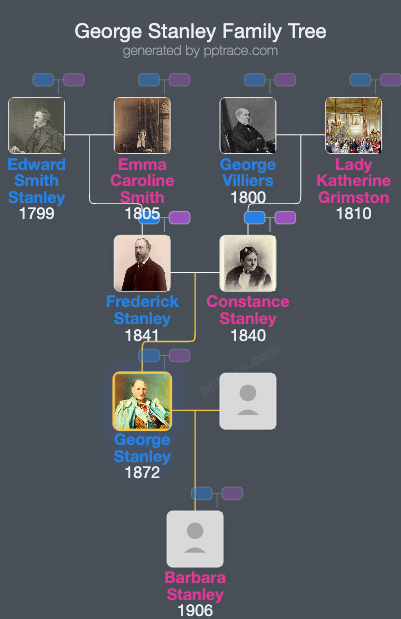
Tap  to expand more relatives
Introduction
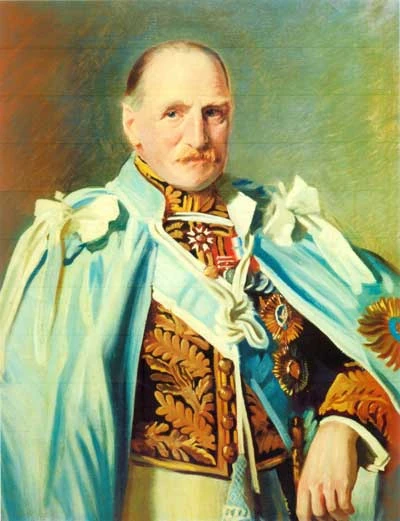
Sir George Frederick Stanley (14 October 1872 – 1 July 1938) was a British military officer and politician involved in governance and administrative roles primarily in the early 20th century. He was the sixth son of Frederick Stanley, 16th Earl of Derby, and a grandson of Edward Smith-Stanley, a former British Prime Minister. Stanley was educated at Wellington College and the Royal Military Academy, Woolwich.
In 1893, he joined the Royal Horse Artillery and was promoted to the rank of captain in 1900. His military service included participation in the Second Boer War during 1899–1900. From 1904 to 1909, he served as Adjutant with the Honourable Artillery Company. During World War I, he continued his military service, earning recognition in several ways, including being mentioned in despatches and receiving the Companion of the Order of St Michael and St George (CMG) in 1916.
In the political sphere, Stanley was a member of the Conservative Party. He served as Member of Parliament for Preston from 1910 to 1922 and later for Willesden East from 1924 to 1929. His governmental roles included positions such as Comptroller of the Household (1919–1921), Financial Secretary to the War Office (1921–1922), Parliamentary Under-Secretary of State for the Home Department (1922–1923), and Parliamentary Secretary to the Ministry of Pensions (1924–1929). He was appointed to the Privy Council in 1927.
In 1929, Stanley was appointed Governor of Madras (present-day Chennai), India, a role he commenced on 12 November 1929 with an annual salary of ₹1,20,000. His tenure coincided with the global impact of the Great Depression and significant political shifts within the region, including the resignation of Premier P. Subbarayan following the 1930 elections, which were characterized by the boycott of the elections by the Swaraj Party as part of the Civil Disobedience Movement. The Justice Party assumed power after the elections in 1930 and 1934, with B. Munuswamy Naidu serving as Premier until 1932, followed by Ramakrishna Ranga Rao of Bobbili.
During his administration as Governor, Stanley oversaw the implementation of the Mettur Dam, which was inaugurated on 21 August 1934. The dam’s reservoir was subsequently named the Stanley Reservoir. He also laid the foundation stone for a Gaudiya Math and a temple at Royapettah, Madras, on 17 January 1930. Additionally, he was involved in inaugurating the first service of the Madras suburban railway line on 2 April 1931 and in establishing higher medical training, inaugurating a five-year diploma course at Royapuram Medical College in 1933, which was renamed Stanley Medical College on 2 July 1938.
During his tenure, Stanley hosted Ignatius Elias III, the Patriarch of Antioch, on his way to Malankara in 1931. His contributions to medicine and infrastructure in Madras were recognized through the naming of institutions, including the Government Stanley Medical College, formerly Royapuram Medical School, renamed in his honor in 1934 and 1938 respectively.
Sir George Frederick Stanley died on 1 July 1938. He was married to Lady Beatrix Taylour (born 6 January 1877, died 3 May 1944), with whom he had a daughter, Barbara Helen Stanley (1906–1986).