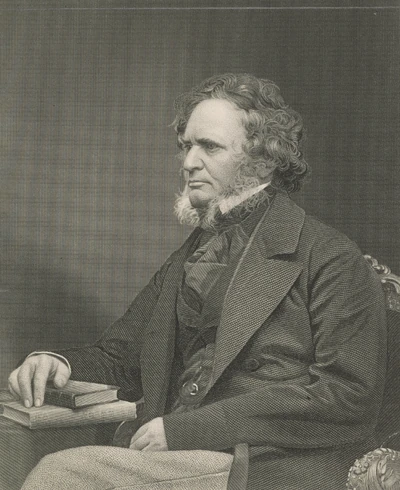
Edward Smith-Stanley, 14th Earl Of Derby
| Name | Edward Smith-Stanley, 14th Earl Of Derby |
| Title | British politician (1799–1869) |
| Gender | Male |
| Birthday | 1799-03-29 |
| nationality | United Kingdom of Great Britain and Ireland |
| Source | https://www.wikidata.org/wiki/Q237829 |
| pptrace | View Family Tree |
| LastUpdate | 2025-11-26T23:29:12.343Z |
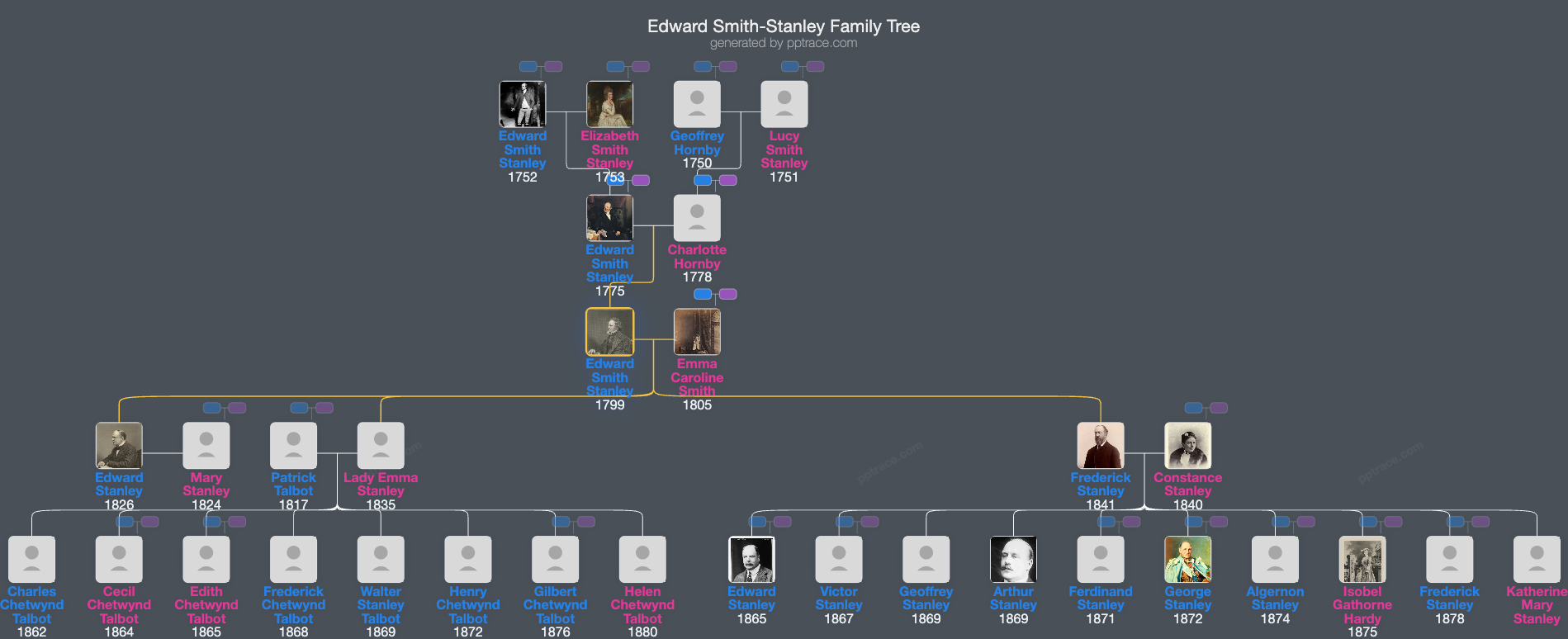
Family Tree
Tap  to expand more relatives
Introduction
Edward George Geoffrey Smith-Stanley, 14th Earl of Derby (29 March 1799 – 23 October 1869), was a British politician and statesman associated primarily with the Conservative Party. Known earlier as Lord Stanley from 1834 to 1851, he served three separate terms as Prime Minister of the United Kingdom and holds the record as the longest-serving leader of the Conservative Party, from 1846 to 1868. His ministries combined spanned less than two years each, totaling three years and 280 days.
Born at Knowsley Hall, Lancashire, as the eldest son of Edward Smith-Stanley, 13th Earl of Derby, and Charlotte Margaret Hornby, he was educated at Eton College and Christ Church, Oxford. His ancestors included Kings of Man from 1405 and Lords of Man. His family background traces back to Thomas Stanley, 1st Earl of Derby, who famously switched allegiances at the Battle of Bosworth Field to place Henry Tudor on the throne.
Stanley's political career commenced in 1822 when he was elected to Parliament representing Stockbridge as a Whig. In 1824, he engaged in a controversial vote against an investigation into the Protestant Church of Ireland, which distanced him from some of his Whig colleagues. He lost his parliamentary seat in 1826. When the Whigs returned to power in 1830, he was appointed Chief Secretary for Ireland in Lord Grey's government, and in 1831, he became a member of the Cabinet. During this period, he introduced the Stanley Letter to Augustus FitzGerald, 3rd Duke of Leinster, which laid the legal groundwork for the modern Irish education system.
In 1833, Stanley became Secretary of State for War and the Colonies, overseeing the passage of the Abolition of Slavery Bill. He resigned from the government in 1834 over reforms to the Anglican Church of Ireland and subsequently formed the group known as the "Derby Dilly." This group aimed to position themselves between the radicals of the Whig party and the traditional Tories. Key members included Sir James Graham, Lord Ripon, and the Duke of Richmond, who were from varied political backgrounds. Over time, many members of the Derby Dilly aligned with Sir Robert Peel’s Conservative Party.
Stanley rejoined government as Colonial Secretary in Peel’s second ministry in 1841. In 1844, he was summoned to the House of Lords as Lord Stanley of Bickerstaffe by a Writ of acceleration. He opposed the repeal of the Corn Laws in 1845, leading to a split with Prime Minister Peel and becoming a leader of the protectionist faction of the Conservative Party.
In 1851, he succeeded his father as Earl of Derby. During the 1850s and 1860s, Derby formed multiple governments, including a minority government in 1852 following the collapse of Lord John Russell’s Whig administration. His government was characterized by a foreign policy emphasizing diplomacy and avoidance of war, contrasting with later Conservative policies under Disraeli.
Derby’s first government included Benjamin Disraeli as Chancellor of the Exchequer. Their tenure faced difficulties, notably the unpopularity of Disraeli’s budget, leading to its defeat and the fall of the government in December 1852. Subsequent administrations saw Derby’s political role evolve, particularly as the Conservative Party transitioned through various issues including Ireland, electoral reform, and foreign policy.
In 1855, Queen Victoria invited Derby to form a government following the fall of Aberdeen’s administration; however, he declined, believing it was not the appropriate time. His political influence persisted until his death in 1869.