James VI And I
| Name | James VI And I |
| Title | King of Scotland (1566–1625), England and Ireland (1603–25) |
| Gender | Male |
| Birthday | 1566-06-19 |
| nationality | Kingdom of Scotland |
| Source | https://www.wikidata.org/wiki/Q79972 |
| pptrace | View Family Tree |
| LastUpdate | 2025-11-12T01:14:41.465Z |
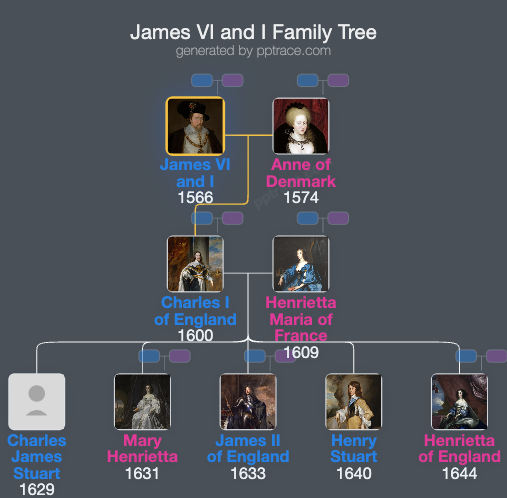
Family Tree
Tap  to expand more relatives
Introduction
James VI and I (born James Charles Stuart on 19 June 1566; died 27 March 1625) was a monarch who ruled over multiple kingdoms in the British Isles during the late 16th and early 17th centuries. He was King of Scotland from 24 July 1567, following his accession as an infant after the abdication of his mother, Mary, Queen of Scots. He also became King of England and Ireland on 24 March 1603, upon the death of Queen Elizabeth I, uniting the crowns of Scotland and England in personal union. His reign in both Scotland and England continued until his death in 1625.
James was the son of Mary, Queen of Scots, and Henry Stuart, Lord Darnley. His paternal grandparents were Matthew Stewart, Earl of Lennox, and Margaret Douglas. His maternal grandparents were the King of France, Henry II, and Madeleine de La Tour d'Auvergne. James inherited titles including Duke of Rothesay and Great Steward of Scotland at a very young age. His mother was a Catholic, but James was raised as a Protestant.
He was born at Edinburgh Castle and was baptized in a Catholic ceremony at Stirling Castle. His early life involved regencies overseen by regents due to his infancy. The regents included James Stewart, Earl of Moray, and others who governed until James assumed more control around 1583. During his childhood, he was educated and tutored by figures such as George Buchanan, who emphasized both literature and the limitations of monarchy.
James's marriage to Anne of Denmark took place in 1589, and they had several children, three of whom survived to adulthood: Henry Frederick, Elizabeth (who became Queen of Bohemia), and Charles I, his successor. His early years were marked by political upheaval, including the imprisonment of his mother and the overthrow of her rule in Scotland.
He was crowned King of Scotland as an infant and later, after reaching adulthood, he worked to consolidate royal authority. His reign saw conflicts such as the Ruthven Raid and the Battle of Langside, as well as efforts to control political and religious factions in Scotland. James signed treaties with England, including the Treaty of Berwick (1586), and sought to reinforce Protestantism within his realms.
In 1603, James succeeded Elizabeth I in England, establishing a personal union of the crowns. His accession was followed by the coronation at Westminster Abbey, and he became known as James I of England and Ireland, as well as "King of Great Britain and Ireland" in official proclamations from 1604. His reign involved efforts to unify the kingdoms politically, which faced opposition from Parliament.
James's foreign policy included attempts to maintain peace, notably through the signing of the Treaty of London (1604) with Spain, ending the Anglo-Spanish War. He prioritized peace and religious stability, and he supported the translation of the Bible into English, resulting in the Authorized King James Version in 1611.
His reign was also marked by internal conflicts, including the Gunpowder Plot of 1605, a failed conspiracy to blow up Parliament led by Guy Fawkes. James's relations with Parliament were often contentious, especially over taxation, royal absolutism, and foreign affairs. He believed in the divine right of kings and sought to strengthen royal prerogative.
James engaged in efforts to reform the church, including attempts to align the Scottish Kirk with the Church of England, often facing resistance. He also promoted Scottish literature and culture, patronizing poets and writers, and published works on monarchy and religion.
His health declined in his later years, suffering from ailments such as arthritis, gout, and kidney stones. He died at Theobalds House in Hertfordshire during a bout of illness, and his funeral was held on 7 May 1625. James was buried in Westminster Abbey.
His legacy includes the beginning of English and Scottish colonization efforts, notably the founding of Jamestown, Virginia, in 1607. His reign laid theoretical foundations for the subsequent conflicts leading to the English Civil War. Contemporary and later historians have re-evaluated his character, with some viewing him as a thoughtful monarch and others criticizing his policies and courtly behavior.