Edward Stanley, 15th Earl Of Derby
| Name | Edward Stanley, 15th Earl Of Derby |
| Title | British politician (1826–1893) |
| Gender | Male |
| Birthday | 1826-07-21 |
| nationality | United Kingdom of Great Britain and Ireland |
| Source | https://www.wikidata.org/wiki/Q332789 |
| pptrace | View Family Tree |
| LastUpdate | 2025-11-26T23:29:15.443Z |
Family Tree
Tap  to expand more relatives
Introduction
Edward Henry Stanley, 15th Earl of Derby (21 July 1826 – 21 April 1893), was a British politician who held the office of Secretary of State for Foreign Affairs and Colonial Secretary during the 19th century.
Background and Education:
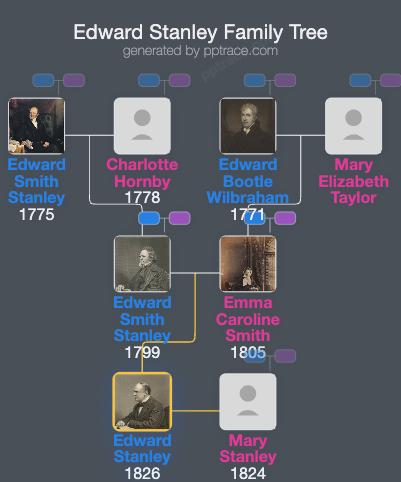
He was born as the eldest son of Edward Smith-Stanley, 14th Earl of Derby, who was a leader of the Conservative Party from 1846 to 1868 and served as Prime Minister on three occasions. His mother was Emma Caroline Bootle-Wilbraham, daughter of Edward Bootle-Wilbraham, 1st Baron Skelmersdale. The Stanley family was one of the wealthiest landowning families in England. Edward Henry Stanley, known as Lord Stanley before inheriting the earldom, received education at Eton College and Rugby School, followed by Trinity College, Cambridge. At Cambridge, he graduated with a first-class degree in classics and was a member of the Cambridge Apostles society.
Political Career:
In March 1848, he unsuccessfully contested the borough of Lancaster and subsequently undertook a tour of the West Indies, Canada, and the United States. During his absence, he was elected Member of Parliament for King's Lynn, a position he held until October 1869 when he succeeded his father as the 15th Earl of Derby. As a member of the Conservative Party, he delivered his maiden speech in May 1850 on sugar duties.
In 1852, he traveled to India, and while in the country, he was appointed Under-Secretary for Foreign Affairs in his father's government. He also received a commission as a captain in the 3rd Royal Lancashire Militia in March 1853. Although from a Conservative background, Stanley was generally more sympathetic to Liberal causes.
Throughout his career, he held various positions, including Secretary of State for the Colonies in 1858, President of the Board of Control, and Secretary of State for India. In 1858, he was responsible for the India Bill introduced in the House of Commons and was recognized for his competence in managing the India Office.
Foreign Minister and Diplomatic Initiatives:
Stanley served as Secretary of State for Foreign Affairs from 1866 to 1868 and again from 1874 to 1878. His foreign policy doctrine, known as "Splendid isolation," emphasized maintaining amicable relations with foreign powers without entangling alliances. Notable achievements during his tenure included arranging the collective guarantee of Luxembourg’s neutrality in 1867 and negotiating a convention with the United States regarding the CSS Alabama, although the latter was not ratified.
In his second term as Foreign Secretary, Stanley oversaw the purchase of controlling shares in the Suez Canal Company in 1875, which became a critical strategic asset for Britain. His diplomatic actions included negotiations resulting in Russia relinquishing gains in the Balkans and Britain acquiring control of Cyprus from the Ottoman Empire as a naval base.
Resignation and Later Political Affiliation:
Derby resigned as Foreign Secretary in January 1878 over disagreements pertaining to the Dardanelles campaign but temporarily stayed in office when the initial conflict was resolved. He resigned definitively later that year upon the Cabinet's decision to mobilize reserves. By 1879, he aligned with the Liberal Party, which he publicly declared in 1880.
In December 1882, he was appointed Colonial Secretary under Prime Minister William Ewart Gladstone, holding the position until the summer of 1885. Following the split of the Liberal Party in 1886, he became a Liberal Unionist, actively leading its activities in the House of Lords until 1891. In 1892, he presided over the Labour Commission.
Military and Other Roles:
He was appointed Honorary Colonel of the 1st Lancashire Rifle Volunteer Corps in September 1870. He also served as President of the first day of the 1881 Co-operative Congress.
Personal Life:
In 1870, Stanley married Lady Mary, daughter of George Sackville-West, 5th Earl De La Warr. She was previously the wife of James Gascoyne-Cecil, 2nd Marquess of Salisbury. The marriage produced no children. His health declined after an influenza attack in 1891, and he died at Knowsley on 21 April 1893 at the age of 66. His younger brother, Frederick, succeeded him in the earldom. Lady Derby died in December 1900.
References:
Further information can be found in biographical works such as George Saintsbury’s "The Earl of Derby" (1892), and primary sources including journals and memoirs of Edward Henry Stanley.