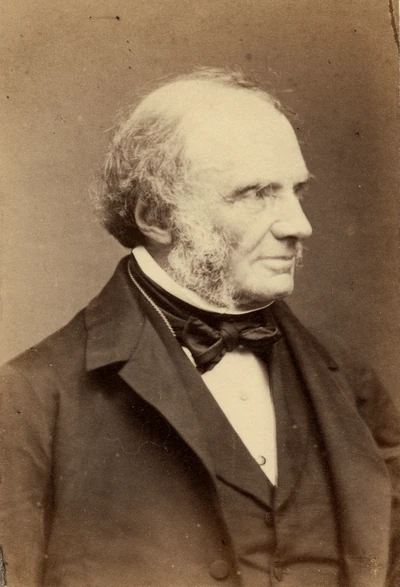
John Russell, 1st Earl Russell
| Name | John Russell, 1st Earl Russell |
| Title | Prime Minister of the United Kingdom, 1846–1852 and 1865–1866 |
| Gender | Male |
| Birthday | 1792-08-18 |
| nationality | Great Britain |
| Source | https://www.wikidata.org/wiki/Q157259 |
| pptrace | View Family Tree |
| LastUpdate | 2025-11-26T23:28:41.329Z |
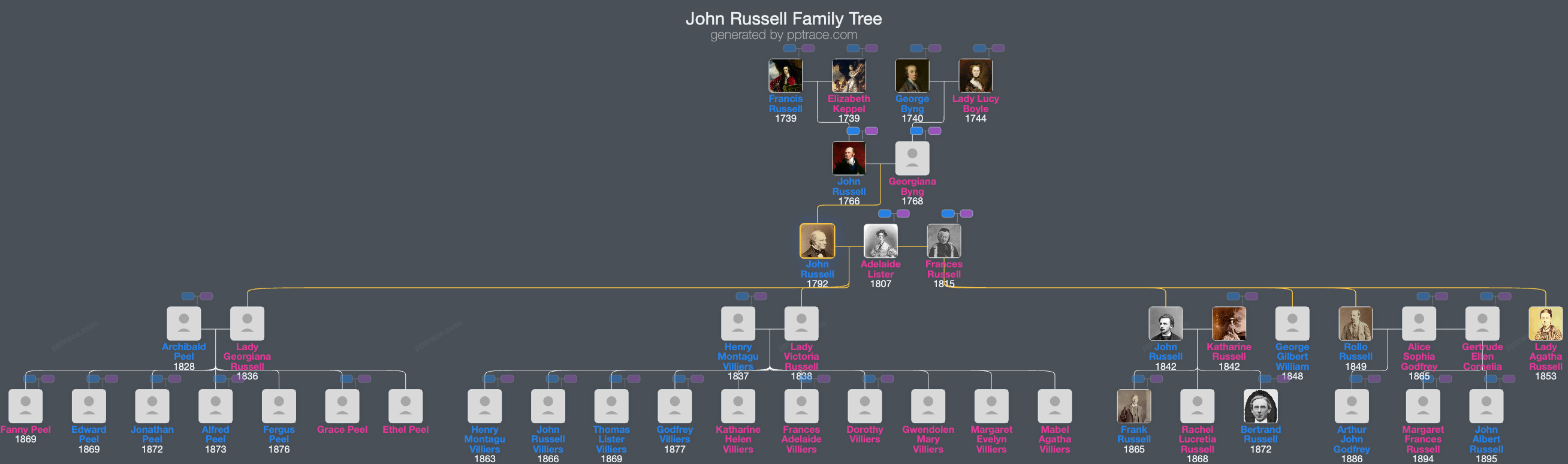
Family Tree
Tap  to expand more relatives
Introduction
John Russell, 1st Earl Russell (18 August 1792 – 28 May 1878), was a British politician of the Whig and Liberal parties, serving as Prime Minister of the United Kingdom during two separate terms: from 1846 to 1852 and from 1865 to 1866. Prior to his peerage in 1861, he was known as Lord John Russell. He was born in 1792 into the aristocratic Russell family as the third son of John Russell, the 6th Duke of Bedford, and Georgiana Byng, daughter of George Byng, 4th Viscount Torrington.
Russell's early education took place at Westminster School and later at Edinburgh University, where he studied from 1809 to 1812, residing with Professor John Playfair. He did not complete a degree but traveled extensively across Britain and continental Europe, with health issues persisting throughout his life. He was five feet five inches tall and was often the subject of caricatures due to his stature.
In 1801, at age nine, Russell was sent to school, but his mother died shortly thereafter. Educated privately after being withdrawn from Westminster School in 1804, he was introduced to politics at a young age, having met Charles James Fox during his father's tenure as Lord Lieutenant of Ireland in 1806. His political views were shaped early on, and he entered Parliament in 1813 at the age of 20, representing Tavistock, through family influence, since his father directed electors to return him, despite Russell's youth and health.
Russell's political career developed gradually, with significant advocacy for reform. He opposed the Bourbon Restoration and Britain's declaration of war against Napoleon in 1815. After a brief hiatus from Parliament in 1817, he re-entered the House of Commons in 1818. He became a prominent supporter of parliamentary reform throughout the 1820s, notably leading efforts to repeal the Test Acts in 1828, which had barred Catholics and dissenters from holding civil and military offices.
In 1830, when the Whigs assumed power under Earl Grey, Russell became Paymaster of the Forces and contributed significantly to the drafting and passage of the Reform Act 1832, which was a major reform of the British electoral system. He was known for his leadership in the passage of this legislation and earned the nickname "Finality Jack" for his assertion that the reform was a definitive measure.
He served as Home Secretary in Lord Melbourne's government starting in 1835 but lost his parliamentary seat in Devonshire during the early elections. He was subsequently elected in the constituency of Stroud. Throughout his ministerial career, Russell served in various government roles under Grey, Melbourne, Aberdeen, and Palmerston between 1831 and 1865. He supported Irish emancipation, opposed the Corn Laws, and engaged in foreign policy debates, including supporting Italian unification and denouncing the revival of Catholic bishoprics by Pope Pius IX.
His relationships with political contemporaries, especially Lord Palmerston, were complex and often contentious. Despite challenges, their alliance helped form the basis for the development of the Liberal Party, which would dominate British politics in later decades. As prime minister, Russell's leadership faced difficulties such as ineffective responses to the Irish Famine during his first term and party division over further reform measures during his second.
He was created Earl Russell in 1861 and was subsequently known as the 1st Earl Russell until his death. Russell remained active in politics until the late 1860s, contributing to reform debates and party politics until his retirement.