Frances Russell, Countess Russell
| Name | Frances Russell, Countess Russell |
| Title | British political wife |
| Gender | Female |
| Birthday | 1815-00-00 |
| nationality | United Kingdom of Great Britain and Ireland |
| Source | https://www.wikidata.org/wiki/Q19040351 |
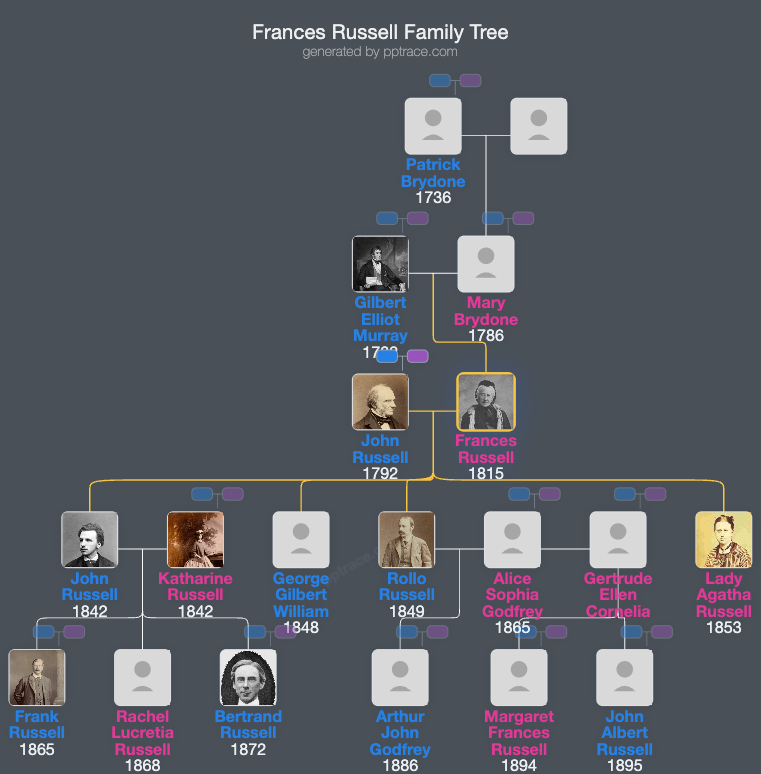
| pptrace | View Family Tree |
| LastUpdate | 2025-11-26T23:28:46.046Z |
Family Tree
Tap  to expand more relatives
Introduction
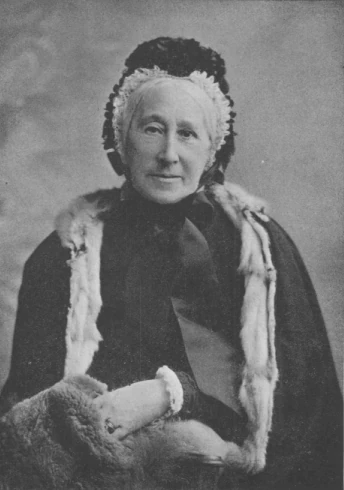
Frances Anna Maria Russell, Countess Russell (née Elliot-Murray-Kynynmound), was born on 15 November 1815 in Minto, Roxburghshire. She was the second daughter of the Earl and Countess of Minto. During her early years, she resided at Minto House before moving to Berlin in 1832, following her father's appointment as Minister to Prussia. In September 1835, her family relocated to London when her father was appointed First Lord of the Admiralty in the government of Lord Melbourne.
In 1840, at the age of 24, Frances received a marriage proposal from Lord John Russell, a fellow politician and her father's cabinet colleague, who had been widowed two years earlier. Initially declining the proposal, she eventually accepted, and they married on 20 July 1841 in Minto House's drawing room. Upon marriage, she became stepmother to Lord John's two daughters from his previous marriage, Georgiana and Victoria, and to four stepchildren—the orphaned children of his first wife Adelaide and her previous husband.
Frances and Lord John Russell had four children: John Russell (later Viscount Amberley), born on 10 December 1842; George Gilbert William Russell, born on 14 April 1848; Francis Albert Rollo Russell ("Rollo"), born on 11 July 1849; and Mary Agatha Russell ("Agatha"), born in 1853. In 1847, during Lord John's first term as Prime Minister, the family was granted Pembroke Lodge in Richmond Park by Queen Victoria; it served as their family residence until her death.
In 1861, Lord John Russell was elevated to the peerage as Earl Russell, and Frances thereafter was titled Countess Russell. Their eldest son, Viscount Amberley, died in 1876 from bronchitis, leaving behind two sons: John ("Frank") Russell, who became the 2nd Earl Russell, and Bertrand Russell, the future philosopher. Their mother, Katharine Russell, Viscountess Amberley, had died in 1874. Amberley's will named guardians for his children that included Douglas Spalding and T. J. Cobden-Sanderson, who wished to keep the children from being raised as Christians. However, Lord and Lady Russell contested the guardianship, assuming full custody.
Lady Russell was known for her devout religious beliefs, initially Presbyterian and later Unitarian, and her political support for liberal causes such as Italian Unification and Irish Home Rule. She also supported the North during the American Civil War, opposing slavery. Bertrand Russell characterized his grandmother as "completely unworldly" and "extremely strict in matters of morality." She was known for living austerely, disliking wine and tobacco, and adhering to a plain diet. Despite her moral strictness, she was regarded as an affectionate grandmother. She was fluent in French, German, and Italian, and had extensive knowledge of classical English and European literature, though she showed little interest in modern European writings.
From age 15 until her husband's death 48 years later, she kept a diary, portions of which were published posthumously by her daughter Agatha. She died at Pembroke Lodge on 17 January 1898 at the age of 82 and was buried beside her husband in the Russell family chapel at St. Michael’s Church, Chenies.