Rollo Russell
| Name | Rollo Russell |
| Title | English meteorologist |
| Gender | Male |
| Birthday | 1849-01-17 |
| nationality | United Kingdom of Great Britain and Ireland |
| Source | https://www.wikidata.org/wiki/Q18527606 |
| pptrace | View Family Tree |
| LastUpdate | 2025-11-26T23:28:44.195Z |
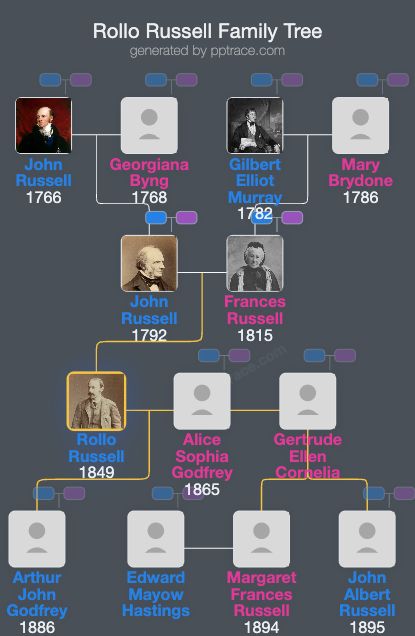
Family Tree
Tap  to expand more relatives
Introduction
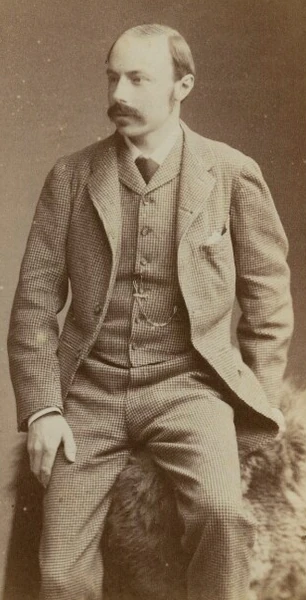
Francis Albert Rollo Russell (11 July 1849 – 30 March 1914) was an English meteorologist and scientific writer. He was born at Pembroke Lodge, Richmond Park. Russell was the third son of Lord John Russell, who served as Prime Minister of the United Kingdom, and his second wife, Lady Frances. He was the uncle of philosopher Bertrand Russell.
Russell received his education at Christ Church, Oxford, graduating with distinction in natural science in 1872. His early career included work as a clerk for the British Foreign Office. Suffering from poor eyesight and characterized as a reclusive and shy individual, he resigned from the British Civil Service in 1888 to focus on scientific writing. His research included studies on the relationship between the atmosphere and disease.
In 1885, Russell married Alice Sophia Godfrey. They had one son named Arthur. Following her death within a year, Russell married Gertrude Ellen Cornelia Joachim in 1891, who was the sister of Harold H. Joachim. They had a son named John and a daughter named Margaret. Russell was a Unitarian and was one of the founding members of the Unitarian Christian Church in Richmond in 1888.
Russell has been described as an advocate of vegetarianism. His publication "Epidemics, Plagues and Fevers" was reviewed positively by the journal Nature, which acknowledged it as a valuable contribution to public health knowledge by collecting facts concerning preventable diseases. Bertrand Russell noted in his autobiography that Rollo Russell stimulated his interest in science. Bertrand described his uncle as suffering from intense shyness throughout his life, which limited his achievements involving social contact, although he displayed a sense of humor during his childhood.
Russell died from septicaemia at Holland Street, Kensington, and was buried in the churchyard at Steep, Hampshire.
As a meteorologist, Russell contributed to the Quarterly Journal of the Royal Meteorological Society and Symon's Meteorological Magazine. His 1880 pamphlet "London Fogs" argued that smoke in London had contributed to decreasing life expectancy, predating the tragic London Smog of 1952 by more than 70 years. He highlighted the health effects of fog, including lung diseases, as well as damage to buildings and monuments. He became a Fellow of the Royal Meteorological Society in 1868, served on its council multiple times between 1879 and 1914, and was Vice-President from 1893 to 1894. He co-authored an influential paper on the global effects of the 1883 eruption of Krakatoa, specifically "On the Unusual Optical Phenomena of the Atmosphere, 1883–1886" with E. Douglas Archibald, published by the Krakatoa Committee of the Royal Society.
In the field of cancer research and prevention, Russell argued that excessive consumption of meat, alcohol, coffee, and tea was correlated with higher cancer rates, based on statistical data and comparisons among different populations. He recommended public education to reduce the intake of these products. His book "Notes on the Causation of Cancer" presented data indicating that nations consuming large amounts of flesh had higher cancer incidences. He examined cancer rates in Benedictine and Cistercian monasteries, where monks adhered to diets with little or no meat, finding lower cancer mortality compared to the general population. His statistical methods drew criticism from Sydney Copeman and Major Greenwood, who noted limitations due to a lack of precise data, but they acknowledged he was working within the constraints of non-medical research.
The reception of Russell's work on cancer was mixed among medical professionals. The "Medical Record" questioned the validity of his claims regarding meat and alcohol causing cancer. Conversely, the "New York Medical Journal" recognized his arguments as worthy of attention. "The New England Journal of Medicine" considered his contributions valuable, though not conclusive. His book "Preventable Cancer" received positive reviews in the Journal of the American Medical Association, which appreciated its collection of facts and opinions. However, the "New York Medical Journal" criticized inaccuracies, and the "Nature" journal remarked that he compared non-comparable statistics. Statistician Frederick Ludwig Hoffman acknowledged the value of some of his observations regarding diet and cancer.
Selected publications by Rollo Russell include "London Fogs" (1880), "Epidemics, Plagues and Fevers" (1892), "The Atmosphere in Relation to Human Life and Health" (1896), "The Reduction of Cancer" (1907), and "Notes on the Causation of Cancer" (1916, posthumous).