John Russell, Viscount Amberley
| Name | John Russell, Viscount Amberley |
| Title | British politician and writer |
| Gender | Male |
| Birthday | 1842-12-10 |
| nationality | United Kingdom of Great Britain and Ireland |
| Source | https://www.wikidata.org/wiki/Q6255964 |
| pptrace | View Family Tree |
| LastUpdate | 2025-11-26T23:28:42.258Z |
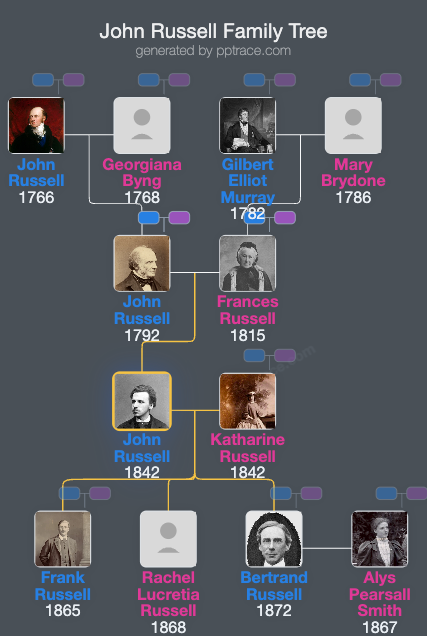
Family Tree
Tap  to expand more relatives
Introduction
John Russell, Viscount Amberley (10 December 1842 – 9 January 1876), was a British politician and writer. He was the eldest son of John Russell, who served twice as Prime Minister of the United Kingdom, and his mother was Lady Frances, daughter of the 2nd Earl of Minto. Amberley's paternal grandfather was the 6th Duke of Bedford.
Born at Chesham Place, London, Amberley received a home education before attending Harrow School. Later, he studied at the University of Edinburgh and Trinity College, Cambridge. He left Cambridge in February 1863 without obtaining a degree, citing dissatisfaction with its social environment and emphasis on mathematics. During his youth, he formed a close friendship with T. J. Cobden-Sanderson, sharing irreligious and progressive views.
In 1861, his father was elevated to the peerage as Earl Russell, and Amberley took the courtesy title Viscount Amberley. He became known for his unorthodox religious and political beliefs. In his early twenties, Amberley declared himself a Deist, rejecting the divinity of Christ, and in 1864 began studying comparative religions and writing "An Analysis of Religious Belief." His writings critiqued the Church of England, arguing that clergy should consider all theological doctrines equally, as the church was a national institution funded by all citizens.
Amberley was pressured by his father to enter politics. He ran unsuccessfully at Leeds in 1865 and was elected as a Liberal Member of Parliament for Nottingham in May 1866, serving until November 1868. His religious views and advocacy for social causes, including birth control and women's suffrage, created conflicts with his political career. His support for birth control, which included opposition to traditional marriage and support for abortion, led to him losing a seat in South Devon in 1868 and subsequently abandoning Parliament to focus on writing and activism.
He maintained progressive views, supporting women's suffrage and joining the Workmen's Peace Association in 1870. However, he opposed disarmament, believing it could lead to war. Amberley's family and peers generally tolerated his beliefs, although they disapproved of his association with Positivism.
In November 1864, Amberley married Katharine Stanley, daughter of Lord Stanley of Alderley. The marriage was considered happy; they had two sons and twin daughters, one of whom was stillborn. Their eldest son, Frank, was born nine months after their marriage. Their youngest child, Bertrand Russell, born in 1872, would later become a renowned philosopher. Amberley also employed Douglas Spalding as a tutor for his children, with whom he had a personal relationship later diagnosed as sexual, a fact he discussed with his wife.
Amberley's health was fragile; he experienced his first epileptic seizure in 1873. During a winter in Rome in 1874, his wife and children fell ill; his wife, Lady Amberley, contracted diphtheria and died on 8 July 1874. Amberley was devastated and had his wife's body cremated and her ashes interred without religious ceremony at their home. After her death, he focused on completing his book "An Analysis of Religious Belief" in her memory.
He died of bronchitis on 9 January 1876 at his home. At his request, he was buried alongside his wife and daughter, but his parents later moved the remains to the Russell family vault at St Michael's, Chenies. In his will, Amberley expressed a desire for his children not to be raised as Christians, appointing Douglas Spalding and T. J. Cobden-Sanderson as guardians, but the guardianship was contested by his parents. His mother, Lady Russell, was dedicated to ensuring the publication of his book posthumously, emphasizing that it was written in the pursuit of truth and progress. Both of his sons later inherited the earldom.