Edward Smith-Stanley, 12th Earl Of Derby
| Name | Edward Smith-Stanley, 12th Earl Of Derby |
| Title | British peer and politician (1752–1834) |
| Gender | Male |
| Birthday | 1752-09-01 |
| nationality | United Kingdom of Great Britain and Ireland |
| Source | https://www.wikidata.org/wiki/Q333496 |
| pptrace | View Family Tree |
| LastUpdate | 2025-11-26T23:29:17.268Z |
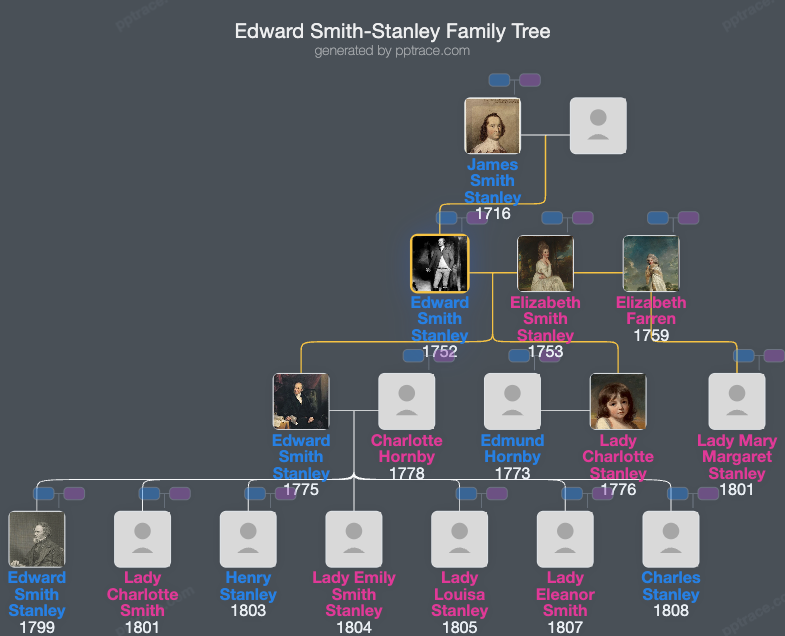
Family Tree
Tap  to expand more relatives
Introduction
Edward Smith-Stanley, 12th Earl of Derby, was born on September 1, 1752, and died on October 21, 1834. He was a British peer and politician active during the late 18th and early 19th centuries. Between 1771 and 1776, he was styled Lord Stanley. His paternal grandfather was Edward Stanley, 11th Earl of Derby, and his father was James Smith-Stanley, Lord Strange, who had adopted the additional surname and arms of Smith in 1747. His mother was Lucy Smith, a daughter and co-heiress of Hugh Smith of Weald Hall, Essex.
Education records indicate that Derby entered Eton College in 1764 and subsequently attended Trinity College, Cambridge, beginning in 1771.
In his political career, Derby was elected to the House of Commons representing Lancashire in 1774, serving as one of two MPs for the county until 1776. Upon the death of his grandfather in 1776, he succeeded to the earldom and entered the House of Lords. He held the office of Chancellor of the Duchy of Lancaster twice: first in 1783 during the Fox–North coalition led by the Duke of Portland, and again in 1806–1807 in the Ministry of All the Talents under Lord Grenville. In 1783, he was sworn into the Privy Council. Additionally, Derby served as Lord Lieutenant of Lancashire from 1776 until his death in 1834. He was also a subscriber to the Manchester Bolton & Bury Canal navigation project in 1791.
Apart from his political endeavors, Derby engaged in horse racing. In 1778, at a dinner party held on his estate, "The Oaks" in Carshalton, he and his acquaintances planned a sweepstake horse race, which was won the following year by Derby’s own horse, Bridget. This event led to the naming of The Oaks race in honor of his estate. A year later, Derby was involved in the creation of the Derby Stakes race after winning a coin toss against Sir Charles Bunbury, which he named the Derby after. Derby himself won this race in 1787 with his horse Sir Peter Teazle. His racing colors were black with a white cap. His influence on horse racing is considered significant.
Derby’s personal interests extended to cockfighting and the breeding of gamefowl, which he practiced systematically and with notable success. He built a cockpit in Preston at his own expense, where he fought cocks, and engaged in annual cockfighting contests with stakes ranging from 1,000 to 3,000 guineas. Historical accounts note that his passion for cockfighting was intense, with some reports indicating he kept fighting cocks in his drawing-room during his later years. He employed Paul Potter, a top breeder of the time, to oversee his gamefowl training. After Derby’s death, his sons inherited his birds, spurs, and fighting equipment.
In his familial life, Lord Derby married Lady Elizabeth Hamilton, daughter of James Hamilton, 6th Duke of Hamilton, on June 23, 1774. They had three children: Edward Smith-Stanley, who became the 13th Earl of Derby; Lady Charlotte Stanley; and Lady Elizabeth Henrietta Stanley. Lady Elizabeth had an affair with John Frederick Sackville, 3rd Duke of Dorset, leading to her leaving Lord Derby’s household in 1779 and being socially ostracized. It is suggested that Lady Elizabeth Henrietta was their child born from this affair, though Derby cared for her afterward. Lady Elizabeth Hamilton died in March 1797 at age 44.
Shortly after her death, Derby married Elizabeth Farren, an actress and daughter of George Farren, on May 1, 1797. They had three children: Lady Lucy Elizabeth Stanley, who died young; Hon. James Stanley, who also died young; and Lady Mary Margaret Stanley, who married Thomas Egerton, 2nd Earl of Wilton. Lord Derby survived his second wife by five years, passing away in 1834 at the age of 82. His successor was his son from his first marriage, Edward, Lord Stanley.
His armorial bearings and further references are documented in biographical and peerage sources, including works by John Brooke, George Edward Cokayne, and Millard Cox.